




War Premium Returns: What Is Driving the Wheat Rally
Wheat has been highly sensitive to developments out of the Black Sea region over the past week, and that sensitivity intensified into today's session. Reports indicate Russia is preparing to escalate attacks on Ukraine, including strikes on infrastructure, after concluding that peace negotiations have reached an impasse. Russia and Ukraine together account for more than a quarter of global wheat exports, and renewed fears of supply disruption from the region have been the single largest catalyst behind this week's move. Shipping data reinforced those concerns after a major shipping line reportedly suspended service into the Russian port of Novorossiysk following Ukrainian drone attacks, while Russian agricultural consultancy SovEcon cut its estimate for Russian August wheat exports by roughly 300,000 metric tons to 1.9 million metric tons, warning that grain will continue backing up domestically unless Black Sea and Azov Sea logistics improve.
Beyond the war headlines, underlying fundamentals have also tightened. Summer harvest assessments confirmed reduced production potential across the European Union following widespread heatwaves and dry conditions during critical grain filling stages, while US supply projections reflect historically low harvested acreage and declining ending stocks, pressuring the stocks to use ratio lower. On the demand side, USDA reported an increase of 14.8 million bushels in wheat export sales for the 2026/27 marketing year, with shipments exceeding the weekly pace needed to reach the export goal, and Egypt, the world's largest wheat importer, was reported to have recently purchased two cargoes of French wheat. This combination of a genuine logistics driven supply shortage in the Black Sea and firming global demand has left the market vulnerable to sharp upside moves, with December wheat trading limit up in consecutive sessions and managed money funds estimated to have purchased roughly 18,000 contracts of SRW wheat during the surge.
What the Market Has Done
- The market has been in an uptrend since the start of the year, staying above the yearly VWAP, with buyers consistently defending the VWAP each time price rotates down to it.
- Buyers initiated a rally from the VWAP near the 585 area at the start of July, and prices rallied up to the 700 area (Daily Level 4), a level last relevant in 2023.
- Sellers responded at that level, resulting in a pullback to the 625 area (Daily Level 5).
- Buyers responded again from that pullback, resuming the broader uptrend.
- Most recently, the market broke above the 700 area and rallied hard to the 760 area (Daily Level 3), a resistance level that was last significant in 2022.
What to Expect in the Coming Weeks
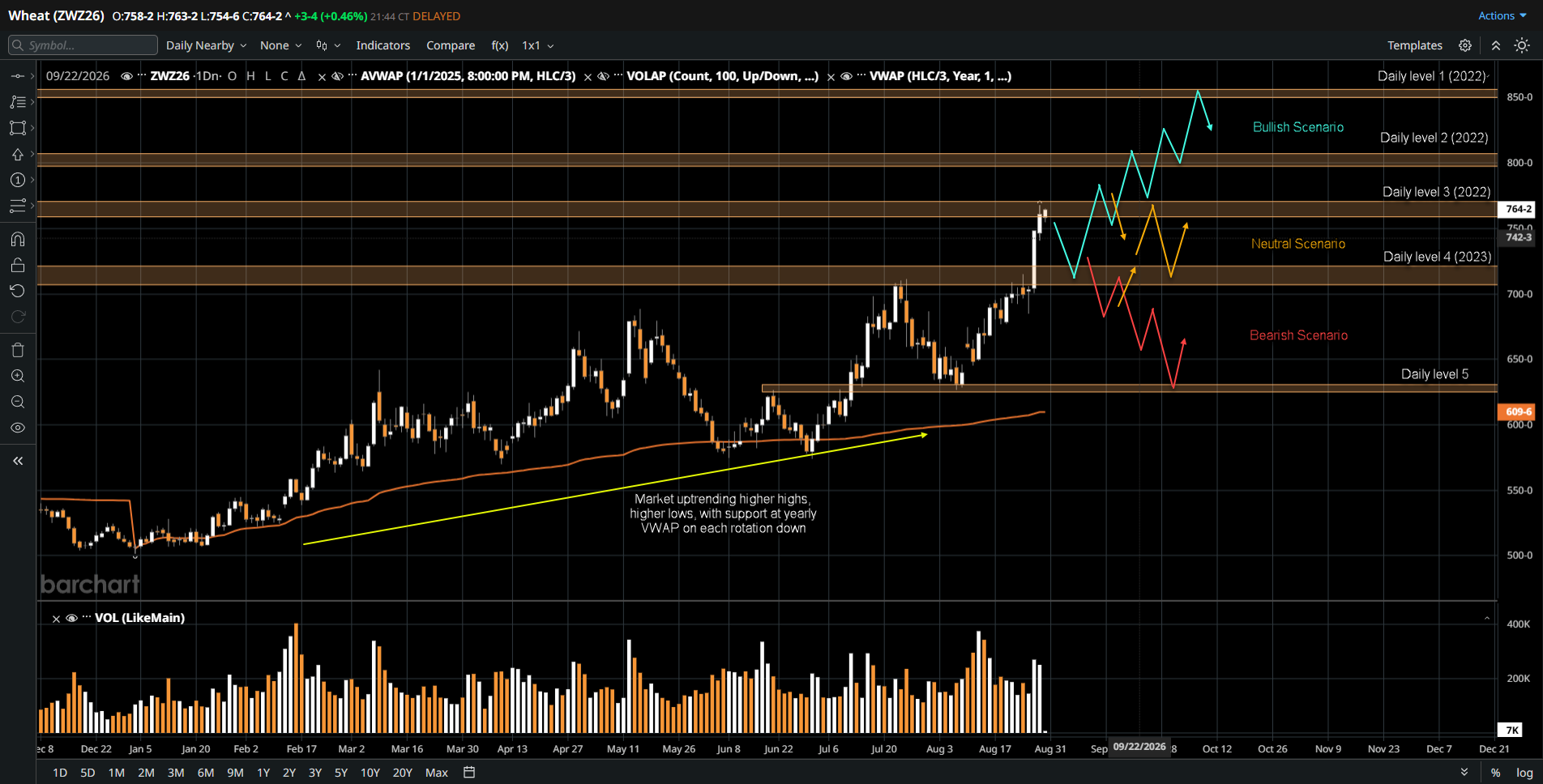
The key levels to watch going forward are 760 (Daily Level 3, a resistance level from 2022) and 700 (Daily Level 4, a level from 2023).
Bullish Scenario:
- If buyers hold the 700 level on a pullback, or if the market breaks above 760 and accepts above it, expect continuation higher toward 800 (Daily Level 2), a resistance level from 2022.
- If price is able to accept above 800, expect a move toward 850 (Daily Level 1), another resistance level from 2022.
- A possible trigger for this scenario is a further escalation in Russian strikes on Ukrainian port and grain infrastructure that meaningfully curtails Black Sea export volumes.
Bearish Scenario:
- If buyers are unable to hold the 700 level and price breaks and accepts below it, expect a move down to the 625 area (Daily Level 5).
- A possible trigger for this scenario is a surprise breakthrough in Russia Ukraine peace negotiations or a ceasefire announcement that removes war premium from the market quickly.
Neutral Scenario:
- Either a false break of the 760 area or the 700 area, with the market able to quickly reclaim back within the 700 to 760 range, would suggest two way rotation as the market re-establishes value at these higher levels.
- A possible supporting condition for this scenario is mixed headline flow, where geopolitical risk stays elevated but without fresh escalation, leaving funds to book profits into month end and quarter end position squaring.
Conclusion
Wheat's move to three year highs reflects a rare alignment of technical and fundamental forces. Structurally, the market has built a clean staircase pattern of higher lows since January, with buyers repeatedly defending the yearly VWAP and now pressing into resistance levels that have not traded since 2022. Fundamentally, that technical strength is being reinforced by a genuine supply side story, tightening EU and US production alongside escalating Black Sea war risk that threatens to choke off exports from one of the world's most important grain producing regions. With 700 and 760 now the two most important lines in the sand, the next leg for wheat will likely be decided by whether the war premium continues to build or headlines shift toward de-escalation. Watch how price behaves around these levels in the sessions ahead, since the market's reaction there should offer an early read on which scenario is taking hold.
We are the technical partner for traders who understand that edge is built, not bought. EdgeClear provides the execution infrastructure, real-time analytics, and data integrity needed to measure every variable in your trading process. Stop estimating your performance. Open an Account and start quantifying it.
Disclaimer:
This article is provided for informational and educational purposes only and does not constitute financial, investment, or trading advice. The analysis presented reflects the author’s market observations and opinions at the time of writing and is not a recommendation to buy or sell any futures contract, security, or financial instrument. Futures trading involves significant risk and is not suitable for all market participants. Losses may exceed initial margin deposits, and market conditions can change rapidly.
Any scenarios, levels, or market expectations discussed are hypothetical in nature and are intended solely to illustrate potential market behavior. They do not represent actual trading results and should not be interpreted as guarantees of future performance. Past performance, market behavior, or historical price action are not indicative of future outcomes.
Readers are solely responsible for their own trading decisions and risk management. Always conduct independent research, consider your financial situation and risk tolerance, and consult with a qualified financial professional, if necessary, before engaging in futures or derivatives trading.


/Nvidia%20logo%20by%20Konstantin%20Savusia%20via%20Shutterstock.jpg)
/Space/Rocket%20launch%20by%20Alones%20via%20Shutterstock.jpg)
/Apple%20logo%20on%20store%20front%20by%20frantic00%20via%20iStock.jpg)