






Video sharing platform Rumble (NASDAQGM:RUM) announced better-than-expected revenue in Q2 CY2026, with sales up 60.9% year on year to $40.37 million. Its GAAP loss of $0.28 per share was significantly below analysts’ consensus estimates.
Is now the time to buy Rumble? Find out by accessing our full research report, it’s free.
Rumble (RUM) Q2 CY2026 Highlights:
- Revenue: $40.37 million vs analyst estimates of $30.66 million (60.9% year-on-year growth, 31.7% beat)
- EPS (GAAP): -$0.28 vs analyst estimates of -$0.10 (significant miss)
- Adjusted EBITDA: -$16.61 million (-41.2% margin, 18.8% year-on-year growth)
- Operating Margin: -175%, down from -117% in the same quarter last year
- Free Cash Flow was -$91.62 million compared to -$16.11 million in the same quarter last year
- Market Capitalization: $2.55 billion
Chris Pavlovski, Founder and CEO, RUM Group Inc., commented, “This was a transformational quarter for our company. On June 17, we closed our acquisition of Northern Data and renamed our parent company RUM Group Inc., establishing two synergistic business units: Rumble, our video platform, and Quake AI, our new cloud and AI-infrastructure business. Revenue grew 61% year-over-year to $40.4 million, marking another all-time record for our company. With Quake AI's existing GPU estate running at 85% utilization, a new multi-year agreement with Together AI, and 250 megawatts of targeted 2027 power, which we believe represents a $3 billion-plus annual run-rate opportunity, RUM Group is uniquely positioned to power the coming robotic and agentic AI era, combining scaled AI compute with the trove of Rumble's video data and creator community that today's neoclouds simply don't have."
Company Overview
Founded in 2013 as a champion for content creator rights and free expression, Rumble (NASDAQ:RUM) is a video sharing platform that positions itself as a free speech alternative to mainstream platforms, offering creators more favorable revenue-sharing opportunities.
Revenue Growth
Examining a company’s long-term performance can provide clues about its quality. Any business can have short-term success, but a top-tier one grows for years.
With $117.7 million in revenue over the past 12 months, Rumble is a small player in the business services space, which sometimes brings disadvantages compared to larger competitors benefiting from economies of scale and numerous distribution channels. On the bright side, it can grow faster because it has more room to expand.
As you can see below, Rumble grew its sales at an incredible 73.1% compounded annual growth rate over the last five years. This shows it had high demand, a useful starting point for our analysis.
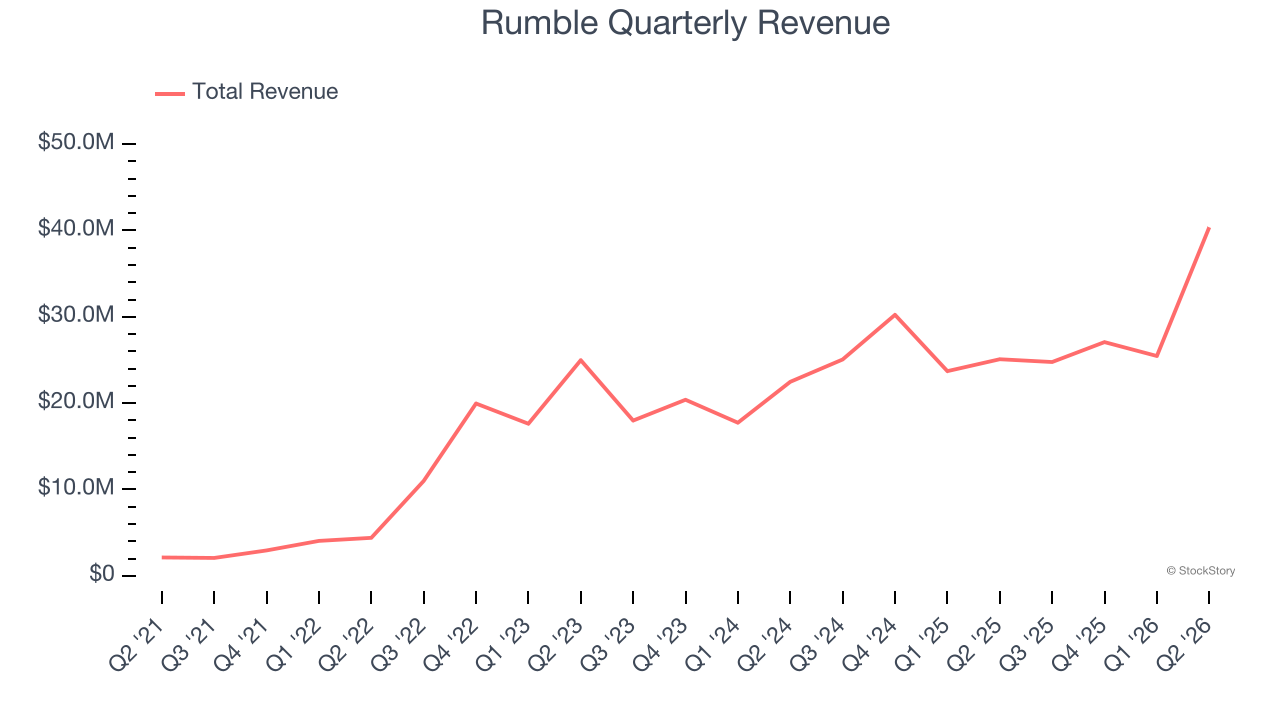
We at StockStory place the most emphasis on long-term growth, but within business services, a half-decade historical view may miss recent innovations or disruptive industry trends. Rumble’s annualized revenue growth of 22.4% over the last two years is below its five-year trend, but we still think the results suggest healthy demand. 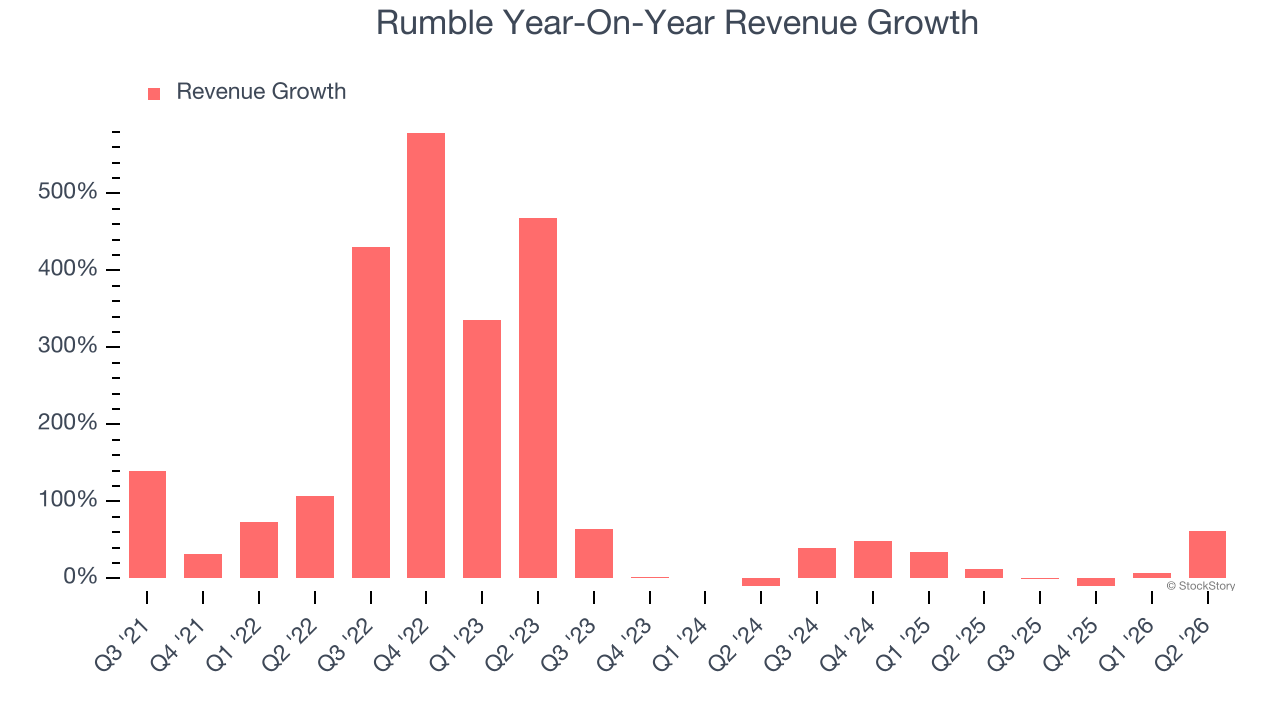
This quarter, Rumble reported magnificent year-on-year revenue growth of 60.9%, and its $40.37 million of revenue beat Wall Street’s estimates by 31.7%.
Looking ahead, sell-side analysts expect revenue to grow 254% over the next 12 months, an improvement versus the last two years. This projection is eye-popping and implies its newer products and services will fuel better top-line performance.
WHILE YOU’RE HERE: The Next Palantir? One satellite company captures images of every point on Earth. Every single day. The Pentagon wants it. Hedge funds are using it to beat earnings. You’ve probably never heard of it.
This is what the early days of Palantir looked like before it became a giant. Same playbook. Different technology. If you missed Palantir, you need to see this. Claim The Stock Ticker for Free HERE.
Adjusted Operating Margin
Rumble’s high expenses have contributed to an average adjusted operating margin of negative 114% over the last five years. Unprofitable business services companies require extra attention because they could get caught swimming naked when the tide goes out. It’s hard to trust that the business can endure a full cycle.
Analyzing the trend in its profitability, Rumble’s adjusted operating margin decreased by 11.1 percentage points over the last five years. This raises questions about the company’s expense base because its revenue growth should have given it leverage on its fixed costs, resulting in better economies of scale and profitability. Rumble’s performance was poor no matter how you look at it - it shows that costs were rising and it couldn’t pass them onto its customers.
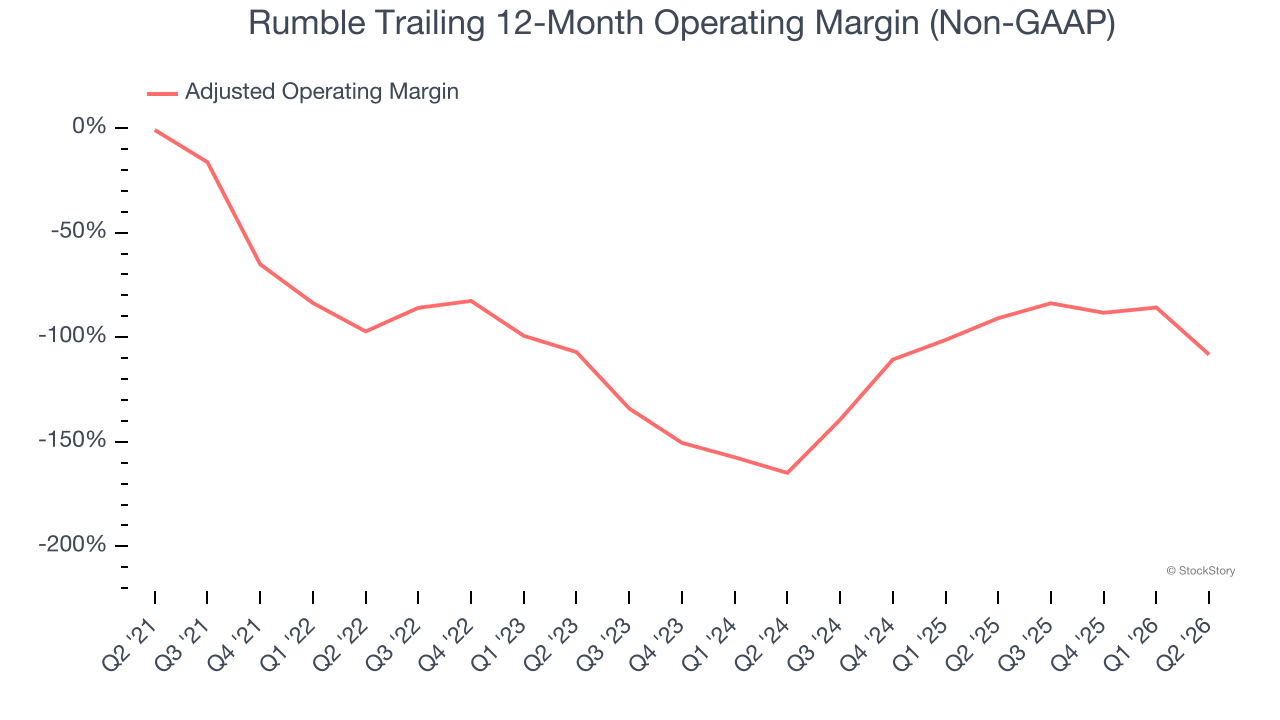
Rumble’s adjusted operating margin was negative 158% this quarter.
Earnings Per Share
We track the long-term change in earnings per share (EPS) for the same reason as long-term revenue growth. Compared to revenue, however, EPS highlights whether a company’s growth is profitable.
Rumble’s earnings losses deepened over the last three years as its EPS dropped 167% annually. We’ll keep a close eye on the company as diminishing earnings could imply changing secular trends and preferences.
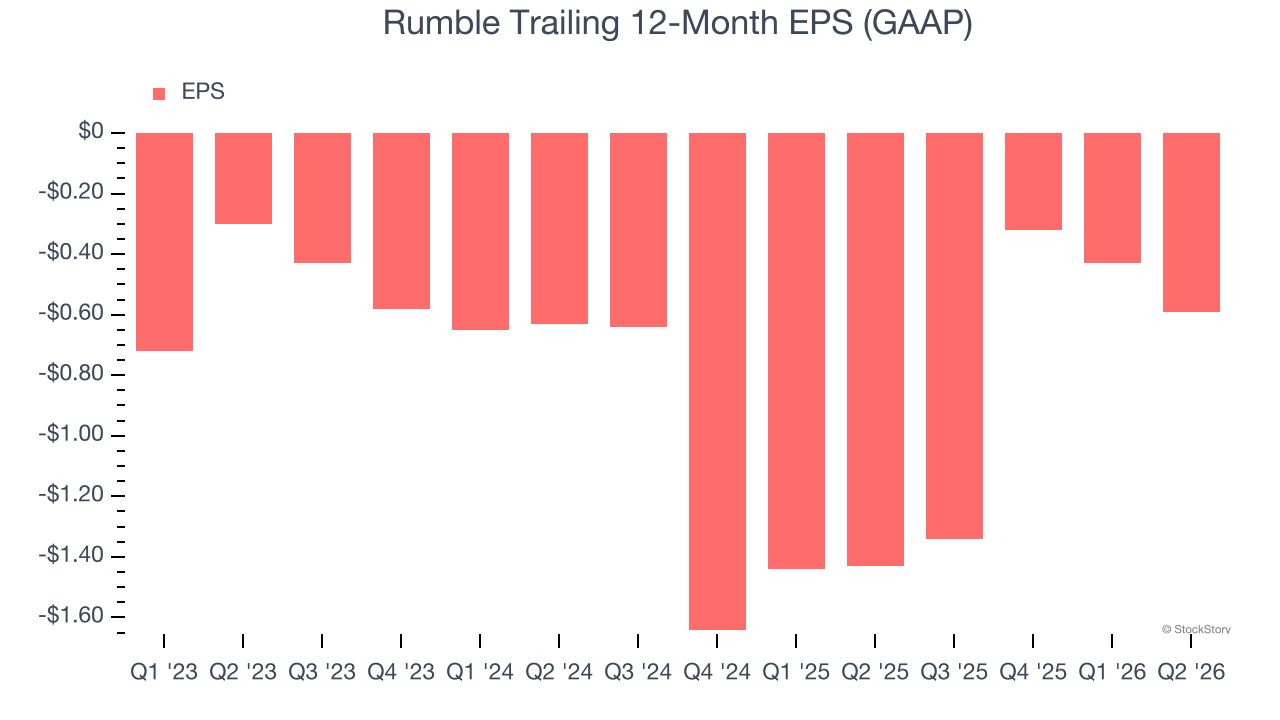
Like with revenue, we analyze EPS over a shorter period to see if we are missing a change in the business.
For Rumble, its two-year annual EPS growth of 3.2% was higher than its three-year trend. Its improving earnings are an encouraging data point, but a caveat is that its EPS is still in the red.
In Q2, Rumble reported EPS of negative $0.28, down from negative $0.12 in the same quarter last year. This print missed analysts’ estimates. We also like to analyze expected EPS growth based on Wall Street analysts’ consensus projections, but there is insufficient data.
Key Takeaways from Rumble’s Q2 Results
We were impressed by how significantly Rumble blew past analysts’ revenue expectations this quarter. On the other hand, its EPS missed. Overall, this quarter could have been better. The stock traded down 1.2% to $6.15 immediately after reporting.
Rumble’s latest earnings report disappointed. One quarter doesn’t define a company’s quality, so let’s explore whether the stock is a buy at the current price. The latest quarter does matter, but not nearly as much as longer-term fundamentals and valuation, when deciding if the stock is a buy. We cover that in our actionable full research report which you can read here (it’s free).



/AI%20(artificial%20intelligence)/Ai%20chip%20by%20Quality%20Stock%20Arts%20via%20Shutterstock.jpg)

/A%20close-up%20of%20the%20Broadcom%20logo%20on%20a%20smartphone%20by%20Timon%20via%20Adobe%20Stock.jpeg)