


Understanding Japanese Yen Futures and What Drives it
Japanese Yen futures, traded under the symbol 6J, reflect the value of the Yen relative to the U.S. Dollar. At a basic level, the Yen is influenced by three main forces: interest rate differences, global risk sentiment, and policy actions from the Bank of Japan. Because Japan has maintained very low interest rates for decades, the Yen is commonly used as a funding currency. Investors borrow Yen cheaply and deploy that capital into higher yielding assets elsewhere, a process known as the carry trade. When markets are calm and risk appetite is strong, this dynamic tends to pressure the Yen lower. When volatility rises or risk sentiment deteriorates, those carry trades are reduced or unwound, often leading to sharp Yen strength. This is why the Yen is frequently described as a risk off currency.
Beyond these structural drivers, recent macro developments have played an outsized role in shaping price action. The primary narrative has been the persistent divergence between U.S. and Japanese monetary policy. While U.S. interest rates have remained elevated and restrictive, the Bank of Japan has moved cautiously, signaling gradual normalization but stopping short of meaningful tightening. Even as Japan has exited its most extreme easing policies, yields remain low relative to global peers, keeping the interest rate gap wide and the Yen under pressure.
Another key theme has been inflation and wage growth in Japan. While domestic inflation has shown signs of stabilizing, the Bank of Japan continues to emphasize sustainability rather than short term data. Markets have repeatedly priced in policy shifts, only to see them delayed, reinforcing skepticism about near term Yen support from policy alone. As a result, speculative positioning has remained skewed toward Yen weakness, with rallies often treated as opportunities to re-establish shorts rather than trend reversals.
Currency intervention also remains an important backdrop. Japan typically intervenes when Yen weakness becomes rapid and disorderly rather than at a fixed price level. Recent official commentary has emphasized monitoring market conditions closely, which keeps intervention risk elevated even as the broader trend persists. This creates an environment where downside can continue in a controlled fashion, but sharp counter trend moves remain a risk, particularly during periods of thin liquidity or heightened global uncertainty.
What the Market has done
• The market has been in a down trend in a block step manner since April 2025, consistently respecting technical levels and remaining below the yearly Volume Weighted Average Price (VWAP).
• On a larger timeframe, the market remains within a multi year sideways range defined by resistance near 0.0071920 and support near 0.0062970.
• Over the past week, the market broke below daily support at the 0.0063950 area and is now trading in the vicinity of the larger long term weekly support around 0.0062970.
What to expect in the coming week
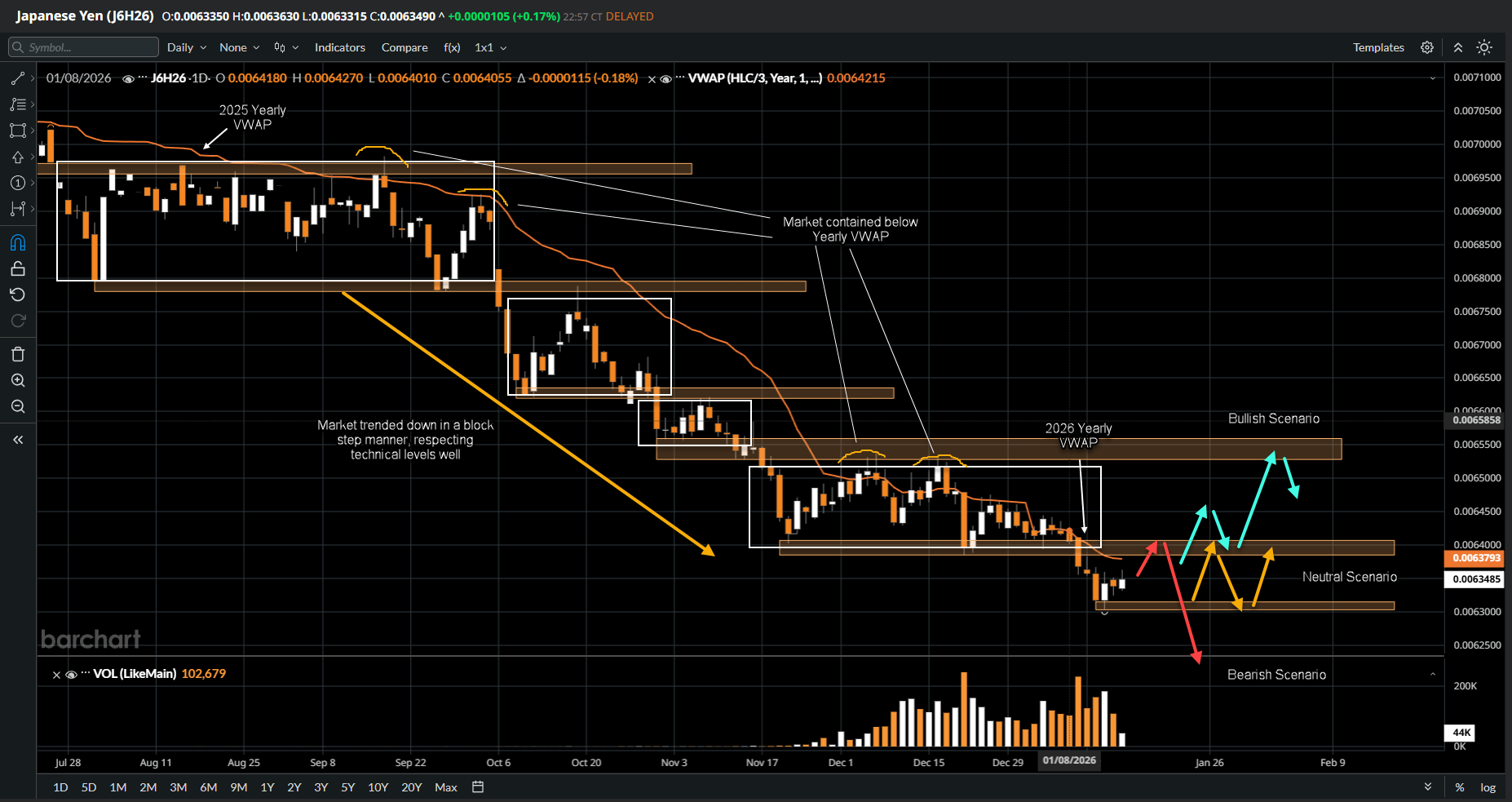
The key level to monitor is the 0.0064000 area, which represents recent daily support that has now turned into resistance.
Bearish scenario
• Sellers are expected to defend the 0.0063950 to 0.0063794 area, which aligns with daily resistance and the yearly VWAP.
• If this area holds, the market may continue to auction price lower toward 0.0062495, a multi year weekly support level where buyers are expected to respond.
Neutral scenario
• The market may enter a consolidation phase between the 0.0064000 area and the 0.0063000 area.
• In this scenario, price lacks the pace and volume needed to break either side, resulting in rotational trade and balance.
Bullish scenario
• Responsive buyers may step in at current weekly support and bid price back up toward the 0.0064000 to 0.0063794 area, which aligns with daily resistance and the yearly VWAP.
• Sellers are expected to respond at this level. If they fail to do so, price could rotate back into the prior consolidation block between 0.0065300 and 0.0064000, targeting the next daily resistance at 0.0065300.
Conclusion
6J is testing an important inflection zone where long term structure meets ongoing macro pressure. Price is trading near the lower boundary of the multi year range, with the 0.0062970 area acting as a key weekly support that has historically attracted buyers. How the market behaves here will help determine whether this move remains a range rotation or develops into a broader breakdown.
To the upside, the 0.0064000 level remains the primary near term reference, aligning with former daily support turned resistance and the yearly VWAP near 0.0063794. As long as price remains below this zone, rallies are likely to be corrective. A sustained reclaim would open the door for rotation back toward the prior consolidation area between 0.0064000 and 0.0065300, with 0.0065300 marking the next daily resistance.
From a macro standpoint, wide rate differentials, cautious Bank of Japan policy, and ongoing carry trade dynamics continue to weigh on the Yen, while intervention risk increases as price presses deeper into long term support. The interaction between these macro forces and the 0.0062970 and 0.0064000 levels will be critical in shaping 6J price action in the weeks ahead.
Disclaimer:
This article is provided for informational and educational purposes only and does not constitute financial, investment, or trading advice. The analysis presented reflects the author’s market observations and opinions at the time of writing and is not a recommendation to buy or sell any futures contract, security, or financial instrument. Futures trading involves significant risk and is not suitable for all market participants. Losses may exceed initial margin deposits, and market conditions can change rapidly.
Any scenarios, levels, or market expectations discussed are hypothetical in nature and are intended solely to illustrate potential market behavior. They do not represent actual trading results and should not be interpreted as guarantees of future performance. Past performance, market behavior, or historical price action are not indicative of future outcomes.
Readers are solely responsible for their own trading decisions and risk management. Always conduct independent research, consider your financial situation and risk tolerance, and consult with a qualified financial professional if necessary before engaging in futures or derivatives trading.

/A%20Palantir%20office%20building%20in%20Tokyo_%20Image%20by%20Hiroshi-Mori-Stock%20via%20Shutterstock_.jpg)


/Adobe%20Inc%20logo%20on%20computer-by%20DANIEL%20CONSTANTE%20via%20Shutterstock.jpg)