
Personal wellness company WeightWatchers (NASDAQ:WW) announced better-than-expected revenue in Q2 CY2026, but sales fell by 14.2% year on year to $162.3 million. On the other hand, the company’s full-year revenue guidance of $627.5 million at the midpoint came in 0.7% below analysts’ estimates. Its GAAP profit of $1.41 per share was significantly above analysts’ consensus estimates.
Is now the time to buy WeightWatchers? Find out by accessing our full research report, it’s free.
WeightWatchers (WW) Q2 CY2026 Highlights:
- Revenue: $162.3 million vs analyst estimates of $159.1 million (14.2% year-on-year decline, 2% beat)
- EPS (GAAP): $1.41 vs analyst estimates of $0.67 (significant beat)
- Adjusted EBITDA: $39.76 million vs analyst estimates of $43.82 million (24.5% margin, 9.2% miss)
- The company reconfirmed its revenue guidance for the full year of $627.5 million at the midpoint
- EBITDA guidance for the full year is $110 million at the midpoint, above analyst estimates of $107.9 million
- Operating Margin: 5.8%, down from 32.3% in the same quarter last year
- Free Cash Flow was $30.06 million, up from -$38 million in the same quarter last year
- Market Capitalization: $165.2 million
Company Overview
Known by many for its old cable television commercials, WeightWatchers (NASDAQ:WW) is a wellness company offering a range of products and services promoting weight loss and healthy habits.
Revenue Growth
Examining a company’s long-term performance can provide clues about its quality. Any business can experience short-term success, but top-performing ones enjoy sustained growth for years. WeightWatchers struggled to consistently generate demand over the last five years as its sales dropped at a 12.4% annual rate. This was below our standards and suggests it’s a low quality business.
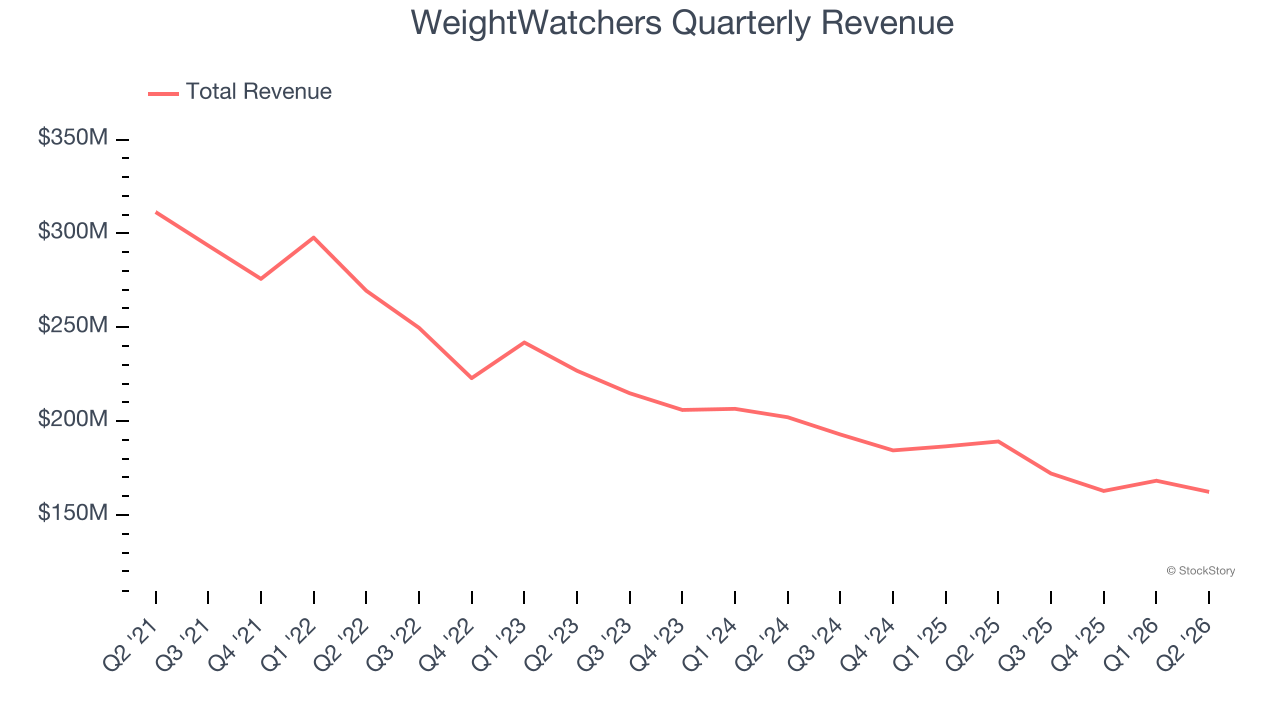
Long-term growth is the most important, but within consumer discretionary, product cycles are short and revenue can be hit-driven due to rapidly changing trends and consumer preferences. WeightWatchers’s annualized revenue declines of 10.4% over the last two years suggest its demand continued shrinking. 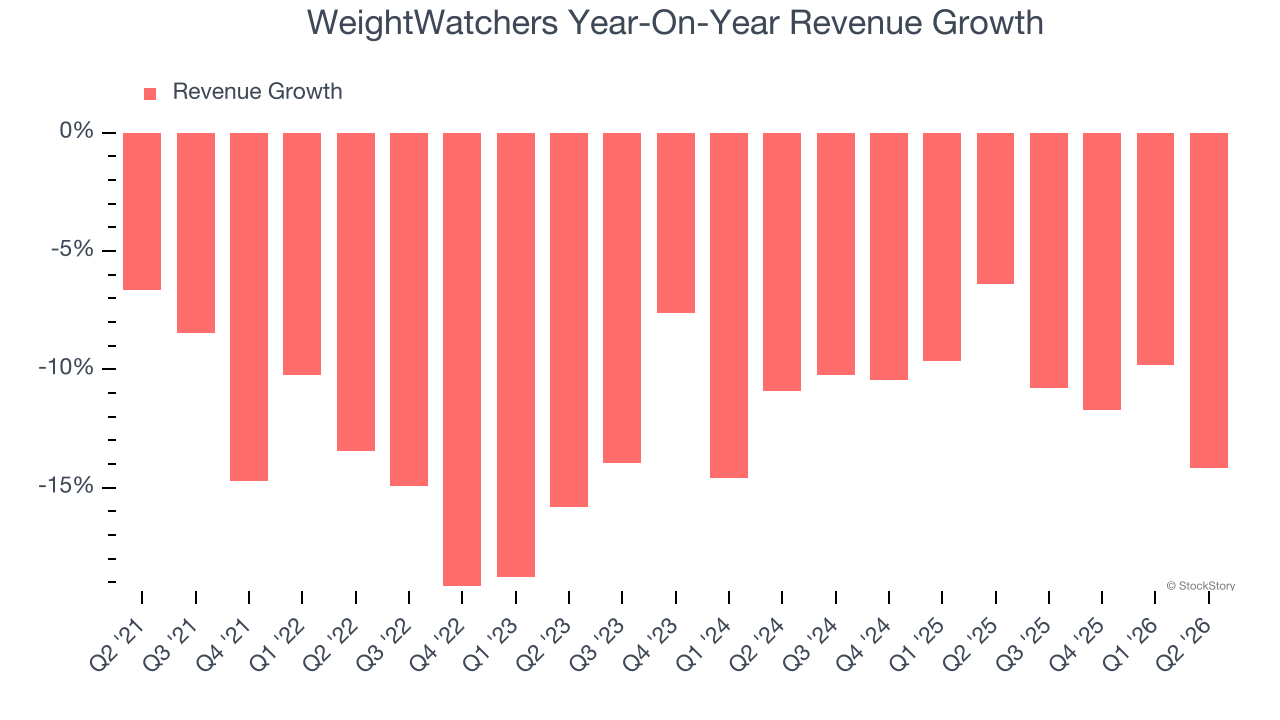
This quarter, WeightWatchers’s revenue fell by 14.2% year on year to $162.3 million but beat Wall Street’s estimates by 2%.
Looking ahead, sell-side analysts expect revenue to decline by 6.2% over the next 12 months. Although this projection is better than its two-year trend, it’s tough to feel optimistic about a company facing demand difficulties.
ONE MORE THING: 3 Hidden Platforms Growing 3X Faster than Amazon, Google, and PayPal. Amazon, Google, and Meta all followed the same playbook: Dominate an ignored market. Build an unbeatable moat. Scale until you’re unstoppable.
These three platforms are running that exact playbook right now. The early investors in Amazon made fortunes. The early investors in these could do the same. Get All 3 Stocks Here for FREE.
Operating Margin
Operating margin is a key measure of profitability. Think of it as net income - the bottom line - excluding the impact of taxes and interest on debt, which are less connected to business fundamentals.
WeightWatchers’s operating margin has shrunk over the last 12 months and averaged 9.3% over the last two years. The company’s profitability was mediocre for a consumer discretionary business and shows it couldn’t pass its higher operating expenses onto its customers.
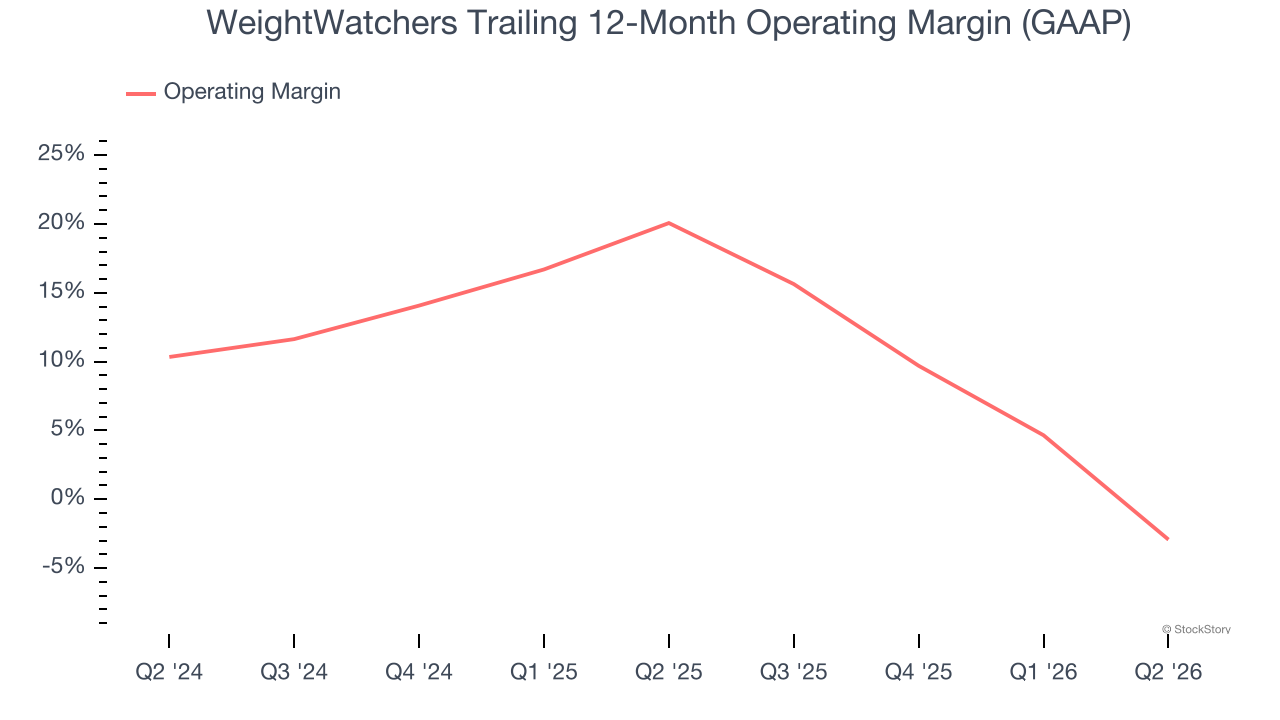
In Q2, WeightWatchers generated an operating margin profit margin of 5.8%, down 26.5 percentage points year on year. This contraction shows it was less efficient because its expenses increased relative to its revenue.
Cash Is King
Free cash flow isn’t a prominently featured metric in company financials and earnings releases, but we think it’s telling because it accounts for all operating and capital expenses, making it tough to manipulate. Cash is king.
While WeightWatchers posted positive free cash flow this quarter, the broader story hasn’t been so clean. Over the last two years, WeightWatchers’s demanding reinvestments to stay relevant have drained its resources, putting it in a pinch and limiting its ability to return capital to investors. Its free cash flow margin averaged negative 1.5%, meaning it lit $1.47 of cash on fire for every $100 in revenue.
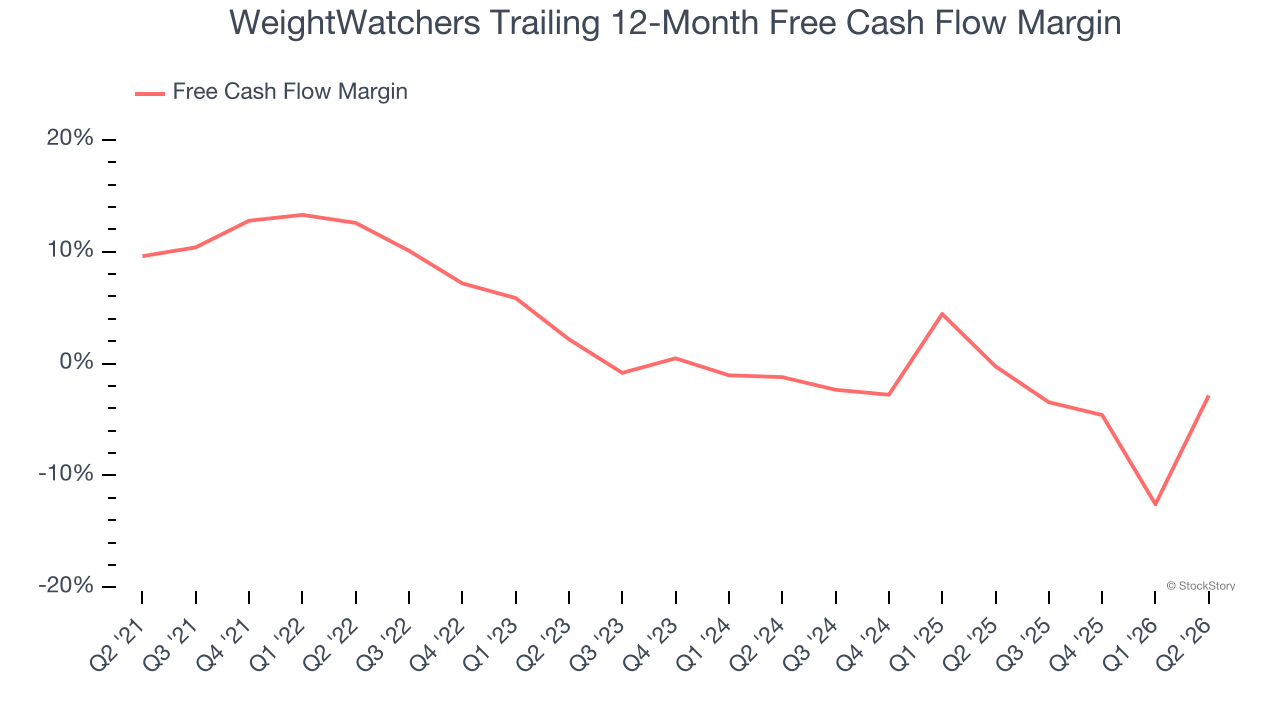
WeightWatchers’s free cash flow clocked in at $30.06 million in Q2, equivalent to a 18.5% margin. Its cash flow turned positive after being negative in the same quarter last year, but we wouldn’t read too much into the short term because investment needs can be seasonal, leading to temporary swings. Long-term trends carry greater meaning.
Looking forward, analysts predict WeightWatchers will generate cash on a full-year basis. Their consensus estimates imply its free cash flow margin of negative 2.8% for the last 12 months will increase to positive 11.8%, giving it more money to invest.
Key Takeaways from WeightWatchers’s Q2 Results
It was good to see WeightWatchers beat analysts’ EPS expectations this quarter. We were also happy its revenue outperformed Wall Street’s estimates. On the other hand, its EBITDA missed and its full-year revenue guidance fell slightly short of Wall Street’s estimates. Overall, this print was mixed but still had some key positives. The market seemed to be hoping for more, and the stock traded down 1.3% to $15.23 immediately after reporting.
Should you buy the stock or not? If you’re making that decision, you should consider the bigger picture of valuation, business qualities, as well as the latest earnings. We cover that in our actionable full research report which you can read here (it’s free).

/Jen-Hsun%20Huan%20NVIDIA's%20Founder%2C%20President%20and%20CEO%20by%20jamesonwu1972%20via%20Shutterstock.jpg)
/Tesla%20dealership%20with%20cars%20in%20lot%20by%20Jetcityimage%20via%20iStock.jpg)