



Rio Tinto (NYSE: RIO) just delivered a first-half report with numbers that back up a broader thesis rooted in a major shift. Physical assets are entering a multi-year period of outperformance. Higher bond yields, oil supply anxieties, and an artificial intelligence (AI) infrastructure buildout are converging. Rio Tinto sits at the intersection of all three trends.
Rio Tinto posted EBITDA of $14.8 billion, up 28% year-over-year. Free cash flow nearly doubled, jumping 75% to $3.8 billion. Underlying earnings rose 43% to $6.9 billion. The board responded with a $3.4 billion interim dividend, up 43% from a year ago.
However, the bigger story is the why. That goes back to the broader thesis that hard assets are at the beginning of a multi-year bull cycle. Copper, aluminum, and lithium now generate more than half of Rio Tinto's EBITDA. That mix gives investors direct exposure to electrification, grid buildout, and AI-driven power demand. Meanwhile, iron ore keeps the balance sheet steady through this transition.
Copper and Iron Ore Drive Rio Tinto's Diversified Growth
Copper EBITDA surged 84% to $5.7 billion, driven by the ramp-up at the company’s Oyu Tolgoi project and a 39% jump in average realized copper prices. Aluminum and lithium combined rose 38% to $3.3 billion. Iron ore stayed roughly flat at $6.8 billion, still the largest single contributor.
Here’s why that balance matters. Copper is needed in the AI and electrification trade. Iron ore is a steady cash generator. Together, they reduce Rio Tinto's dependence on any single commodity cycle. That level of diversification is rare among pure-play miners.
Management also flagged accelerating productivity gains. The company banked $870 million in savings during H1, targeting a $1.8 billion annualized run-rate by year-end. Lower unit costs mean margins can hold even if commodity prices soften later in the cycle.
Rio Tinto Stock Hasn't Caught Up to Strong Fundamentals
Despite the strong quarter, RIO shares have pulled back from 2026 highs near $110. The stock now trades around $96, still well above its 200-day moving average near $89. It's also about 9% below its consensus price target of $105.50. That gap between fundamentals and price action is worth watching.
The daily chart shows a bullish MACD crossover forming in recent sessions, with the MACD line at 0.88 crossing above the signal line at -1.01. That's typically an early momentum signal. Shares are also up nearly 3% on the earnings reaction, suggesting the market is still digesting just how strong this quarter was.
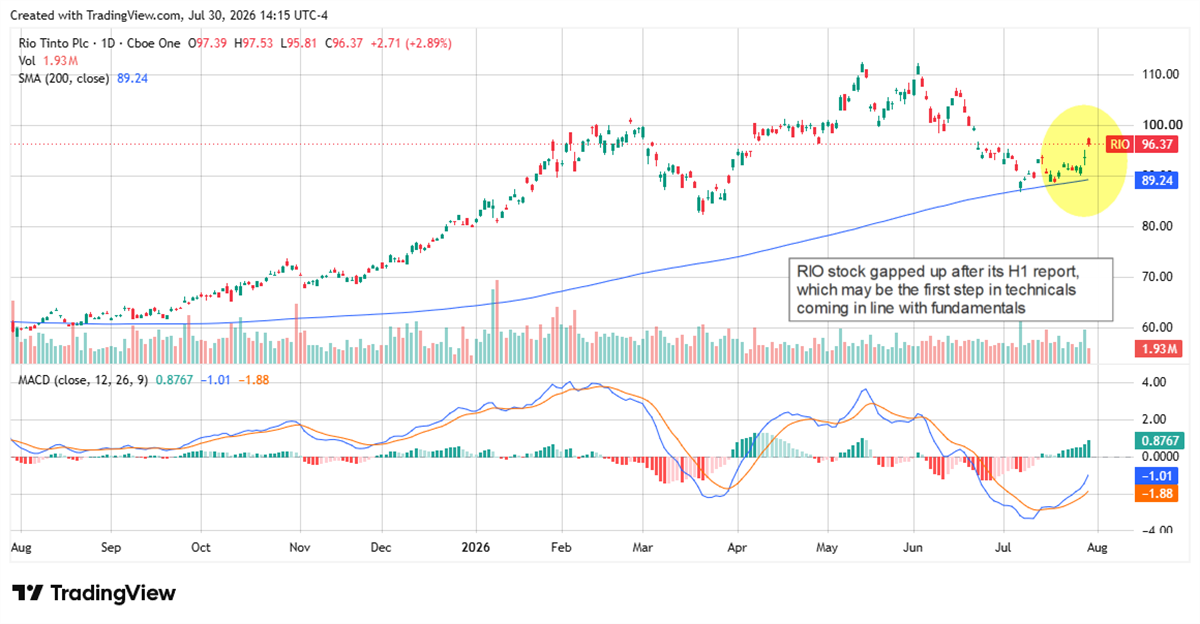
The disconnect may reflect broader sentiment toward miners, not Rio Tinto specifically. Investors have spent much of 2026 rotating toward technology and away from commodities. That rotation looks increasingly mistaken given the factors driving demand for copper, aluminum, and lithium.
AI Infrastructure Is Driving Demand for Industrial Metals
Three forces are converging to favor hard assets over the next several years. Higher bond yields raise the cost of capital for speculative growth stories. Oil supply disruptions, including the Middle East tensions cited in this report, raise energy input costs across the board. Rio Tinto's diesel costs alone rose by $0.8 per ton year-over-year due to higher oil prices.
At the same time, AI infrastructure buildout requires enormous quantities of copper and aluminum. Data centers need grid capacity, transmission lines, and backup power, all copper-intensive. Rio Tinto's guidance indicates copper production will grow to 800,000 to 870,000 tons for the full-year 2026.
This isn't a story about one commodity. It's about physical inputs becoming the bottleneck for the next phase of economic growth. Companies that own the mines, not just the technology layer, may capture outsized value.
Key Risks Investors Should Watch
Not every signal is favorable. Iron ore prices dipped modestly through the first half, and IOC production in Canada fell 22% year-over-year. The Oyu Tolgoi tax dispute with Mongolia, totaling $443 million paid under protest, adds geopolitical risk to the copper growth story.
Currency headwinds were also present in the results. A weaker U.S. dollar against the Australian and Canadian dollars reduced underlying EBITDA by $700 million. If the dollar continues weakening, that pressure could persist. Investors should weigh these risks against the productivity and diversification tailwinds.
Rio Tinto Offers Long-Term Exposure to AI and Infrastructure
Rio Tinto's first-half results showed what a well-diversified physical-asset business can deliver in a favorable pricing environment. Free cash flow up 75%, dividends up 43%, and copper EBITDA nearly doubling all support the underlying thesis. Hard assets are becoming harder to ignore.
For investors building portfolios around the next several years of higher rates, energy uncertainty, and AI infrastructure spending, Rio Tinto offers direct, diversified exposure. The stock's pullback from 2026 highs, despite improving fundamentals, may represent an entry point rather than a warning sign.
Where Should You Invest $1,000 Right Now?
Before you make your next trade, you'll want to hear this.
MarketBeat keeps track of Wall Street's top-rated and best performing research analysts and the stocks they recommend to their clients on a daily basis.
Our team has identified the five stocks that top analysts are quietly whispering to their clients to buy now before the broader market catches on... and none of the big name stocks were on the list.
They believe these five stocks are the five best companies for investors to buy now...
The article "Rio Tinto’s Results Make the Case for Looking Beyond Tech in the AI Trade" first appeared on MarketBeat.

/Jen-Hsun%20Huan%20NVIDIA's%20Founder%2C%20President%20and%20CEO%20by%20jamesonwu1972%20via%20Shutterstock.jpg)

/Tesla%20dealership%20with%20cars%20in%20lot%20by%20Jetcityimage%20via%20iStock.jpg)

/Close%20up%20metal%20sockets%20on%20computer%20video%20board%20by%20YouraPechkin%20via%20Adobe%20Stock.jpeg)