




War, Weather, and Warehouses: The Forces Pulling Cotton in Both Directions
Sentiment in cotton has been unusually volatile this year, and the market remains sensitive to a mix of geopolitical, macro, and crop specific developments. The Iran war, which began on February 28, 2026, helped ignite the spring rally by lifting crude oil prices and making cotton more attractive relative to its petroleum-based substitute, polyester. That conflict appeared to ease under a June memorandum of understanding, but it flared back up in early July after strikes resumed near the Strait of Hormuz, with the United States and Iran now in their third consecutive week of exchanged attacks as of late July. Brent crude has held in the mid to high 70s per barrel through this stretch, keeping the substitution dynamic with polyester relevant for cotton demand. On the supply side, the USDA's July WASDE report, released July 10, raised its 2026/27 US cotton production estimate to 13.70 million bales, above trade expectations, while global ending stocks ticked up slightly to 71.22 million bales. At the same time, weakening US crop conditions and renewed weather concerns across Texas and the Delta have kept a bid under prices, helping December futures push back above 80 cents by mid-July after dipping into the low 70s in June. Speculative positioning has also swung dramatically, moving from a record net short position of roughly 90,000 contracts last October to a net long position near 95,000 contracts by early May, one of the largest six month reversals on record, and that unwind has been a major driver of both the rally and the subsequent pullback.
What the Market Has Done
- The market staged an aggressive rally to the 90 area on the weekly chart between March and May, driven primarily by a historic short covering wave among speculative funds, a weaker US dollar, and the geopolitical shock from the onset of the Iran war.
- That rally became technically overbought, and buying capitulation followed in mid to late May, as heavy profit taking and long liquidation combined with weak US export sales and broader agricultural commodity weakness to trigger a sharp selloff.
- Since June, the market has largely traded sideways, establishing a range between 82 on the daily chart as the upper boundary and 76 on the daily chart as the lower boundary.
- Through the month of June and into July, buyers have progressively stepped up their bids within the 82 and 76 range, compressing price action toward the 82 level as the range has narrowed.
What To Expect In The Coming Weeks
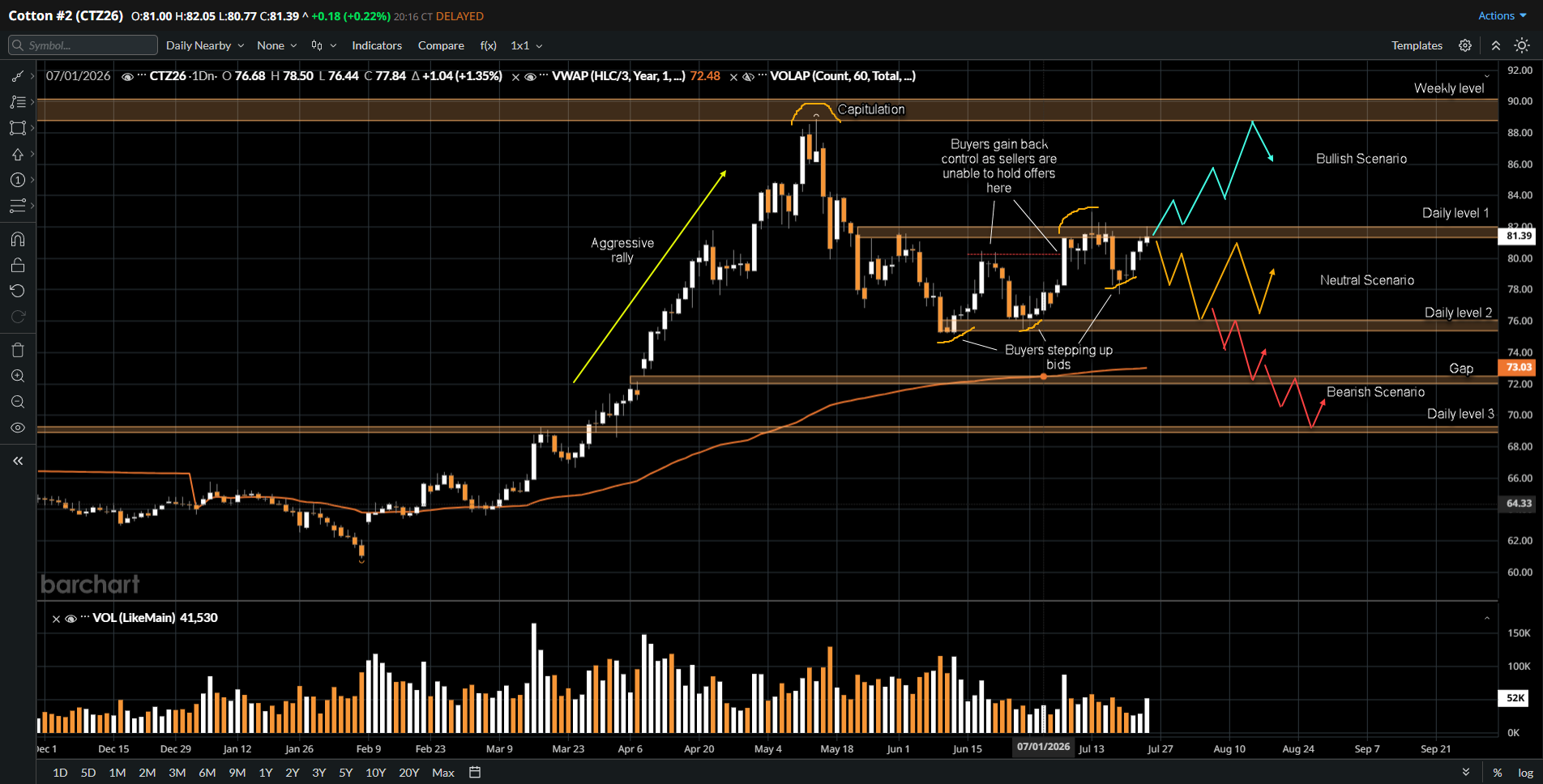
The 82 level on the daily chart remains the level to watch, as it has repeatedly capped upside attempts and will likely determine the market's next directional move.
Bullish Scenario:
- If buyers are able to bid the market above the 82 level and hold that acceptance, a move toward the 88 area on the weekly chart, which also marks the prior swing high, becomes the likely target.
- A plausible trigger would be further escalation in the Iran conflict that pushes crude oil meaningfully higher, reinforcing cotton's price advantage over polyester and drawing fresh speculative buying.
Neutral Scenario:
- If the edges of the range, 82 on the daily chart and 76 on the daily chart, continue to hold, expect continued two way rotation as the market works to re-establish fair value within the range.
- A possible situation supporting this, would be a period of mixed WASDE data and inconclusive Iran war headlines that leave traders without a clear catalyst to commit in either direction.
Bearish Scenario:
- If sellers are able to break and hold acceptance below the 76 level, a move down to 72 to close the earlier chart gap becomes likely, and without responsive buyers emerging, the decline could extend to 69 on the daily chart.
- A possible trigger would be a diplomatic breakthrough or ceasefire in the Iran conflict that sends crude oil sharply lower, removing the substitution support for cotton just as global supply estimates continue to grow.
Conclusion
Cotton No. 2 futures sit at a technical inflection point, with the tightening range between 76 and 82 cents reflecting a genuine tug of war between a still fragile geopolitical backdrop and a fundamental picture that has grown slightly heavier following the July WASDE report. A confirmed break and acceptance above 82 would open the door toward the 88 area, while a breakdown below 76 would expose the market to a retest of 72 and potentially 69. On the fundamental side, the path of the Iran conflict and its influence on crude oil will likely remain just as important as crop conditions and export demand in determining which scenario plays out. With volatility this pronounced and the range compressing by the week, this is a market worth watching closely into the next round of USDA data and any fresh developments out of the Middle East.
We are a professional-grade futures brokerage engineered by traders to provide the high-performance architecture and futures trading platform required for serious market participation. We serve as a professional technical partner for traders who prioritize data integrity and objective analysis. Take the next step in your professional evolution and Open an Account today.
Disclaimer:
This article is provided for informational and educational purposes only and does not constitute financial, investment, or trading advice. The analysis presented reflects the author’s market observations and opinions at the time of writing and is not a recommendation to buy or sell any futures contract, security, or financial instrument. Futures trading involves significant risk and is not suitable for all market participants. Losses may exceed initial margin deposits, and market conditions can change rapidly.
Any scenarios, levels, or market expectations discussed are hypothetical in nature and are intended solely to illustrate potential market behavior. They do not represent actual trading results and should not be interpreted as guarantees of future performance. Past performance, market behavior, or historical price action are not indicative of future outcomes.
Readers are solely responsible for their own trading decisions and risk management. Always conduct independent research, consider your financial situation and risk tolerance, and consult with a qualified financial professional, if necessary, before engaging in futures or derivatives trading.


/Space/Rocket%20launching%20into%20space%20by%20BEST%20BACKGROUNDS%20via%20Shutterstock.jpg)
/A%20close-up%20of%20an%20AMD%20office%20by%20gehapromo%20via%20Adobe%20Stock.jpeg)
/Applied%20Materials%20Inc_%20campus%20sign-by%20Sundry%20Photography%20via%20iStock.jpg)
/Micron%20Technology%20Inc_%20logo%20on%20building-by%20vzphotos%20vis%20iStock.jpg)