




Trade Deadlines and an Oil Shock: What Is Moving the Loonie
Sentiment around the Loonie has been shaped by domestic monetary policy, cross border trade friction, and a sharp jump in energy prices. On July 15, the Bank of Canada left its overnight rate unchanged at 2.25% for a sixth straight meeting, a decision markets had largely priced in. The Bank acknowledged that growth stalled in the first quarter but expects activity to strengthen through the second half of 2026, while trimming its full year GDP growth forecast to 0.7%. The Federal Reserve, meanwhile, held its target range at 3.50% to 3.75% on June 17, keeping the rate differential between the two central banks a relevant factor for the pair.
Trade policy has added another layer of pressure. The July 1 deadline for Canada, the United States, and Mexico to review and potentially extend the CUSMA trade pact for another sixteen years passed without an agreement. The Trump administration declined to commit to the full extension, so the deal now shifts to annual reviews ahead of its scheduled 2036 expiry, while existing tariffs on Canadian goods remain in force. This has kept a persistent overhang of uncertainty for Canadian exporters and, by extension, the currency.
Adding a further twist, crude oil has surged over the past week as hostilities between the United States and Iran intensified. The United States reinstated a naval presence near the Strait of Hormuz, and West Texas Intermediate climbed toward the low eighties by July 17, up more than 10% on the week. Because Canada remains a major oil exporter, this move has offset some of the drag from trade uncertainty and helped keep the Loonie from breaking down more decisively.
What the Market Has Done
- The market was consolidating in a smaller range, labeled consolidation range 2, between 0.74 (daily level 1 - range high), and 0.72 (daily level 2).
- This smaller range was the market’s attempt to establish value higher within a larger consolidation range 1, which spans from 0.74 (daily level 1), down to 0.71 (daily level 3 - range low).
- In June, the market broke below 0.72 (daily level 2), which triggered a selloff that carried price down to 0.71 (daily level 3).
- Recently, there was a liquidity check below the 0.71 level, where buyers stepped in and absorbed.
- This absorption resulted in a quick rejection back above 0.71, leaving the market positioned right at the boundary of the larger consolidation range.
What to Expect in the Coming Weeks
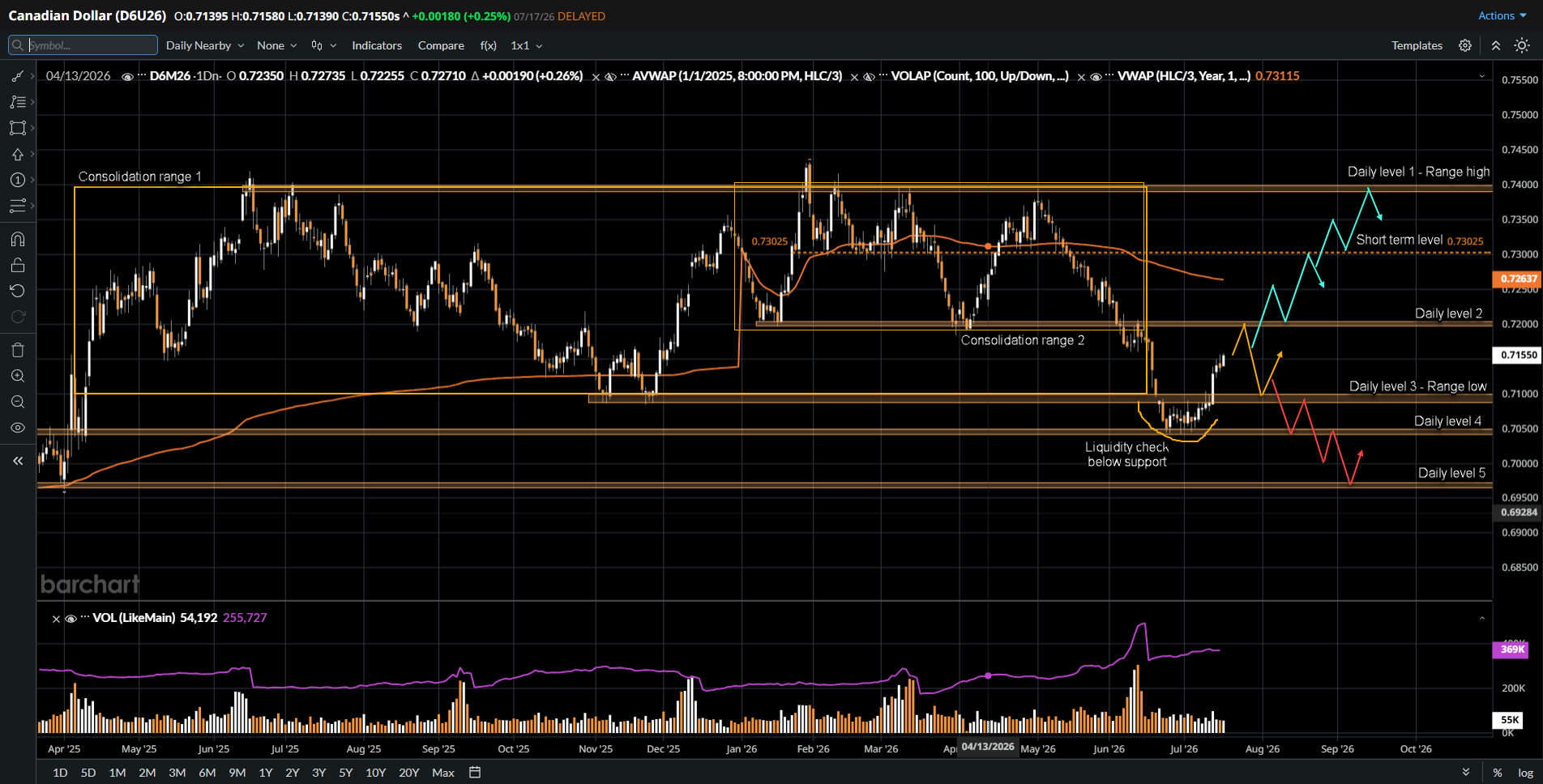
The key level to watch is 0.71, daily level 3, which now separates continuation of the broader range from a deeper breakdown.
Neutral Scenario
- If sellers defend 0.72, daily level 2, capping any upside rotation attempts, while buyers continue holding bids at 0.71, this will cause a two-way rotation.
- This would establish value lower within the consolidation range.
- The current holding pattern, where both central banks stay on hold and the CUSMA annual review process proceeds without fresh escalation, would likely be supportive of this scenario.
Bullish Scenario
- If the market reclaims and holds above 0.72, daily level 2, expect an initial move up to 0.73, a short-term level, where sellers may step back in.
- If sellers fail to defend 0.73, expect the move to extend back up through consolidation range 2 toward 0.74 (daily level 1).
- A possible trigger would be a further extension of the oil rally if the United States and Iran conflict keeps disrupting the Strait of Hormuz traffic, combined with any signal from Washington of easing tariffs on CUSMA compliant goods.
Bearish Scenario
- The first clue of a bearish scenario would be sellers stepping down their offers and capping upside rotation below 0.72, compressing price back toward 0.71.
- If buyers fail to defend 0.71 this time, expect a move down to 0.705 (daily level 4), and potentially further to 0.697 (daily level 5).
- A potential trigger would be a renewed ceasefire or de-escalation between the United States and Iran that reverses the recent oil rally, or a fresh tariff announcement out of Washington tied to the CUSMA review.
Conclusion
Technically, the Loonie sits at a decision point, with the market having just defended 0.71 after a liquidity check, leaving 0.72 as the near-term pivot that will decide whether value continues to build lower within the larger consolidation range or whether buyers can reclaim the upper half of the structure toward 0.74. Fundamentally, the currency remains caught between two competing forces, a Bank of Canada that has now held rates steady for six consecutive meetings amid a soft growth outlook and lingering CUSMA uncertainty on one side, and a sharp oil rally driven by escalating United States and Iran tensions on the other, which has offered the Loonie some underlying support. Traders should watch the 0.71 to 0.72 zone closely, since a decisive break in either direction is likely to set the tone for the Loonie through the rest of the summer. What is your take on whether the Bank of Canada's cautious hold or the oil driven tailwind will end up dominating price action from here?
EdgeClear is designed for traders who refuse to guess. We deliver unfiltered tick data via Rithmic, competitive pricing starting at $0.22 per side, and performance analytics that transform your trade log into a roadmap. The serious trader’s next move is clear. Open an Account today.
Disclaimer:
This article is provided for informational and educational purposes only and does not constitute financial, investment, or trading advice. The analysis presented reflects the author’s market observations and opinions at the time of writing and is not a recommendation to buy or sell any futures contract, security, or financial instrument. Futures trading involves significant risk and is not suitable for all market participants. Losses may exceed initial margin deposits, and market conditions can change rapidly.
Any scenarios, levels, or market expectations discussed are hypothetical in nature and are intended solely to illustrate potential market behavior. They do not represent actual trading results and should not be interpreted as guarantees of future performance. Past performance, market behavior, or historical price action are not indicative of future outcomes.
Readers are solely responsible for their own trading decisions and risk management. Always conduct independent research, consider your financial situation and risk tolerance, and consult with a qualified financial professional, if necessary, before engaging in futures or derivatives trading.


/Space/Rocket%20launching%20into%20space%20by%20BEST%20BACKGROUNDS%20via%20Shutterstock.jpg)
/A%20close-up%20of%20an%20AMD%20office%20by%20gehapromo%20via%20Adobe%20Stock.jpeg)
/Applied%20Materials%20Inc_%20campus%20sign-by%20Sundry%20Photography%20via%20iStock.jpg)
/Micron%20Technology%20Inc_%20logo%20on%20building-by%20vzphotos%20vis%20iStock.jpg)