/AI%20(artificial%20intelligence)/Data%20center%20by%20IM%20Imagery%20via%20Shutterstock.jpg)
This is sponsored content. Barchart is not endorsing the websites or products set forth below.
- Carrier Connect has built a portfolio of five data centres across Vancouver, Perth, Ottawa, and Saint John, New Brunswick, in about a year, and is finalizing its first U.S. acquisition in Rochester, New York.
- Annualized recurring revenue sits near $5 million today and moves toward $6 million as Rochester closes, with management targeting roughly $10 million by the end of 2026.
- A tight structure of about 32.8 million shares, with insiders holding roughly 15% and only about 26 million trading freely, sits behind the story.
Artificial intelligence is rewriting the economics of computing. A single question to an AI chatbot can burn roughly ten times the processing power of an ordinary web search, and every one of those calculations has to run on a physical server somewhere.
Those servers live in data centres. The world suddenly needs far more of them.
That pivot from a global compute crunch to a single small-cap opportunity is the bet behind Carrier Connect Data Solutions Inc. (TSXV: (CCDS.VN) | OTCQB: (CCDSF) | FSE: F5Z0). The Vancouver-based company has spent the past year quietly assembling the kind of portfolio that demand curve rewards.
Its model is simple: buy small, profitable data centres and fold them into a single public platform. The footprint already reaches Vancouver, Perth, Ottawa, and Saint John, with a first U.S. location in Rochester, New York, now being finalized.
The whole strategy rests on one bet: that AI keeps multiplying the demand for places to put servers. Chief Executive Mark Binns frames the math plainly.
“If you ask ChatGPT a question, it takes about ten times as much processing power as asking Google the same thing,” Binns said. “Ten times as many servers, and they all have to live in data centres. That’s what’s driving demand.”
Why buying beats building
Building a data centre from scratch can take two years. Power can be hard to secure, and local councils often resist new construction as they are uncertain as to the impact of data centres on local resources.
Carrier Connect skips all of that. By buying centres that already run, it inherits a paying customer base and positive cash flow on day one.
The bigger prize is what happens to the price tag. The company's own investor materials lay out the gap: a single private data centre might change hands at two to three times its annual revenue, while a public company with a portfolio of them is valued at ten times (or more) revenue.
That gap, known in the market as a re-rate, is the engine of the whole model.
"If we buy single-location private data centres for two to three times revenue, the valuation of a public company with a portfolio is ten times or higher," Binns said. "If we pay two and a half times, we're getting a 400% lift on our investment."
A portfolio across three countries
What ties the acquisitions together is geography. Spreading sites across cities lets Carrier Connect offer customers a network rather than a single building, so that they can run equipment in multiple locations for backup and resilience.
The anchor is the flagship Vancouver site at 200 Burrard, wired directly into the Harbour Centre internet hub. From there, the portfolio runs east to two Ottawa facilities and Saint John, New Brunswick, and across the Pacific to a fully built-out site in Perth, Australia. Their first U.S. foothold in Rochester, New York, is being finalized.
Today, the portfolio generates close to $5 million in annualized recurring revenue across roughly 80 customers. That figure moves toward $6 million once Rochester closes.
"What ties them together is they're cash-flow positive, they have up-to-date infrastructure, and some have significant capacity for us to sell without new capital," Binns said. "They fit our model, we can buy them at the right price, and they have upside."
From Colo capacity to global connectivity
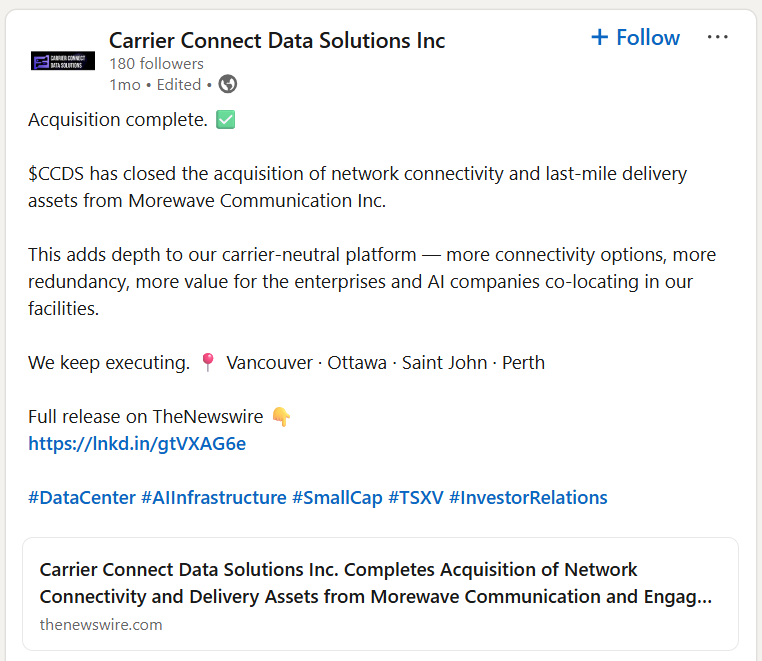
In May 2026, Carrier Connect closed its acquisition of Morewave Communication, a move that pushed the company beyond data centres and into network connectivity.
The logic is to stitch the sites together. Linking the centres lets a customer place servers in several cities at once, which improves backup and cuts latency, the lag a user feels when data has to travel a long way.
"What Morewave lets us do is network all of our data centres together," Binns said. "It gives us a new product to sell, and it gives our customers the ability to network everything together."
The empty racks are the upside

Several of Carrier Connect's sites run well below capacity. The Perth facility, for one, sits at roughly 15 to 20% utilization.
For most businesses, empty space is dead weight. Here, it is built-in growth, because filling racks that already exist costs very little new capital. Management is targeting about $10 million in annualized revenue by the end of 2026, with the portfolio capable of roughly $12 million at full utilization and profit margins of 30 to 40% once the network runs near capacity.
To get there, the company hired Mark Alexander as Chief Revenue Officer after its last financing, tasking him with direct sales and partner channels.
"There's a lot of demand in the industry," Binns said. "It's finding the right-size customer for the space we have left."
Skin in the game
Carrier Connect's leadership is invested alongside shareholders, and the share structure is unusually tight. The company's latest investor materials show roughly 32.8 million shares outstanding, with insiders holding about 15%.
Six and a half million of those shares are locked up for up to two years, and only about 26 million shares trade freely. Management also puts institutional ownership near 30%, leaving a small pool of stock changing hands day to day.
Binns and co-founder Johan Arnet say they buy their own stock consistently.
"We're very steady buyers of our own stock, Johan and I," Binns said. "We put our money where our mouth is."
Binns brings a public-market track record to the pitch, having built BIGG Digital Assets from a two-person startup into a billion-dollar company.
Where this is heading
The near-term plan is to reach 15 or more data centres by 2027, drawn from a deal pipeline the company describes as full. Management has set out a clear run of catalysts: adding a sixth and seventh data centre, filling unused space in Perth and Ottawa, and using its U.S. listing to court American investors.
From there, the path forks in two directions, both of which management views as wins. Carrier Connect either matures into a cash-generating, dividend-paying network, or it becomes an acquisition target for one of the multibillion-dollar operators that prefer to buy scale rather than assemble it.
"In two years, we're either already taken out by a larger player, or we've become a larger player and we're a cash-flowing, dividend-paying stock," Binns said.
The backdrop is moving in its favour. The global data-centre market is forecast to more than double, from about $138 billion in 2025 to over $360 billion by 2034, according to Precedence Research.
For investors, the appeal is a rare combination of hard, cash-flowing assets and an early-stage growth profile in a sector with few small-cap entry points. Carrier Connect is currently covered by Beacon Securities, which rates it a Buy with a $3.00 price target. Beacon has disclosed that it provided investment-banking services to Carrier Connect within the past year.
Near-term earnings will stay lumpy as deal costs work through the books, a normal feature of an aggressive roll-up. The question for the next year is simple: how quickly can Carrier Connect fill the space it already owns and add the sites it has lined up.
About Carrier Connect Data Solutions Inc.
Carrier Connect Data Solutions Inc.’s (TSXV: (CCDS.VN) | OTCQB: (CCDSF) | FSE: F5Z0) mission is to roll up Tier II/III data centres internationally that specialize in delivering co-location and data centre solutions to AI companies, service providers, enterprises and small businesses.
Learn more at carrierconnectds.com
Follow Carrier Connect on X and LinkedIn.
This article contains forward-looking information, including management’s revenue targets and growth projections, which are subject to risks and uncertainties. Actual results may differ materially, and readers should not place undue reliance on forward-looking statements.
The above is sponsored content. Barchart was paid up to two thousand dollars for placement and promotion of the content on this site and other forms of public distribution covering the period of June - July 2026. For more information please view the Barchart Disclosure Policy here.




/Micron%20Technology%20Inc_%20logo%20on%20building-by%20vzphotos%20vis%20iStock.jpg)