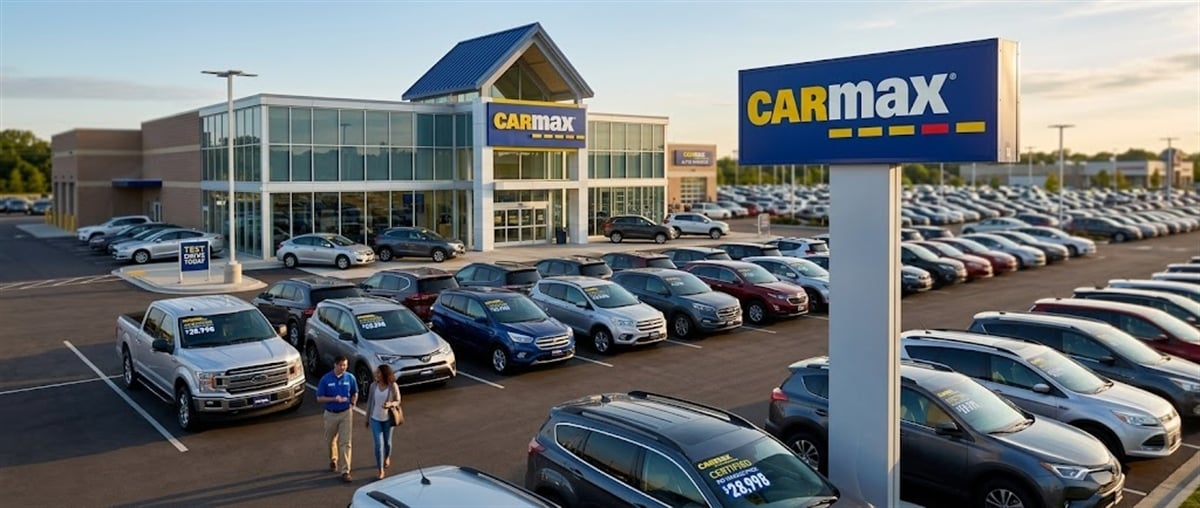
CarMax (NYSE: KMX) entered a market reversal earlier this year asc it transitioned to a new CEO and activist investors took positions. The story now is that Keith Barr’s four-pillar strategy to increase volume, improve digital sales, add value on each transaction, and drive efficiency is gaining traction.
The question is whether CarMax can preserve its cost savings and return to profitable growth in the coming quarters, and the early signs are encouraging. In this environment, CarMax remains in the middle of an evolving catalyst, with the stronger signal—sustained operational improvement—still to come.
CarMax Outperforms in Q1, First Report With New Ceo
CarMax faced headwinds in Q1 fiscal year 2027 (FY2027), including uneven consumer demand and affordability pressure, but performed well, with unit volume increasing by 3.3% across the system.
Revenue grew by 6% to just over $8 billion, outperforming expectations by more than 780 basis points. Segmentally, wholesalers did the heavy lifting, with units up 8% compared to a basically flat retail side.
Lower relative pricing aided the strength and is reflected in the margin. The company managed to reduce selling, general, and administrative (SG&A) expenses and improve efficiency on a per-unit basis, but gross margin impairment offset these gains. The takeaway is that gross profit declined by nearly 5%, net margin contracted by approximately 50 basis points despite an improvement in SG&A, and GAAP earnings declined.
The offset is that earnings per share (EPS) of $1.31 outpaced consensus by a wide 34-cent margin, providing sufficient cash flow to sustain operations and maintain balance sheet quality. CarMax's balance sheet carries debt, but it did not provide any red flags for investors.
The company does not provide specific guidance on operational metrics, but it did offer color on what to expect this year. As it stands, the focus is on improving sales and customer satisfaction, which will put pressure on margins. That trade-off is important for investors to watch. Lower asking prices can help rebuild unit volume, while continued investment in digital services may weigh on profitability until those efficiencies scale.
Among the critical Q1 takeaways, however, are the 84% of retail unit sales supported by digital capabilities and 14% online retail sales, with digital channels central to reducing time-to-close, improving customer outcomes, and supporting longer-term operating efficiency.
Analyst Sentiment Trends Key to CarMax’s Stock Price Outlook
Analyst sentiment is central to CarMax’s 2025 stock price decline and 2026 rebound.
After price target cuts and weaker coverage weighed on KMX in 2025, the tone in 2026 has shifted toward cautious optimism as investors evaluate the CEO transition and early signs of operational improvement.
Analyst activity since February 2026 has included initiations, reaffirmed targets, and, more recently, price target increases that have helped stabilize the consensus estimate.
The consensus price target is around $42, below the current share price but aligning with the technical price floor put in place last year, and is likely to advance amid operational improvements and strengthen the expected catalyst.
Institutional trends look more bullish despite mixed activity over the trailing 12-month period. Selling outweighed buying in parts of 2025, but activity in the first half of 2026 suggests renewed accumulation. More importantly, the periods of accumulation and distribution align with CarMax’s price action, revealing group buying on dips and market support at the lower end of its trading range.
The likely outcome is that KMX's downside is limited, and institutional support will strengthen and advance in subsequent quarters.
CarMax Catalysts: There Is More Than One Coming Down the Pipe
CarMax has several catalysts coming down the pike, centered on its upcoming earnings reports. The reports are expected to show improvements, including cash flow and future profitability. Among the catalysts is the capacity for capital return, which centers on share buybacks.
CarMax paused share repurchases in the latest quarter, but prior buybacks have still reduced the company’s share count over the past year. A resumption of repurchases could become a bullish catalyst if earnings stabilize. Management is also expected to provide more details on its turnaround strategy later this year.
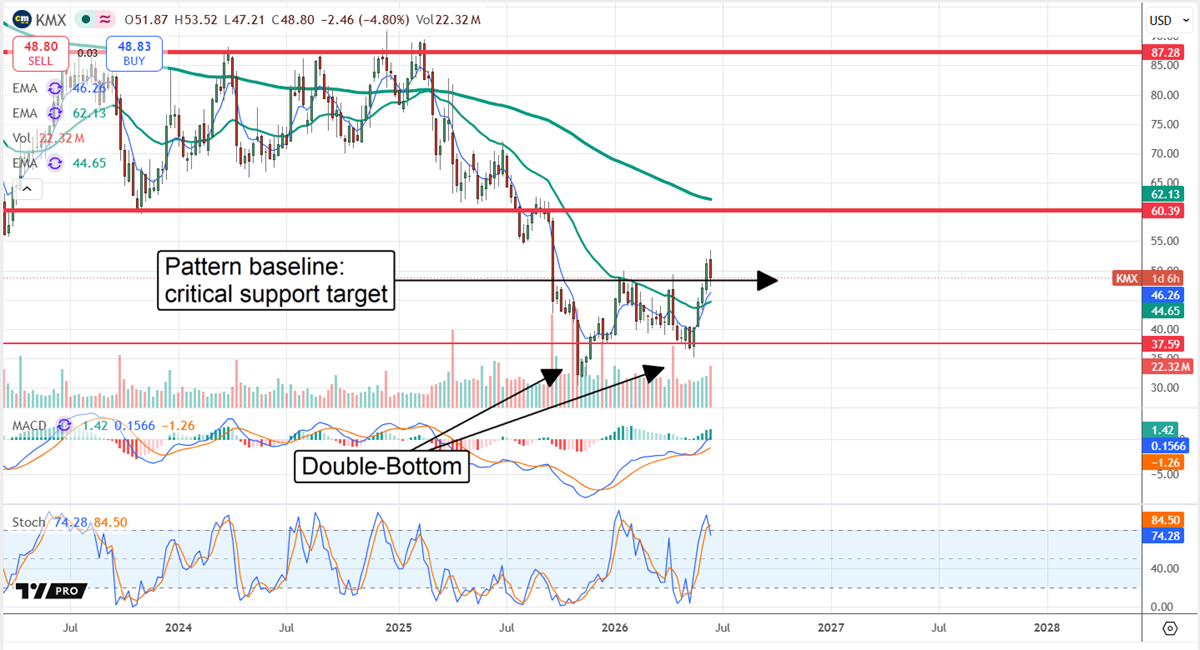
Chart price action is not bullish following the release. The market for KMX stock is down more than 5% and may continue to decline in the near term. The caveat is that this market appears in the midst of a Double-Bottom Reversal, and the mid-June pullback is testing critical support.
Assuming support holds, KMX shares could advance this summer, potentially reaching $70 by early Fall. If not, a move to retest recent lows near $37.50 is probable—lower lows are not expected to come this year.
Where Should You Invest $1,000 Right Now?
Before you make your next trade, you'll want to hear this.
MarketBeat keeps track of Wall Street's top-rated and best performing research analysts and the stocks they recommend to their clients on a daily basis.
Our team has identified the five stocks that top analysts are quietly whispering to their clients to buy now before the broader market catches on... and none of the big name stocks were on the list.
They believe these five stocks are the five best companies for investors to buy now...
The article "CarMax In Reverse? Why You Should Buy Now Before the Big Catalysts Emerge" first appeared on MarketBeat.

/A%20close-up%20of%20a%20SpaceX%20sign%20by%20Sundry%20Photography%20via%20Adobe%20Stock.jpeg)

/AI%20(artificial%20intelligence)/AI%20chip%20by%203Dsss%20via%20Shutterstock.jpg)