Sterling Caught Between Oil Shocks and a Patient BoE
Sentiment around the Pound, or Sterling as traders often call it, has been dictated almost entirely by two competing forces over the past month. The first is the energy backdrop stemming from the Middle East. On May 8, US and Iranian forces exchanged fire in the Strait of Hormuz, breaking a tenuous truce at the time and sending Brent crude futures up as much as 7.5 percent intraday before easing. That episode kept fears alive that disruption to the chokepoint, which normally carries roughly a fifth of global oil and gas flows, could keep imported energy costs elevated for the United Kingdom, a net energy importer. Sentiment shifted again on June 17, when Trump and Iranian President Masoud Pezeshkian signed a 14 point memorandum of understanding extending the ceasefire and calling for the Strait to reopen to maritime traffic, alongside a framework for sanctions relief and a reconstruction plan. If the agreement holds, it points toward easing energy price pressure rather than a sustained shock, though reports of domestic pushback in Washington and lukewarm public comments from Iran's supreme leader suggest the deal remains fragile.
The second force has been the Bank of England itself. The Monetary Policy Committee voted 8-1 to hold Bank Rate at 3.75 percent on April 30, with the lone dissenter actually favoring a hike rather than a cut, a sign that hawkish discomfort with the inflation outlook has been building beneath the surface. That backdrop carried into the June 18 decision, where the MPC again held rates at 3.75 percent. Just ahead of that meeting, traders digested a softer-than-expected UK inflation print, which briefly nudged Sterling lower as markets priced in slightly more room for the Bank to ease later this year. Governor Andrew Bailey has repeatedly said the Bank is in no rush to raise rates, even as its own projections show CPI inflation rising further into the third and fourth quarters before easing. The result has been a market sensitive to every headline out of the Gulf and every word from Bailey, with Sterling unable to build sustained momentum in either direction.
A third source of pressure has been domestic political instability. Prime Minister Keir Starmer has faced sustained pressure from within his own Labour Party, with more than ninety backbench MPs reportedly calling on him to resign or set out a departure timetable by mid-May. That pressure deepened in June, when disputes over the government's planned defence spending led to three resignations within the Ministry of Defence, including Defence Secretary John Healey. Investors have grown wary that continued leadership uncertainty could complicate the government's fiscal path, with UK gilt yields climbing to multi-year highs in May on related concerns, adding a layer of political risk premium on top of the energy and rate driven moves in Sterling.
What the Market Has Done
- The market is in an overall larger sideways consolidation range between 1.3781 (Daily level 1) and 1.3189 (Daily level 2), a range that has held since May 2025.
- In April, buyers responded firmly from 1.3162 and were able to bid prices back above 1.3474, the range midpoint and yearly VWAP.
- Despite that recovery, the market was unable to revisit 1.3781, the Daily level 1 and range high, and price subsequently fell back below 1.3474.
- In the past two trading days, the market has sold off aggressively, pulling Cable back down toward the lower boundary of the range and reviving focus on 1.3189 as the key pivot.
- This pullback reflects the broader macro tug of war, with lingering Hormuz related uncertainty even after the recent ceasefire memorandum, ongoing political noise around Starmer's leadership, and a cautious but not dovish Bank of England keeping two-way flow alive rather than producing a clean trend.
What to Expect in the Coming Weeks
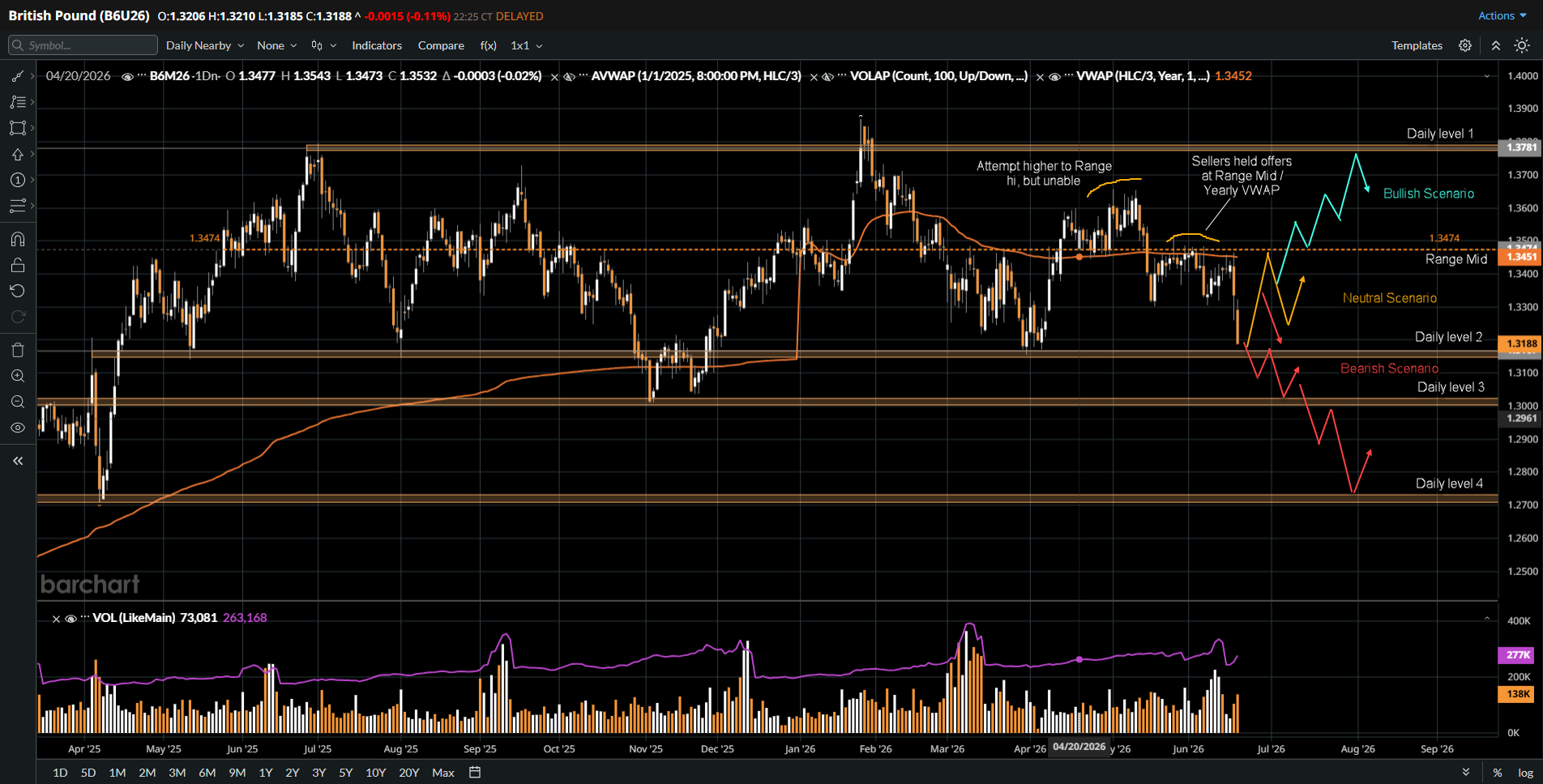
The key level to watch is 1.3189, the Daily level 2 and range low.
Neutral Scenario
- If buyers hold at 1.3189, expect a move back up toward 1.3451, the range midpoint.
- If sellers remain present at that midpoint, expect continued two-way rotation between 1.3189 and 1.3451
- This scenario is possible if the Iran ceasefire memorandum holds without fully resolving, the Starmer leadership situation stays unresolved but contained, and the BoE keeps its language unchanged at the next meeting.
Bullish Scenario
- If buyers reclaim and hold above 1.3474, the range midpoint and yearly VWAP, expect a move back up toward the 1.36 area, where sellers last held offers.
- If sellers are absent there, expect a further push toward 1.3781, the Daily level 1 and range high.
- A possible scenario that would likely support this scenario is US-Iran ceasefire memorandum holding and maritime traffic resuming smoothly, a stabilization in Starmer's leadership position that calms fiscal credibility concerns, and/or steady or firmer UK inflation data that keeps the BoE on hold.
Bearish Scenario
- If buyers fail to defend 1.3189, or a rotation up from that level is met with sellers stepping offers down to the 1.33 area, expect a move down toward 1.30 (Daily level 3).
- If buyers do not respond and reclaim prices back above 1.3189 quickly, expect further downside toward 1.273, the Daily level 4.
- This scenario would likely be triggered by the Iran ceasefire memorandum unraveling given reported domestic opposition in both the US and Iran, or by a renewed leadership challenge against Starmer that reignites fiscal credibility concerns and pushes gilt yields higher again.
Conclusion
Sterling's next move looks set to hinge on the interplay between geopolitical risk, monetary policy patience, and domestic political stability. A Bank of England that continues to hold steady while UK inflation cools, alongside a Starmer government that manages to stabilize its leadership position, would tend to support a recovery toward the range midpoint and beyond, while a breakdown of the newly signed Iran ceasefire memorandum or a fresh leadership crisis in Westminster could quickly tip the pound toward the lower levels outlined above. With price now testing the lower half of a year long range, the coming sessions around 1.3189 should offer an early read on which narrative is winning out. Traders watching Cable would do well to keep one eye on the MPC's tone, another on whether the Gulf ceasefire holds, and a third on Downing Street.
We believe that professional growth is impossible without the truth found in your own data. Our presence on Barchart bridges the gap between complex exchange data and professional execution. Open an Account and access the tools you need to see your performance clearly.
Disclaimer:
This article is provided for informational and educational purposes only and does not constitute financial, investment, or trading advice. The analysis presented reflects the author’s market observations and opinions at the time of writing and is not a recommendation to buy or sell any futures contract, security, or financial instrument. Futures trading involves significant risk and is not suitable for all market participants. Losses may exceed initial margin deposits, and market conditions can change rapidly.
Any scenarios, levels, or market expectations discussed are hypothetical in nature and are intended solely to illustrate potential market behavior. They do not represent actual trading results and should not be interpreted as guarantees of future performance. Past performance, market behavior, or historical price action are not indicative of future outcomes.
Readers are solely responsible for their own trading decisions and risk management. Always conduct independent research, consider your financial situation and risk tolerance, and consult with a qualified financial professional, if necessary, before engaging in futures or derivatives trading.

/A%20close-up%20of%20a%20SpaceX%20sign%20by%20Sundry%20Photography%20via%20Adobe%20Stock.jpeg)

/AI%20(artificial%20intelligence)/AI%20chip%20by%203Dsss%20via%20Shutterstock.jpg)