From Lab to Factory Floor: The ‘$68 Billion’ Structural Shift, Reshaping Every Industry
Physical AI: the convergence of embodied intelligence, adaptive robotics, and real-world perception is no longer a horizon technology. It is operational infrastructure. Companies that treat it as a future investment risk are already falling behind those treating it as present-day capital allocation.
Physical AI Is Moving from Experimentation to Infrastructure. Who Will Own the Next Industrial Layer?
For nearly a decade, experts spoke about AI as if it was entirely in the software world: models, algorithms, recommendation engines nested inside cloud computing infrastructure. That era is over. The primary story of AI for the next ten years will be the rise of machines, embodied in physical hardware, that can see, think, and act directly in the material world around them. It's physical AI. This involves the marriage of cutting-edge machine learning with robots and embedded sensors and the ability to control a machine in real time in unpredictable, unstructured environments.
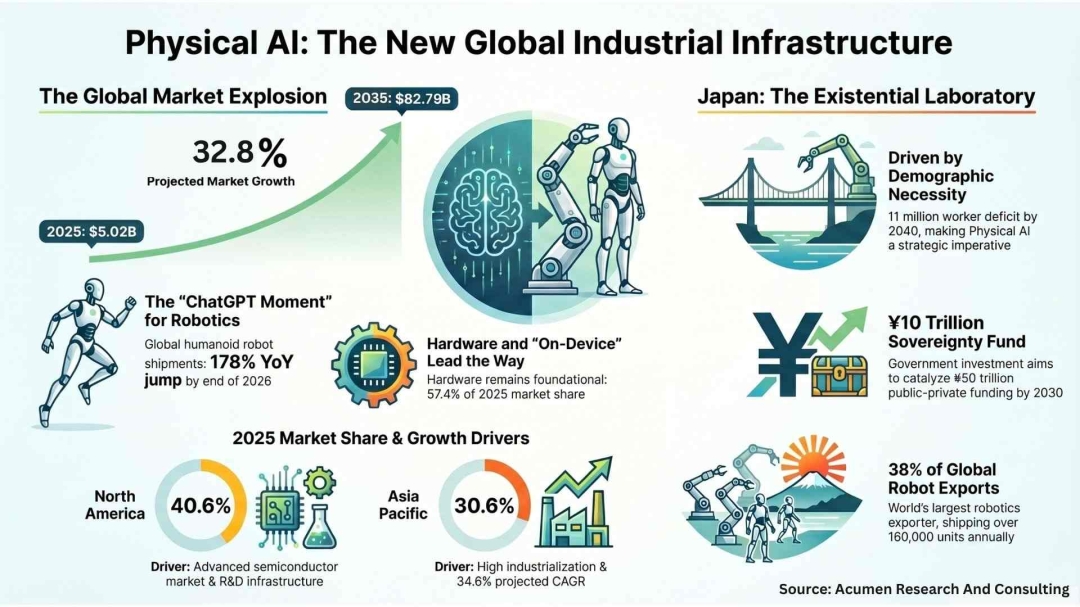
These figures alone warrant more than a passing glance; Acumen Research and Consulting’s analysis indicates that in 2025 the global physical AI market was sized at $5,021.2 million, projected to reach around $82,790.9 million by 2034, at a CAGR of 32.8% in the period 2025–2034.
NVIDIA CEO Jensen Huang announced at CES 2026, "The ChatGPT moment for robotics is here." Global humanoid robot shipments are poised to reach more than 50,000 units by the end of 2026-a 178% jump year-over-year from the approximate 12,000 shipped in 2025.
For manufacturers, logistics operators, healthcare providers, and defense contractors, this convergence is not a distant scenario to model in a five-year strategic plan. It is the present-day operating reality shaping capex decisions, workforce design, and competitive positioning. The robotics industry recorded a landmark €38.5 billion in venture funding in 2025, accounting for 9% of all global venture capital deployed that year.
Japan: The World's Most Instructive Physical AI Laboratory
A demographic imperative and an engineering heritage to make Japan the market's most consequential proving ground.
- Japan possesses a robot density of 419 robots per 10,000 workers in manufacturing and ranks as the top fivemost automated countries. The country holds an active industrial robot installed base of 435,000 units and install over 50,000 units per year, approximately 12% of global robot installations. These advanced robot densities are necessary given the fact that Japan's working population is expected to decrease by over 11 million in 2040. Physical AI has become extremely strategic for Japan.
- In 2024, Japan was one of the largest robotics exporter, providing 38% of the worlds industrial robots (over 160,000 units in 2024) with a robotics equipment export value of over 1.9 trillion (USD 12.5 billion) toward countries including China, the United States and Germany. Fanuc Corporation has about 20% market share in the global CNC and factory automation market. Yaskawa Electric Corporation sells over 25,000 units of servo driven robotic system a year.
- In November 2024, the government of Japan planned a 10 trillion investment fund centered on AI, Semiconductors, and robotics infrastructure, which is one of the largest industrial technology investment packages in Japanese history. About 3.9 trillion has been allocated for the nation's domestic semiconductor fabrication and AI chip production, and over 1.2 trillion for robotic R&D, automation system, and edge AI implementation. Japan also seeks to boost the total AI related public-private investment by over 50% by 2030 under the new strategy for enhancing industrial competitiveness.
Why Japan Is Different: The Demographic Imperative
Most countries treat physical AI as an efficiency lever. Japan treats it as an existential necessity. The country's population has declined for 14 consecutive years as of 2024. Today, working-age individuals constitute just 59.6% of the total population, a share projected to shrink by approximately 15 million people over the next two decades.
“According to the experts at Acumen Research and Consulting,the Japan physical AI market was valued at $307.30 million in 2025, expected to reach around $6764.02 million by 2035; the market is expected to grow at a CAGR of 36.2% during the predicted timeframe of 2026-2035.”
This is not a policy abstraction. Japan's automotive industry alone installed approximately 13,000 industrial robots in 2024, an 11% year-over-year increase and the highest single-year figure since 2020. Robotics orders in Japan hit a record ¥324.5 billion in Q1 2025, a 14.2% year-over-year gain. Industrial robot orders in a single quarter reached ¥271.4 billion. These are not speculative pipeline numbers; they are confirmed purchase orders.
What Is the Government Actually Spending and Where?
Japan's public commitment to physical AI has moved decisively from policy declaration to financial deployment. In November 2024, Prime Minister Ishiba announced a ¥10 trillion ($65 billion) investment fund for AI and semiconductor industries. This fund is explicitly structured to catalyze over ¥50 trillion ($327 billion) in combined public-private investment by 2030, making it one of the largest coordinated industrial-technology funding mechanisms in any democracy's recent history.
In December 2025, the Cabinet approved Japan's Basic National AI Plan; the first national framework to formally designate Physical AI and humanoid robotics as sovereign strategic priorities. This matters because it shifts capital allocation from discretionary corporate R&D to nationally coordinated investment programs. The Ministry of Economy, Trade and Industry (METI) separately allocated ¥48 billion ($ 320 million) for robot R&D programs across the 2025–2027 fiscal cycle.
In April 2025, METI announced an additional ¥150 billion subsidy for next-generation robotics R&D. The Cabinet Office's Moonshot R&D Program, Goal 3, funds foundational research aimed at creating "AI robots that autonomously learn, adapt to their environment, and act alongside human beings by 2050."
Japan's updated National Robot Strategy 2.0 sets binding targets: double service-sector robots by 2028, establish global leadership in human-robot coexistence standards, and build a domestic robot integrator workforce of 50,000 certified professionals. The Society 5.0 national initiative formally identifies robotics and AI as core instruments for addressing demographic decline while maintaining quality of life.
Japan's Corporate Ecosystem: The Companies Setting the Agenda
Company | Financial / Market Data | Strategic Significance in Physical AI |
Fanuc Corporation | FY2025 revenue: ¥857.8B ($ 4.8B); Robot division: ¥378.6B |
|
Yaskawa Electric Corporation | FY2024 revenue: ¥575.6B (USD 3.7B) |
|
Harmonic Drive Systems | Orders projected to grow 2–3x (2025–2027) |
|
Preferred Networks | Total capital raised: USD 2.6B |
|
Cyberdyne Inc. | HAL exoskeleton globally certified |
|
Does Japan's 2040 Ambition Add Up?
Japan has officially announced a goal of capturing 30% of the worldwide physical AI market by 2040. This is within reach given recent investment levels-but not assured. Already Japan captures 38% of worldwide robot production; their five largest manufacturers-FANUC, Yaskawa, Kawasaki, DENSO, and Mitsubishi Electric-together account for more than 40% of the global shipments of industrial robots.
Fanuc, Yaskawa, Sony and Toyota alone have a combined automation R&D spend of >$2 billion/year, not counting the money injected via the government programs described below. Japanese VCs poured $420M into robotics start-ups in 2025 versus $280M in 2023, an increase of 50% over two years. In 2024, Microsoft pledged $2.9 billion in cloud and AI investments in Japan, including AI and robotics research labs.
Regional Distribution: North America's Lead vs. Asia-Pacific's Velocity
- The North American market dominated the physical AI market and was the largest market in 2025, accounting for 40.6% share. The increasing adoption of AI and well-established R&D infrastructure along with the well-developed semiconductor market allowed North America to retain the top position. In the U.S., companies such as NVIDIA Corporation, Intel Corporation and Qualcomm Incorporated played major roles in driving growth and Amazon operated over a million robots that are essential for delivering close to 75% of their orders.
- Considering the forecast period, Asia Pacific is observed to grow at 34.6% CAGR, the region also held a significant share of 30.6% in 2025 due to high industrialization, widespread implementation of robots and increasing focus of the government to promote AI across the region such as in China, Japan, and South Korea. AgiBot alone captured 39% share in the China's humanoid robot market in 2025 and shipped 5100 units showing dominance of the region in the Physical AI deployment.
Which Segment Should Operators Bet On and Why Does the Answer Depend on Your Time Horizon?
Segment | Share / Growth | Key Insights |
By Component | Hardware dominated with 57.4% share in 2025 | Hardware remains the foundational layer of Physical AI because every intelligent machine requires high-performance sensors, edge processors, AI accelerators, motion controllers, LiDAR systems, and embedded chips to function in real-world environments. A single advanced humanoid robot can integrate over 30–50 sensors and more than 200 semiconductor components, making hardware the highest-value layer. |
By Robot Type | Industrial robots held 38.6% share in 2025 | Industrial robots dominate because manufacturing remains the earliest and most scalable commercialization pathway for Physical AI. These robots are increasingly deployed for welding, assembly, painting, material handling, and quality inspection, improving throughput by 20–40% while reducing operational defects by up to 30%. |
By Application | Manufacturing & automotive held the largest share of 23.1% in 2025 | Manufacturing and automotive continue to lead due to large-scale deployment of intelligent robotics across production lines, predictive maintenance, digital twins, and supply chain optimization. Automotive plants now deploy robot densities exceeding 1,500 robots per 10,000 workers in highly automated markets like Japan and South Korea. |
By Deployment | On-device segment led the market with 52% share in 2025 | The segment led owing to its high reliability, accountability and capability of quick decision making, especially for sectors including defence, healthcare and industrial automation. |
By Technology | Computer vision held the dominant share while holding 42.4% in 2025 | Being the dominant one, computer vision is observed to be one of notably growing segments as it offers essential capabilities of inspecting and navigating environments. Object detection, manipulation and quality control are few other applications of computer vision. |
The Software Platform Race in Physical AI Market:
The most impactful battle of the competition for the physical AI market is not being waged on hardware. Instead it is being waged on the software stack that govern how the robots learn, how they adapt and how they receive updates to models in scale. Cervicorn Consulting's analysis on the physical AI market estimates that software layer orchestration, simulation based learning and foundation models will form the vast majority of the value creation over the next decade and that businesses are shifting their attention toward a scalable intelligence layer over isolated robotic hardware.
FANUC, Yaskawa, Universal Robots, KUKA, and Agility are all building on NVIDIA's stack, which means NVIDIA's royalty-like position across the ecosystem is consolidating rapidly. Industry players who have not yet evaluated their platform dependency on NVIDIA infrastructure should do so immediately. The time to negotiate favorable terms is before, not after, lock-in.
What Does This Mean for Businesses in the Upcoming Years?
Physical AI's market structure presents different strategic imperatives depending on where you sit in the value chain. For manufacturers and industrial operators, the key question is not whether to adopt but at what speed and via which platform partnerships. The upgrade cycle from conventional industrial automation to AI-adaptive systems is already underway operators who treat their installed robot base as an upgrade opportunity will generate faster ROI than those waiting for full hardware replacement cycles.
Media Contact
Company Name: Acumen Research And Consultng
Contact Person: Digvijay
Email: Send Email
Country: United States
Website: https://www.acumenresearchandconsulting.com/physical-ai-market
Press Release Distributed by ABNewswire.com
To view the original version on ABNewswire visit: Physical AI Market to Reach $82.8 Billion: How Japan Is Leading the Next Industrial Revolution

/Oracle%20Corp_%20office%20logo-by%20Mesut%20Dogan%20via%20iStock.jpg)
/NVIDIA%20Corp%20logo%20outside%20building-by%20BING-JHEN_HONG%20via%20iStock.jpg)
/Uber%20Technologies%20Inc%20logo%20outside%20offices-by%20Sundry%20Photography%20via%20iStock.jpg)
/Space%20Technology%20by%20Rini_%20com%20via%20Shutterstock.jpg)