



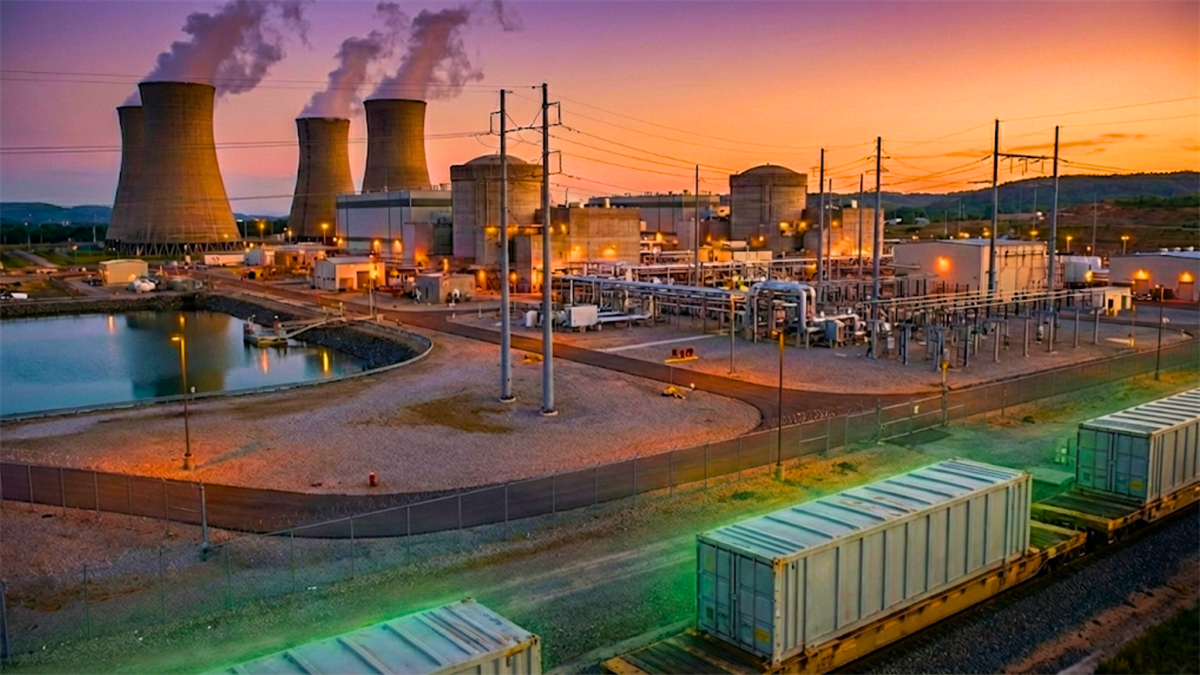
Perhaps the most notable consequence of the proliferation of artificial intelligence (AI)—beyond the now-ubiquitous generative chatbots—is the technology’s voracious appetite for energy. Most notably, the gradual suffusion of data centers across the United States has resulted in skyrocketing utility bills for everyday Americans.
AI’s growing energy needs are adding pressure to global power systems. The International Energy Agency (IEA) estimates that data centers, which support much of AI model training and deployment, now account for about 1.5% of global electricity consumption, with demand projected to grow by about 15% per year through 2030.
The most prominent solution to that AI-induced energy demand issue is a revival of the nuclear energy industry—specifically, the use of small modular reactors (SMRs), which could provide electricity to data centers while alleviating the stress on electrical grids and, potentially, consumers.
While that’s good news for pre-revenue startups operating in that space like microreactor designer NuScale Power (NYSE: SMR), it is even better news for the United States’ largest uranium producer.
As AI Energy Demand Skyrockets, Nuclear Is Increasingly Seen as the Solution
The IEA also found that while AI use broadly accounts for just a fraction of global consumption at current rates, AI-focused server demand requires more electricity and is projected to increase by approximately 30% per year by the end of the decade.
Over the next five years, renewables are expected to meet half that additional demand, “followed by natural gas and coal, with nuclear starting to play an increasingly important role towards the end of this decade and beyond,” according to the IEA.
That projected growth is also supported in industry consultancy firm Grand View Research’s outlook for the global nuclear energy industry. The nuclear energy market was $176.6 million in 2021. Grand View’s findings indicate that market could reach $346 million by 2033, registering a compound annual growth rate of 4.9% from 2026 to 2033.
By the end of that forecast period, SMRs are expected to play an increasingly larger role as a source of reliable, uninterrupted energy that can also help achieve decarbonization goals and justify investments in reliable baseload power generation.
Grand View Research points to the growing use of small modular reactors, advanced reactors and nanonuclear technologies as key drivers of new market opportunities.
The firm also expects government support for energy security, reactor life-extension efforts and low-carbon infrastructure investment to help fuel long-term global growth.
For shareholders of Uranium Energy (NYSEAMERICAN: UEC), a mining and exploration company focused on the development and production of uranium through in-situ recovery (ISR) methods, that is the type of long-term tailwind that makes the stock a buy-and-hold.
This Mid-Cap Company’s Growth Is Positioning It for the Emerging Nuclear Megatrend
With its 2021 acquisition of Uranium One Americas as well as the addition of Rio Tinto (NYSE: RIO)’s Wyoming portfolio in late 2024, Uranium Energy has positioned itself as the largest domestic uranium mining company in the United States.
That expansion has been reflected in the company’s growth.
Since 2022, the company’s revenue has grown from just over $23 million annually to nearly $67 million in 2025—an increase of nearly 189%. During that time, shares of UEC have surged. The stock is up nearly 315% over the past five years and more than 120% just in the past year.
But more impressively than its recent stock performance, the company’s balance sheet discipline and liquidity have it uniquely positioned for what it—outlooks from the IEA and Grand View Research—expect to be a surging demand for nuclear reactor-grade uranium.
That backdrop matters because the IEA and Grand View Research both point to a larger long-term role for nuclear power, and Uranium Energy is entering that environment with significant liquidity, no long-term debt, and direct exposure to the uranium market.
Uranium Energy ended Q2 FY2026 with:
More than $486 million in total cash
Around $818 million in liquid assets
Zero long-term debt
1.456 million pounds of low-enriched uranium (LEU)
That last facet is critically important. The company uses an unhedged inventory model, meaning it keeps its inventory exposed to market risks—like fluctuating commodity prices, exchange rates, or supply disruptions—without using financial contracts to offset potential losses.
In turn, Uranium Energy’s unhedged 1.3 million-pound stockpile of LEU is a bet on the radioactive metal’s spot price. According to TradingEconomics, earlier this year, the price per pound of uranium challenged its all-time high set in January 2024, specifically driven by “interest in nuclear power by governments and power-hungry AI hyperscalers that develop data centers.”
At around $85 per pound, the spot price of uranium is currently around 260% higher than it was at the start of January. That means Uranium Energy’s inventory is valued at nearly $124 million.
Uranium Energy’s Recent Success Serves as a Bellwether for the Industry
The company’s ecologically friendly and cost-efficient IRS extraction methods continue to help margin expansion. In its fiscal Q2, Uranium Energy reported nearly 46,000 pounds of LEU produced at a cumulative cash cost of $30.52 per pound.
That aligns with management efforts to focus on domestic nuclear fuel security as part of a strategic alignment with strengthening U.S. policy support and anticipated structural supply deficits, according to CEO Amir Adnani’s Q2 earnings call comments.
Adnani added that Uranium Energy sold 200,000 pounds of uranium during the quarter at $101 per pound, or approximately 25% above the quarterly average price of $80 per pound.
“Our strategy has been consistent,” he said. “Maintain a strong balance sheet, hold physical uranium inventory, and sell opportunistically when pricing supports value creation for shareholders.”
Notably, the company’s unhedged inventory management is indicative of the opportunities in the broader uranium market. “We continued advancing the broader strategy that underpins UEC's long-term growth, expanding beyond mining into refining and conversion to help address both a critical and structural gap in the U.S. nuclear fuel cycle,” Adnani said.
Where Should You Invest $1,000 Right Now?
Before you make your next trade, you'll want to hear this.
MarketBeat keeps track of Wall Street's top-rated and best performing research analysts and the stocks they recommend to their clients on a daily basis.
Our team has identified the five stocks that top analysts are quietly whispering to their clients to buy now before the broader market catches on... and none of the big name stocks were on the list.
They believe these five stocks are the five best companies for investors to buy now...
The article "AI's Power Crunch Is Putting Uranium Energy Back on Investors' Watchlists" first appeared on MarketBeat.


/Nvidia%20logo%20by%20Konstantin%20Savusia%20via%20Shutterstock.jpg)
/Space/Rocket%20launch%20by%20Alones%20via%20Shutterstock.jpg)
/Apple%20logo%20on%20store%20front%20by%20frantic00%20via%20iStock.jpg)