
Another week for Palantir Technologies (NASDAQ: PLTR) that can be summed up as the more things change, the more they stay the same. PLTR is down 12% in 2026, and many retail investors (if you believe the online chatter) are bailing on the stock.
Palantir was a rebellious stock that refused to grow into its valuation over the last two years. It’s starting to do that, and now some investors are convinced the stock’s best days are behind it. Well, if you define best days as 10x returns, that may be true.
But the company that investors are buying now has performance that supports a long-term bull case. If that’s the case, then buying the stock at these levels may be a gift that won’t be fully appreciated for several years.
Cantor Fitzgerald Delivers a Backhanded Compliment
Palantir got a quiet but meaningful vote of confidence on May 22, when Cantor Fitzgerald hosted CFO David Glazer and Chief Architect Akshay Krishnaswamy for an investor meeting.
Cantor came away incrementally more bullish on Palantir's positioning to benefit from secular AI growth trends in both U.S. Commercial and Government markets. The firm noted Palantir continues to gain traction as a leading ontology and orchestration layer for Enterprise AI, using large language models (LLMs) and the company's unique FDE (Federated Data Environment) go-to-market motion to create a deterministic, continuously updating data analytics system governing enterprise operations.
Palantir's Ontology acts as a real-time digital twin, integrating operational data, workflows, security, APIs, and human inputs to ground AI-driven decisions and agentic workflows in an enterprise context.
The firm pointed to Palantir's 84% gross margin and 68% revenue growth over the past 12 months. And yet, Cantor kept its Neutral rating and $138 price target because the stock looks expensive.
This is notably conservative compared to peers—other firms, including Citigroup and Rosenblatt, recently raised their targets to $225, following Palantir's strong Q1 results with earnings per share of 33 cents on $1.633 billion in revenue, both topping estimates.
It would seem that Cantor is more impressed with Palantir's AI platform story than before, but the valuation gap between its $138 target and the bull camp's $225–$230 targets reflects a real divide on Wall Street about how much to pay for that growth.
The Chart Tells a Cautious Story
For investors who follow price action, PLTR's chart adds another layer of complexity to an already nuanced fundamental picture. After peaking near $210 in mid-November 2025, the stock collapsed sharply to a low around $120 by late January—a steep decline that created what technical analysts call a "flagpole." Since then, PLTR has slowly ground higher in a choppy, narrow range between roughly $125 and $145, a consolidation that has now stretched for nearly three months.
That pattern has the look of a bear flag—one of the more reliable bearish continuation setups in technical analysis. The structure forms when a sharp decline is followed by a slow, low-conviction drift higher, before sellers re-engage and push the stock to new lows. The longer the flag flies without a breakout to the upside, the more it tends to favor the bears.
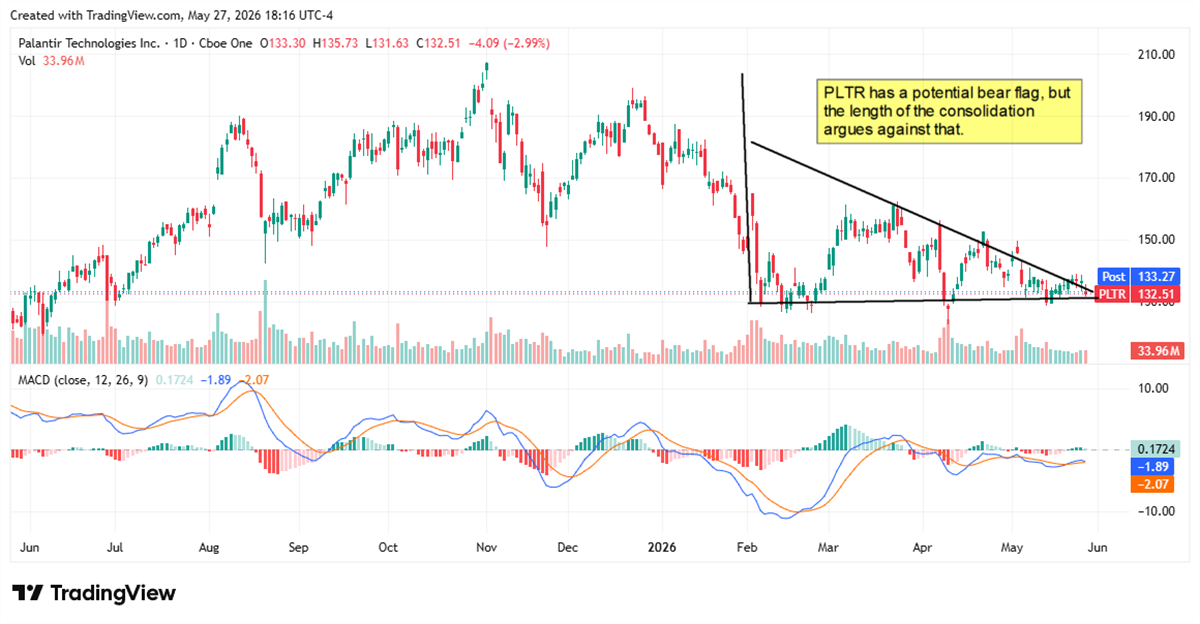
Wednesday's session itself was telling—the stock tagged an intraday high of $135.73 before sellers stepped in hard, pushing it back down to close at $132.51, a loss of nearly 3% on the day. That kind of rejection near resistance is exactly the type of price action bears watch for.
The key support level to monitor is around $130, which corresponds to a horizontal zone that has held multiple times over recent months. A decisive close below that level would technically confirm the bear flag breakdown and open the door toward a retest of the February lows near $120. On the upside, the $135 to $138 zone represents both near-term chart resistance and, notably, the exact price target Cantor Fitzgerald assigned this week—a level that may prove easier to defend in analyst models than on a candlestick chart.
None of this means the bull case is broken. Fundamentally, Palantir remains one of the more compelling AI infrastructure stories in the market. But for investors eyeing an entry, the chart suggests patience may be rewarded. A clean hold of $130 and a reclaim of $140 would go a long way toward neutralizing the bearish technical setup and giving the long-term thesis room to breathe.
Don’t Pass on PLTR Without Knowing Why
Palantir is not a stock for investors looking for excitement or a quick win. The days of triple-digit annual returns are almost certainly in the rearview mirror, and anyone expecting that kind of ride again is likely to be disappointed.
What remains is something arguably more valuable—a company with a defensible AI platform, expanding margins, and a growing footprint in both government and enterprise markets. The stock is cheaper than it was six months ago, but it is still not cheap by conventional measures, and the chart suggests the path of least resistance may still be lower before it is higher.
For patient, long-term investors willing to look past near-term volatility and a valuation that will never satisfy the skeptics, current levels could look like a reasonable entry point in hindsight. For everyone else, there are flashier trades out there. But don’t be surprised if PLTR quietly compounds while you are chasing them.
Where Should You Invest $1,000 Right Now?
Before you make your next trade, you'll want to hear this.
MarketBeat keeps track of Wall Street's top-rated and best performing research analysts and the stocks they recommend to their clients on a daily basis.
Our team has identified the five stocks that top analysts are quietly whispering to their clients to buy now before the broader market catches on... and none of the big name stocks were on the list.
They believe these five stocks are the five best companies for investors to buy now...
The article "Palantir Stock Faces Technical Pressure Despite Strong AI Growth" first appeared on MarketBeat.

/Microsoft%20Corporation%20logo%20on%20sign-by%20Jean-Luc%20Ichard%20via%20iStock.jpg)
/Dell%20Technologies%20by%20Poetra_RH%20via%20Shutterstock.jpg)