

Missiles, Margins, and Megawatts: What Is Driving the Copper Tape
The dominant macro narrative behind copper's recent bid has been the sustained build-out of AI data center infrastructure, which has materially raised the demand ceiling for the metal. Individual hyperscale facilities are estimated to require up to 50,000 tonnes of copper for wiring, grounding, and cooling alone, and with over $600 billion in data center expansion planned globally for 2026, this demand vector is structural rather than cyclical.
On the supply side, Codelco, the Chilean state miner responsible for nearly 10% of global copper production, continues to face significant headwinds. The company has flagged approximately $2 billion in targeted cost reductions, raising concerns about a further pullback in output at a time when global refined copper supply is already running a deficit. Chile's broader production challenges, combined with the ongoing fallout from the July 2025 rock-burst incident at El Teniente that killed six workers and cut August output by 25%, have kept the supply outlook tight heading into the second half of 2026.
Geopolitically, the US-Iran conflict that began on February 28, 2026,, has remained a key market sensitivity. While Comelx copper is not directly supply-exposed to Iran, the Strait of Hormuz closure has introduced meaningful shipping disruptions and input cost concerns, particularly around sulfuric acid used in copper refining. As of this week, however, US and Iranian delegations have reached a tentative agreement, with the deal structured in two phases. Phase one would see Iran reopen the Strait of Hormuz and provide nuclear non-proliferation assurances in exchange for the unfreezing of up to $24 billion in Iranian assets. US Secretary of State Marco Rubio noted "some good signs" on a peace deal last week, though the US military still carried out self-defense strikes against Iranian missile launch sites on May 25, complicating the path to a signed agreement. Markets responded positively to the peace momentum, with copper extending gains to around $6.40 as of Wednesday, May 28, with bulls pricing in a reduction of the Middle East risk premium.
Section 232 copper tariffs modified effective April 6, 2026, under a Presidential Proclamation signed by Trump, continue to be a source of price distortion, having pulled forward significant refined copper imports into the US in anticipation of higher duties. This has tightened global availability outside the US while elevating domestic stockpiles.
What the Market Has Done
- From January through mid March, the market auctioned two ways within a broad sideways range between 6.15 and 5.60, forming Auction Block 1.
- During the second half of March, sellers briefly forced prices below 5.60 and into the 5.20 area. However, the market failed to accept lower prices, triggering a sharp short squeeze back into Auction Block 1.
- The recovery ultimately carried price back toward 6.15, which is the upper boundary of Auction Block 1.
- At the beginning of May, buyers stepped up bids around 5.95, an area that aligned with both the midpoint of Auction Block 1 and the 2026 yearly VWAP.
- That successful defense established a higher low and reinforced buyer control of the broader structure.
- During the second week of May, the market achieved an important technical milestone by breaking above and accepting above 6.15, converting prior resistance into support.
- More recently, rotational selling pressure brought price back toward 6.15, where buyers once again stepped up bids and successfully defended the breakout area.
- From a market structure perspective, the repeated defense of 6.15 continues to suggest that participants are treating pullbacks as opportunities to accumulate rather than initiate fresh shorts.
What to Expect in the Coming Weeks
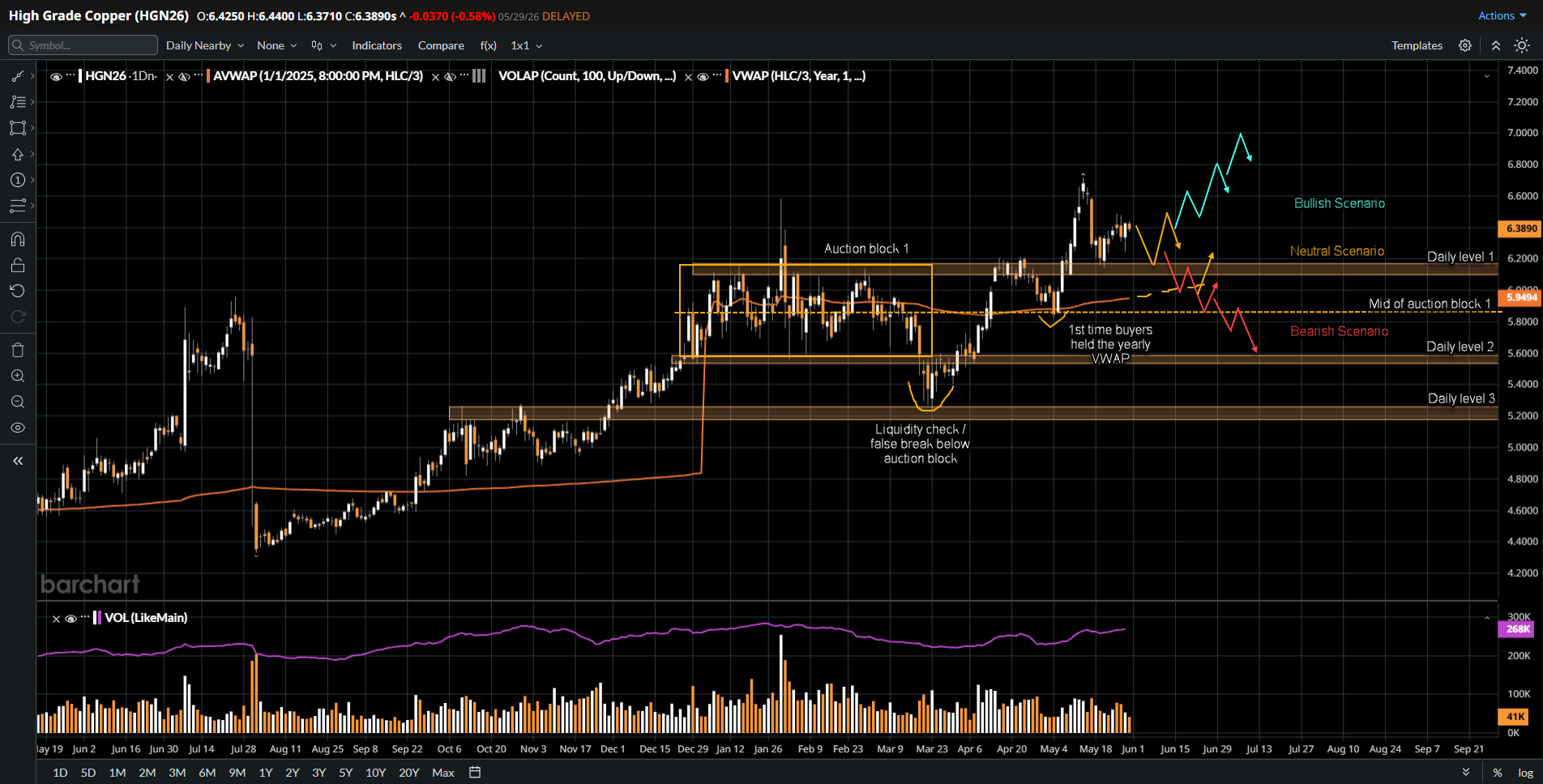
The key level to watch is 6.15 (daily level 1).
Neutral Scenario
- A possible two-way auction within the past week's range is the base case before directional resolution, with price oscillating between 6.15 and the 6.40 to 6.50 area as the market digests both the breakout and the still-unresolved US-Iran peace process.
- A possible macro scenario that supports this outcome would be US-Iran negotiations remaining in flux with no signed agreement, keeping a moderate geopolitical risk premium in the market while AI demand and Codelco supply headlines continue to underpin the bid at lower levels.
Bullish Scenario
- As long as buyers continue defending and holding above 6.15, the path of least resistance remains higher.
- Under this scenario, expect a move back toward the 6.716 swing high where sellers are likely to respond initially.
- If the market successfully accepts above that area, a continuation toward the psychologically important 7.000 level becomes increasingly likely.
- The possible macro trigger here would be a formal signing of the US-Iran peace agreement with the Strait of Hormuz confirmed reopened, which would reduce the geopolitical risk premium currently priced into the commodity complex and trigger a broader risk-on rotation into industrial metals. A reopened strait also restores Iranian oil flows, easing global energy costs and supporting industrial activity across the Gulf and broader emerging market economies, which feeds directly into the demand side of the copper equation. Combined with continued positive data on AI infrastructure spending from hyperscalers and any incremental headline confirming further Codelco output reductions, this confluence of demand recovery and supply constraint would reinforce the structural bull case.
Bearish Scenario
- If buyers fail to defend 6.15, expect a rotation lower toward the 6.00 area near the projected yearly VWAP.
- Buyers should respond quickly in this region to maintain the current bullish market structure.
- Failure to attract meaningful buying interest at 6.00 would expose the 5.95 midpoint of Auction Block 1.
- If that level also fails to hold, the market could rotate back toward 5.60, where buyers would be expected to mount a more significant defense.
- The macro trigger for this scenario would be a breakdown of US-Iran negotiations, a resumption of full-scale hostilities that re-closes the Strait of Hormuz, or a meaningful deterioration in Chinese demand signals, whether from a re-escalation in tariff policy following the November 2026 extension deadline or softer-than-expected industrial data out of Beijing.
Conclusion
HG copper is at an inflection point that is as much about the macro backdrop as it is about the chart. The technical structure is constructive, with the successful break and acceptance above 6.15 shifting the burden of proof to the bears. But the market remains sensitive to headline risk, particularly the trajectory of the US-Iran peace process and the timeline for the Strait of Hormuz reopening, both of which carry direct implications for geopolitical risk premium reduction and the broader industrial demand recovery outlook. Structurally, the convergence of AI-led demand, a tight Chilean supply picture, and a global energy transition that is nowhere near copper-sufficient makes the underlying fundamental case hard to dismiss. The question is whether bulls can hold 6.15 and turn it into a launchpad rather than a tombstone. How the market answers that question in the coming sessions will define whether the recent breakout was conviction or noise. Watch the tape at 6.15 closely.
We provide the infrastructure you need to quantify your discipline and ensure every decision is backed by the confidence of seeing exactly what drives your performance. Start trading with the clarity you deserve. Open an Account today.
Disclaimer:
This article is provided for informational and educational purposes only and does not constitute financial, investment, or trading advice. The analysis presented reflects the author’s market observations and opinions at the time of writing and is not a recommendation to buy or sell any futures contract, security, or financial instrument. Futures trading involves significant risk and is not suitable for all market participants. Losses may exceed initial margin deposits, and market conditions can change rapidly.
Any scenarios, levels, or market expectations discussed are hypothetical in nature and are intended solely to illustrate potential market behavior. They do not represent actual trading results and should not be interpreted as guarantees of future performance. Past performance, market behavior, or historical price action are not indicative of future outcomes.
Readers are solely responsible for their own trading decisions and risk management. Always conduct independent research, consider your financial situation and risk tolerance, and consult with a qualified financial professional, if necessary, before engaging in futures or derivatives trading.

/International%20Business%20Machines%20Corp_%20logo%20on%20phone-by%20rafapress%20via%20Shutterstock.jpg)
/Micron%20Technology%20Inc_%20logo%20on%20building-by%20vzphotos%20vis%20iStock.jpg)