



/NVIDIA%20Corp%20logo%20on%20phone%20and%20AI%20chip-by%20Below%20the%20Sky%20via%20Shutterstock.jpg)
Editor's note: Any and all references to time frames longer than one trading day are for purposes of market context only, and not recommendations of any holding time frame. Daily rebalancing ETFs are not meant to be held unmonitored for long periods. If you don't have the resources, time or inclination to constantly monitor and manage your positions, leveraged and inverse ETFs are not for you.
Investing in the funds involves a high degree of risk. Unlike traditional ETFs, or even other leveraged and/or inverse ETFs, these leveraged and/or inverse single-stock ETFs track the price of a single stock rather than an index, eliminating the benefits of diversification. Leveraged and inverse ETFs pursue daily leveraged investment objectives, which means they are riskier than alternatives which do not use leverage. They seek daily goals and should not be expected to track the underlying stock’s performance over periods longer than one day. They are not suitable for all investors and should be utilized only by investors who understand leverage risk and who actively manage their investments. The Funds will lose money if the underlying stock’s performance is flat, and it is possible that the Bull Fund will lose money even if the underlying stock’s performance increases, and the Bear Fund will lose money even if the underlying stock’s performance decreases, over a period longer than a single day. Investing in the Funds is not equivalent to investing directly in NVDA.
NVIDIA Corporation (Ticker: NVDA) remains the market’s biggest AI tell, with direct read-throughs for mega-cap tech, semiconductor momentum, and the durability of infrastructure spending. The company reports fiscal first-quarter 2027 results on May 20 after the close,1 and the setup is getting tighter by the day with the stock near 52-week highs.
Nvidia comes into the earnings after record quarterly revenue of $68.1 billion2 and a market that still treats Nvidia as the cleanest expression of the AI buildout. The stakes are even higher after reports that OpenAI missed internal growth and revenue targets, news that hit AI infrastructure names across the board.3
Nvidia’s Earnings Setup
Nvidia shares have been strong, which helps lift the indices because the stock is one of the largest in the U.S. by market cap. The fundamental backdrop also looks powerful for Nvidia.
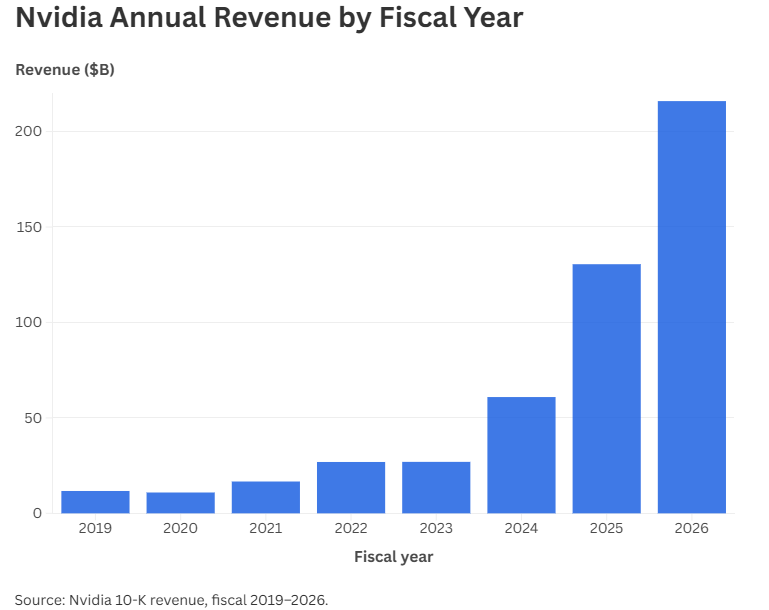
In the last earnings report, Nvidia CEO Jensen Huang said computing demand was “growing exponentially on agentic AI.” Huang added enterprise adoption of agents was “skyrocketing” and that customers are racing to invest in what he called the AI industrial revolution.2
China, meanwhile, is back in the bull-bear debate. Huang recently noted Nvidia’s market share of AI accelerators in China has dropped to zero.4 That sharpens the policy risk around export controls, end-market access, and future growth outside U.S. cloud giants.
Wall Street is setting a high bar for Nvidia’s upcoming earnings with a consensus earnings per share (EPS)* estimate of $1.77 a share for the quarter. Traders will be keeping their eyes on how both Nvidia and the broader tech sector react in a market that’s been highly resilient despite the U.S.-Iran conflict, rising oil prices, and concerns the AI trade is overdone.
Why Bulls like Nvidia
The bull case starts with scale. Nvidia is selling chips, systems, networking, software, and a developer ecosystem that customers already know how to use. That matters when cloud providers are racing to deploy capacity and when enterprise AI workloads are still moving from pilot projects to production.
Nvidia is still the center of gravity for large-scale AI infrastructure. The company’s most recent quarter showed 91.5% of sales coming from the Data Center segment, with networking revenue inside it up 263% year over year. This is a sign that the platform story is broader than the GPU business alone.5 If the May 20 earnings report shows that data center demand is still holding the line and management keeps the revenue ramp intact, traders have a fresh reason to treat recent AI jitters as noise rather than a regime change.
Nvidia’s Bear Case
A big part of the bear case for Nvidia revolves around if expectations are too high. Nvidia does not need a bad quarter to disappoint traders. A good quarter with softer guidance, margin pressure, or a less forceful AI demand message could still reset expectations. Investors will be listening closely to anything new from CEO Huang.
The recent disappointing results from OpenAI did not break Nvidia’s core thesis, but they did remind traders the AI complex is now big enough to react to second-order demand questions. If the market starts wondering whether infrastructure spending is outrunning near-term monetization, Nvidia will feel that pressure first because it sits at the top of the heap. That is especially true with the stock coming into earnings after a strong run and with consensus expectations high.
Rising competition is another potential headwind, even if it is not an immediate earnings problem. AI chip startups have raised $8.3 billion globally in 2026 as investors shift attention toward lower-cost deployment.6 Nvidia clearly still has scale, software, and cash, and it spent $18.5 billion on research and development in its latest fiscal year. Yet the market could get more selective on past winners like Nvidia and ask who may be best positioned for the next phase of the cycle.
Macro pressure remains part of the downside view as well. Oil prices are a key risk as traders monitor U.S.-Iran talks and limited Strait of Hormuz traffic. Higher energy prices won’t rewrite Nvidia’s earnings setup, but they can complicate rate expectations and risk appetite for the highest-beta parts of tech.7
How Traders Can Express Views on Nvidia, the Mag 7, and Semis
For traders focused on the single-name setup, the Direxion Daily NVDA Bull 2X ETF (Ticker: NVDU) and the Direxion Daily NVDA Bear 1X ETF (Ticker: NVDD) seek daily investment results, before fees and expenses, of 200% or 100% of the inverse (or opposite), respectively, of the performance of the common shares of NVIDIA Corporation.
If the focus is broader and the trade is really about how the print hits mega-cap AI leadership, the Direxion Daily Magnificent 7 Bull 2X ETF (Ticker: QQQU) and the Direxion Daily Magnificent 7 Bear 1X ETF (Ticker: QQQD) seek daily investment results, before fees and expenses, of 200%, or 100% of the inverse (or opposite), of the performance of the Indxx Magnificent 7 Index*.
And if the goal is to trade the sector reaction rather than Nvidia alone, the Direxion Daily Semiconductor Bull 3X ETF (Ticker: SOXL) and the Direxion Daily Semiconductor Bear 3X ETF (Ticker: SOXS) seek daily investment results, before fees and expenses, of 300%, or 300% of the inverse (or opposite), of the performance of the NYSE Semiconductor Index*.
What Traders Are Watching Next
Nvidia’s May 20 report lands as a referendum on AI spending, not just one company’s quarter. Things to watch include data center growth, guidance, gross margins, China commentary, and AI capex* spending.
If the quarter reinforces the demand outlook, Nvidia, the Magnificent 7, and semis could lead the way. If the reaction questions the durability of AI returns, traders may see a very different setup in short order.
1 Nvidia Investor Relations. https://investor.nvidia.com/events-and-presentations/events-and-presentations/default.aspx
2 Nvidia Announces Financial Results for Fourth Quarter and Fiscal 2026. https://nvidianews.nvidia.com/news/nvidia-announces-financial-results-for-fourth-quarter-and-fiscal-2026
3 CNBC, “OpenAI reportedly missed revenue targets. Shares of Oracle and these chip stocks are falling.” https://www.cnbc.com/2026/04/28/openai-reportedly-missed-revenue-targets-shares-of-oracle-and-these-chip-stocks-are-falling.html
4 Yahoo Finance, “Nvidia CEO Jensen Huang says company now has zero market share in China.” https://finance.yahoo.com/sectors/technology/article/nvidia-ceo-jensen-huang-says-company-now-has-zero-market-share-in-china-150805330.html
5 CNBC, “Nvidia reports earnings and guidance beat as AI boom pushes data center revenue up 75%.” https://www.cnbc.com/2026/02/25/nvidia-nvda-earnings-report-q4-2026.html
6 CNBC, “Nvidia AI chip rivals attract record funding as competition heats up.” https://www.cnbc.com/2026/04/17/nvidia-ai-chip-rivals-funding-euclyd-fractile.html
7 Thomson Reuters, “Oil prices hit two-week high as Iran talks stall and Strait of Hormuz shipments lag.” https://whbl.com/2026/04/27/oil-prices-hit-two-week-high-as-iran-talks-stall-and-strait-of-hormuz-shipments-lag/
*Definitions and Index Descriptions
Investing in a Direxion Shares ETF may be more volatile than investing in broadly diversified funds. The use of leverage by an ETF increases the risk to the ETF. The Direxion Shares ETFs are not suitable for all investors and should be utilized only by sophisticated investors who understand leverage risk, consequences of seeking daily leveraged, or daily inverse leveraged, investment results and intend to actively monitor and manage their investment. The Direxion Shares ETFs are not designed to track their respective underlying indices over a period of time longer than one day.
The Indxx Magnificent 7 Index (IFOTQ) is provided by Indxx and is designed to track the performance of seven of the leading NASDAQ listed companies, as identified by Indxx. The Magnificent 7 is comprised of the following companies: Apple, Alphabet, Microsoft, Amazon, Nvidia, Tesla, and Meta.
The NYSE Semiconductor Index (ICESEMIT) is a rules-based, modified float-adjusted market capitalization-weighted index that tracks the performance of the thirty largest U.S. listed semiconductor companies.
One cannot invest directly in an index.
Neither Rafferty nor the Direxion Daily Semiconductor Bull 3X ETF and the Direxion Daily Semiconductor Bear 3X ETF (the “Financial Products”) are sponsored, endorsed, sold or promoted by Interactive Data Pricing and Reference Data, LLC or its affiliates (“Vendor”). Vendor makes no representation or warranty regarding the advisability of investing in securities generally, in the Financial Products particularly, or the ability of the NYSE Semiconductor Index to track general financial market performance. VENDOR MAKES NO EXPRESS OR IMPLIED WARRANTIES, AND HEREBY EXPRESSLY DISCLAIMS ALL WARRANTIES OF MERCHANTABILITY OR FITNESS FOR A PARTICULAR PURPOSE WITH RESPECT TO THE INDEX OR ANY DATA INCLUDED THEREIN.IN NO EVENT SHALL VENDOR HAVE ANY LIABILITY FOR ANY SPECIAL, PUNITIVE, INDIRECT, OR CONSEQUENTIAL DAMAGES (INCLUDING LOST PROFITS),EVEN IF NOTIFIED OF THE POSSIBILITY OF SUCH DAMAGES.
Direxion Shares Risks – An investment in a Fund involves risk, including the possible loss of principal. Each Fund is non-diversified and includes risks associated with a Fund concentrating its investments in a particular security, industry, sector, or geographic region which can result in increased volatility. A Fund’s investments in derivatives such as futures contracts and swaps may pose risks in addition to, and greater than, those associated with directly investing in securities or other investments, including imperfect correlations with underlying investments or the Fund’s other portfolio holdings, higher price volatility and lack of availability. As a result, the value of an investment in a Fund may change quickly and without warning.
Leverage Risk – The Bull Fund obtains investment exposure in excess of its net assets by utilizing leverage and may lose more money in market conditions that are adverse to its investment objective than a fund that does not utilize leverage. A total loss may occur in a single day. Leverage will also have the effect of magnifying any differences in the Fund’s correlation with NVDA and may increase the volatility of the Bull Fund.
Daily Correlation Risk – A number of factors may affect the Bull Fund’s ability to achieve a high degree of correlation with NVDA and therefore achieve its daily leveraged investment objective. The Bull Fund’s exposure to NVDA is impacted by NVDA’s movement. Because of this, it is unlikely that the Bull Fund will be perfectly exposed to NVDA at the end of each day. The possibility of the Bull Fund being materially over- or under-exposed to NVDA increases on days when NVDA is volatile near the close of the trading day.
Daily Inverse Correlation Risk – A number of factors may affect the Bear Fund’s ability to achieve a high degree of inverse correlation with NVDA and therefore achieve its daily inverse investment objective. The Bear Fund’s exposure to NVDA is impacted by NVDA’s movement. Because of this, it is unlikely that the Bear Fund will be perfectly exposed to NVDA at the end of each day. The possibility of the Bear Fund being materially over- or under-exposed to NVDA increases on days when NVDA is volatile near the close of the trading day.
NVIDIA Corporation Investing Risk — NVIDIA Corporation faces risks associated with meeting the evolving needs of its large markets – gaming, data center, professional visualization and automotive – and identifying new products, services and technologies; competition in its current and target markets; changes in customer demand; supply chain issues; manufacturing delays; potential significant mismatches between supply and demand giving rise to product shortages or excessive inventory; the dependence on third-parties and their technology to manufacture, assemble, test, package or design its products which reduces control over product quantity and quality, manufacturing yields, development, enhancement and product delivery schedules; significant product defects; international operations, including adverse economic conditions; impacts from climate change, including water and energy availability; business investment and acquisitions; system security and data protection breaches, including cyberattacks; business disruptions; a limited number of customers; the ability to attract, retain and motivate executives and key employees; the proper function of its business processes and information systems; its intellectual property; and other regulatory and legal issues.
Semiconductor Industry Risk – Semiconductor companies may face intense competition, both domestically and internationally, may have limited product lines, markets, financial resources or personnel and may face risks related to the availability of materials.
Information Technology Sector Risk —The value of stocks of information technology companies and companies that rely heavily on technology is particularly vulnerable to rapid changes in technology product cycles, rapid product obsolescence, government regulation, and competition, both domestically and internationally, including competition from competitors with lower production cost.
Interactive Media & Services Industry Risk — The prices of technology and media companies, especially those of smaller, less-seasoned companies, tend to be more volatile and less liquid than the overall market. These companies are subject to rapid changes in technology and consumer platform preference, including the increased use of mobile-based apps, competition for advertising revenue, changes in audience preferences, evolving industry standards and frequent new product productions.
Retail Industry Risk – Retail and related industries can be significantly affected by the performance of the domestic and international economy, consumer confidence and spending, intense competition, changes in demographics, and changing consumer tastes and preferences.
Additional risks of each Fund include Effects of Compounding and Market Volatility Risk, Derivatives Risk, Counterparty Risk, Rebalancing Risk, Intra-Day Investment Risk, Industry Concentration Risk, Market Risk, Indirect Investment Risk, and Cash Transaction Risk. Additionally, for the Direxion Daily NVDA Bear 1X ETF, Direxion Daily Mag 7 Bear 1X ETF, and Direxion Daily Semiconductor Bear 3X ETF, Shorting or Inverse Risk. Please see the summary and full prospectuses for a more complete description of these and other risks of a Fund.
Distributor: ALPS Distributors, Inc.

/CPU%20Chip.jpg)
/Intel%20Corp_%20Santa%20Clara%20campus-by%20jejim%20via%20Shutterstock.jpg)
/Microsoft%20Corporation%20logo%20on%20sign-by%20Jean-Luc%20Ichard%20via%20iStock.jpg)

/A%20Palantir%20office%20building%20in%20Tokyo_%20Image%20by%20Hiroshi-Mori-Stock%20via%20Shutterstock_.jpg)