


When Geopolitics Turned the Macro Script Upside Down
The past month has delivered a complicated and at times contradictory macro picture for EUR/USD. The dominant driver has been the ongoing US-Iran war, which began on February 28, 2026, with joint US-Israel strikes on Iran. A Pakistan-brokered ceasefire on April 8 brought brief relief and helped fuel the euro's early April rally, but the truce collapsed quickly, and a US naval blockade on Iranian ports has since kept the Strait of Hormuz crisis firmly in focus. As of today, May 21, Iran's Foreign Ministry confirmed it is reviewing the latest US peace proposal, with Secretary of State Rubio noting "some good signs" toward a deal, though the IRGC has simultaneously warned of expanded war if further strikes occur. This tug-of-war between diplomacy and escalation is keeping sentiment highly reactive and oil prices elevated, which is directly feeding Eurozone inflation.
The macro data is reflecting that stress. Eurozone Q1 2026 GDP growth came in at just 0.1%, the weakest reading since Q2 2025, while Eurozone headline inflation climbed to 3.0% in April, its highest print since September 2023 and a full percentage point above the ECB's 2% target. This combination of stagflation-lite has forced the ECB into a hawkish pivot it was not expecting to make. At the April 30 meeting, the ECB held rates at 2.00% unanimously, but President Lagarde explicitly noted that a June rate hike was being actively debated, acknowledging the bank was "moving away" from its baseline scenario. A May Bloomberg survey of economists now forecasts two 25bps hikes from the ECB in June and September. Slovak ECB policymaker Peter Kazimir went further, describing a June hike as "virtually certain."
On the USD side, sentiment has faced its own weight. Moody's downgraded the US sovereign credit rating from AAA to AA1 on May 16, 2025, making it the last major agency to strip the US of a triple-A rating, and the fiscal narrative has only deteriorated further into 2026 with federal deficits projected near 7% of GDP annually. The DXY slipped following the downgrade, and broader dollar-bearish structural arguments around US fiscal credibility and Fed easing expectations have kept the greenback on the defensive at the margin. The pair is currently most sensitive to any development on the Iran ceasefire front, the upcoming June ECB decision, and the pace of US Treasury yield moves driven by the fiscal deterioration narrative.
What the Market Has Done
- 6E futures have remained in a broad range bound market between 1.186 and 1.150 since June 2025.
- The middle of the range near 1.168 has acted as a major pivot point since March and continues to define the current auction.
- In March, sellers were able to hold offers below 1.168, keeping the market contained beneath the range midpoint and maintaining downside pressure.
- In April, buyers stepped up aggressively and were able to bid prices back above 1.168 while successfully defending acceptance above that level. This area was also confluent with the 2026 yearly VWAP, which strengthened the bullish response.
- More recently through May, sellers regained control and stepped down offers back below 1.168, shifting the market back into a more neutral to bearish posture inside the broader range.
- Despite elevated volatility from macro headlines and geopolitical developments, the market has still not achieved meaningful acceptance outside of the larger 1.150 to 1.186 range structure.
- The recent inability to sustain trade above range mid suggests the market is still searching for directional conviction rather than initiating a clean trend environment.
What to Watch in the Coming Weeks
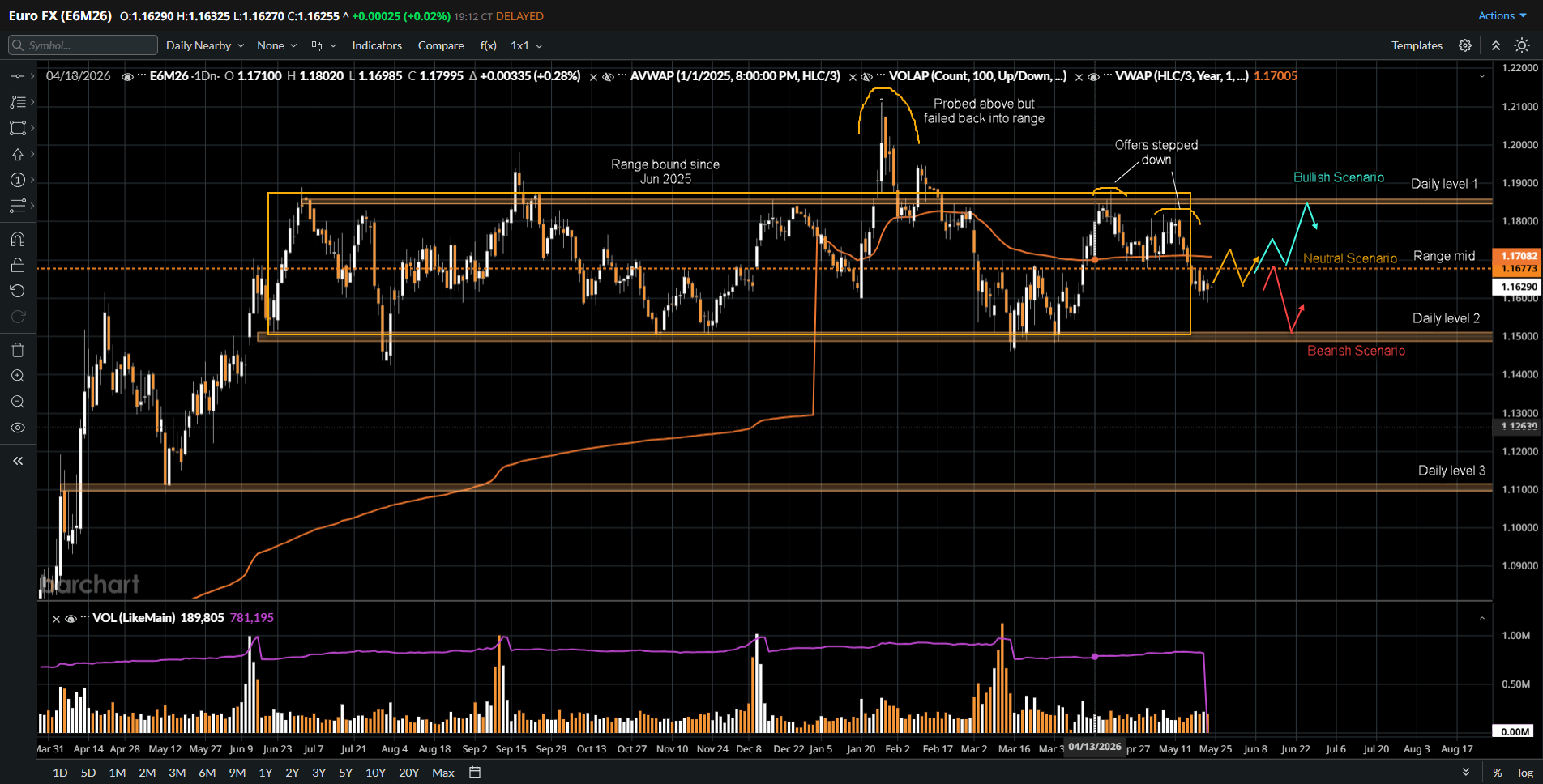
The key level to watch is 1.168, the range mid and 2026 yearly VWAP confluence. Directional resolution likely hinges on how this level is defended or retaken.
Neutral Scenario
- Prices continue to chop and auction 2-way around 1.168 with no sustained commitment from either side, producing noise rather than direction.
- A possible trigger for this outcome is a continuation of the current Iran diplomatic stalemate, where neither a ceasefire nor an escalation materializes, keeping risk sentiment in limbo and leaving both ECB and Fed rate path expectations in a holding pattern heading into the June decisions.
Bearish Scenario
- If sellers are able to hold down offers at 1.168 and prevent buyers from reclaiming that level, the path of least resistance is a rotation back down toward 1.150, where daily level 2 support sits and responsive buyers can be expected to show up.
- A possible trigger here is a breakdown in the current US-Iran talks, whether from IRGC escalation beyond the region as threatened, a resumption of US strikes, or a sharp spike in Brent crude that compounds stagflation fears in Europe and causes the market to reprice even more aggressive ECB hikes, which would paradoxically weigh on the euro through the growth deterioration channel rather than lift it.
Bullish Scenario
- If buyers are able to bid back above 1.168 and hold above that level, the setup opens a move back toward 1.180 and the top of range at 1.186. This bid back above 1.168 would imply that buyers have stepped up and are potentially ready to compress prices toward the upper boundary of the current range, with a breakout scenario in play should 1.186 give way.
- A possible trigger here is a credible ceasefire or peace deal between the US and Iran, which would relieve energy price pressure, ease Eurozone inflation fears, reduce the ECB's urgency to hike aggressively, and allow the market to refocus on the structural dollar-negative story driven by US fiscal deterioration and the Moody's downgrade backdrop.
Conclusion
The 6E is sitting at a macro and technical crossroads, and 1.168 is where the argument will be settled. Technically, the market has demonstrated that this level is not a formality. It has been contested, lost, reclaimed, and lost again, meaning each engagement with it carries real informational weight about who is in control of the range. Fundamentally, the pair is caught between a dollar that is structurally under pressure from Moody's fiscal concerns and Fed easing expectations, and a euro that is wrestling with the growth cost of a war-driven energy shock even as the ECB moves toward tightening. Today's breaking reports of a US-Iran final draft agreement through Pakistani mediation are the most consequential development in weeks, and if confirmed, could represent the catalyst that forces a directional resolution above 1.168 that the April rally attempted but could not sustain.
From a trading standpoint, engaging from range mid carries the inherent risk of being on the wrong side of a 2-way chop that has now persisted for nearly a year. The cleanest way to engage with this market remains from the edges of the range itself, where the risk-reward is most clearly defined: responsive buyers at 1.150 and responsive sellers at 1.186, where price has repeatedly found its opposing force. Fading the extremes with defined risk is a structurally sounder approach than trying to pick a side from the middle of a contested pivot. With the June ECB decision, the US-Iran deal confirmation, and the US fiscal reconciliation bill all converging in the near term, the macro setup is getting noisier and more binary by the day. Watch 1.168 for directional intent, but let the edges of the range do the talking when it comes to execution.
EdgeClear is designed for traders who refuse to guess. We deliver unfiltered tick data via Rithmic, competitive pricing starting at $0.22 per side, and performance analytics that transform your trade log into a roadmap. The serious trader’s next move is clear. Open an Account today.
Disclaimer:
This article is provided for informational and educational purposes only and does not constitute financial, investment, or trading advice. The analysis presented reflects the author’s market observations and opinions at the time of writing and is not a recommendation to buy or sell any futures contract, security, or financial instrument. Futures trading involves significant risk and is not suitable for all market participants. Losses may exceed initial margin deposits, and market conditions can change rapidly.
Any scenarios, levels, or market expectations discussed are hypothetical in nature and are intended solely to illustrate potential market behavior. They do not represent actual trading results and should not be interpreted as guarantees of future performance. Past performance, market behavior, or historical price action are not indicative of future outcomes.
Readers are solely responsible for their own trading decisions and risk management. Always conduct independent research, consider your financial situation and risk tolerance, and consult with a qualified financial professional, if necessary, before engaging in futures or derivatives trading.

/Oracle%20Corp_%20office%20logo-by%20Mesut%20Dogan%20via%20iStock.jpg)
/NVIDIA%20Corp%20logo%20outside%20building-by%20BING-JHEN_HONG%20via%20iStock.jpg)
/Uber%20Technologies%20Inc%20logo%20outside%20offices-by%20Sundry%20Photography%20via%20iStock.jpg)
/Space%20Technology%20by%20Rini_%20com%20via%20Shutterstock.jpg)