Running Hot but Cooling Off: What Has the Market Been Sensitive to Lately
The past month has seen platinum carve out a distinct identity from its precious metals peers. While gold and silver have remained caught in a persistent tug of war between Middle East-driven safe-haven demand and rising rate hike expectations stemming from elevated inflation, platinum has been decoupling to the upside on the back of its industrial demand story.
On the supply side, Johnson Matthey's 2026 PGM Market Report, released May 14, confirmed that platinum is projected to remain in a structural supply deficit of approximately 317,000 ounces in 2026, following a widened deficit of 951,000 ounces in 2025. South African mine output continues to face pressure from aging infrastructure, high power costs, and only gradual contributions from new projects. Russia, the world's second-largest producer, faces ongoing sanctions-related constraints that further limit supply availability. These are not new themes, but the Johnson Matthey report gave the market fresh, hard numbers to trade around this week.
On the demand side, platinum has benefited from accelerating auto-catalyst and hybrid vehicle demand as the EV growth narrative continues to lose momentum globally. The gold-to-platinum ratio also remains at historically wide levels, prompting a rotation of investor capital into platinum as a relative-value play. As of May 15, platinum futures pushed toward the 2200 level, reaching their highest print since March 12, as investors rotated into the metal while gold and silver struggled under inflationary pressure tied to the ongoing Strait of Hormuz disruption.
The Hormuz situation remains a live market variable. As of early May, President Trump paused the US effort to escort vessels through the strait pending deal negotiations with Iran, while the US counter-blockade on Iranian ports remained in place. This has kept energy prices elevated and reinforced market expectations that the Fed may be forced to hold rates higher for longer, a headwind for non-yielding assets generally. However, platinum has managed to outperform the broader precious metals complex in this environment, leaning on its industrial identity rather than its monetary one.
What the Market Has Done
- Platinum made an aggressive run from December 2025, with buyers bidding prices up to new ATHs, peaking near 2925 towards the end of January 2026. The rally was fueled by a confluence of structural supply deficits, strong Chinese investment flows, and a broader precious metals bid driven by global uncertainty.
- Sellers stepped in aggressively off that ATH, with the market selling off hard all the way down to the 1800 area (daily level 3). The scale and speed of the selloff reflected a market that had gotten significantly overbought relative to the fundamental backdrop, with longs liquidating.
- Buyers responded at 1800 at the start of February, staging a recovery that pushed prices back toward the 2400 level. However, sellers stepped down offers at 2400 at the start of March (daily level 3 on the upside), stopping the auction up and rotating prices back down toward the 1800 area.
- Prices spiked below 1800 briefly but were quickly rejected back above it, reinforcing 1800 as a meaningful demand area. The 1876 level established itself as the most recent significant swing low within this broader range.
- The market subsequently settled into a sideways range between 1800 and 2200, rotating two-ways within this range, but with progressively higher highs and higher lows forming within the range, suggesting buyers are gradually building a base.
- Most recently, sellers defended the top of the range at the 2200 level (daily level 2), a level that is confluent with the 2026 yearly VWAP. This confluence of a key structural level and a major anchored price reference has kept a lid on upside momentum for now, rotating prices back lower from that resistance zone.
What to Expect in the Coming Weeks
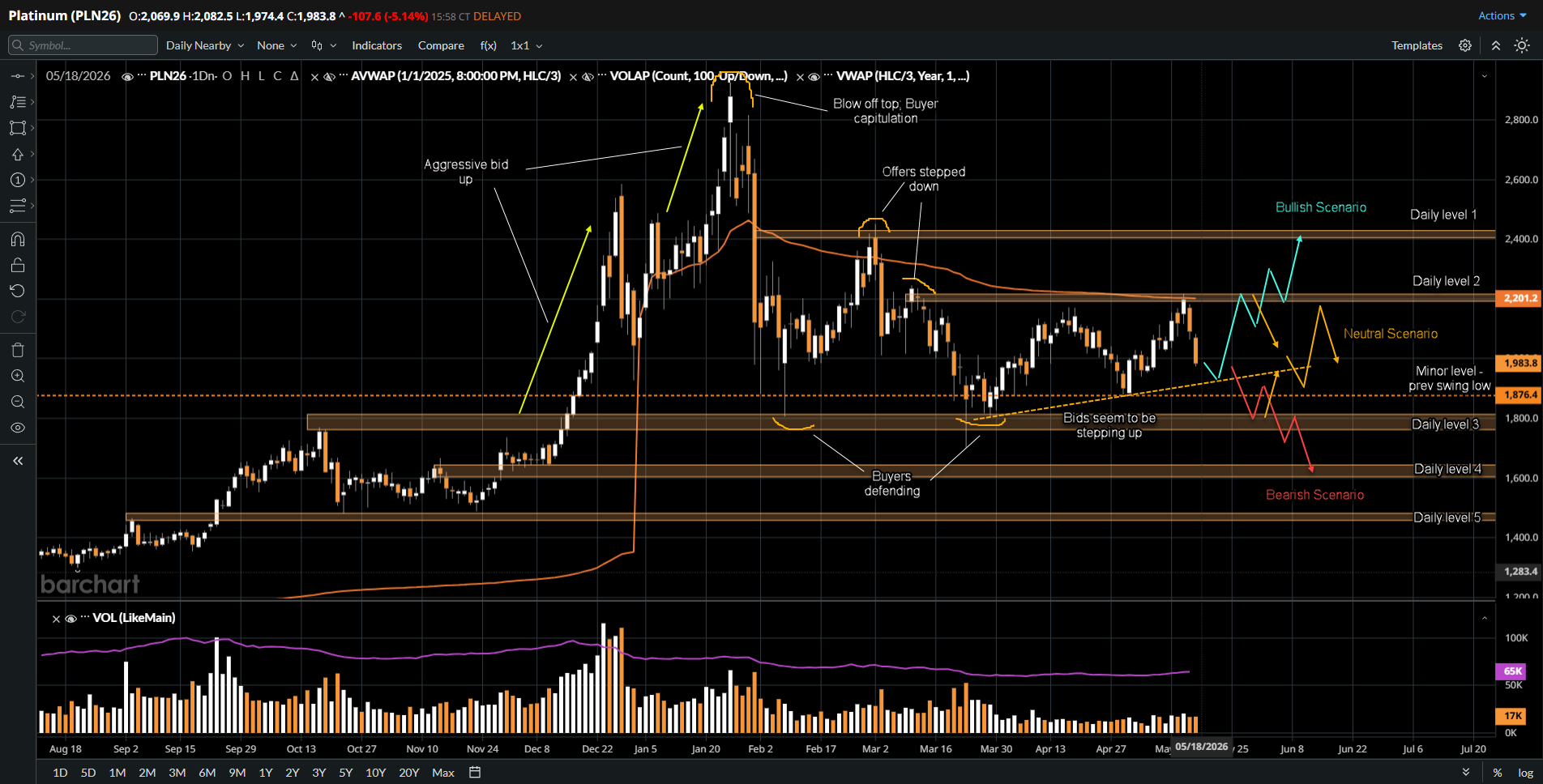
The key levels to watch remain 2200 to the topside (daily level 2), confluent with the 2026 yearly VWAP, and 1800/1876 to the downside (daily level 3).
Neutral Scenario
- If buyers are not able to sustain a breakout above 2200, or if prices fail to hold outside the current range after any initial probe above or below, expect rotation back within the established 1800 to 2200 range to continue.
- A possible macro trigger for this scenario would be a ceasefire extension in the Iran conflict without full resolution, keeping energy prices and rate expectations in a holding pattern that neither meaningfully supports nor undermines platinum's industrial demand story.
Bullish Scenario
- If buyers step up bids within the current range and do not allow prices to rotate back down to the 1876 swing low, that is the first sign that the bullish scenario may be developing. Buyers holding above 1876 keeps the pattern of higher lows intact and increases the probability of a challenge of the 2200, which is confluent with 2026 yearly VWAP.
- Acceptance above 2200 would open the door for a move up toward 2400 (daily level 3), where sellers are expected to step in and defend.
- A possible macro trigger here would be a material breakthrough in US-Iran peace talks leading to a credible reopening of the Strait of Hormuz, which would ease inflationary pressure, revive rate cut expectations, and provide a tailwind for non-yielding assets.
Bearish Scenario
- If buyers fail to hold above 1876, that is the first clue that the bearish scenario may be in play. The loss of that swing low would break the pattern of higher lows that has been developing within the range.
- If buyers are then unable to defend the 1800 level (daily level 3), expect a move down toward the 1630 area (daily level 4), where buyers are expected to respond.
- A possible macro trigger for this scenario would be a breakdown in US-Iran negotiations, an escalation of attacks on commercial shipping in the strait, or a fresh round of Fed hawkishness driven by a hotter-than-expected inflation print.
Conclusion
Platinum finds itself at a genuinely interesting crossroads. The structural story remains compelling, with Johnson Matthey confirming a 2026 supply deficit of approximately 317,000 ounces as recently as May 14, with South African and Russian supply headwinds that are persistent rather than cyclical and growing auto-catalyst demand from hybrid vehicles continuing to underpin the industrial demand case. Yet the market is clearly not in a hurry to revisit its January ATH near 2925, with sellers defending the 2200 daily level and 2026 yearly VWAP with conviction. The 2200 to the upside and 1800 to 1876 to the bottom remain the levels that matter most in the weeks ahead. Whichever side breaks first with acceptance and follow-through will likely set the tone for the next leg, and whether the macro catalyst comes from the Hormuz negotiating table or from a shift in rate expectations, platinum is a market worth watching closely right now. What is your read on which side breaks first?
We built EdgeClear for traders who treat trading as a business. That means low commissions, zero-friction order routing, and free access to EdgeClear Insights—a cloud-based analytics platform that tracks your P&L, discipline, and execution quality in real time. Build your trading business on a foundation that scales with you. Open an Account today.
Disclaimer:
This article is provided for informational and educational purposes only and does not constitute financial, investment, or trading advice. The analysis presented reflects the author’s market observations and opinions at the time of writing and is not a recommendation to buy or sell any futures contract, security, or financial instrument. Futures trading involves significant risk and is not suitable for all market participants. Losses may exceed initial margin deposits, and market conditions can change rapidly.
Any scenarios, levels, or market expectations discussed are hypothetical in nature and are intended solely to illustrate potential market behavior. They do not represent actual trading results and should not be interpreted as guarantees of future performance. Past performance, market behavior, or historical price action are not indicative of future outcomes.
Readers are solely responsible for their own trading decisions and risk management. Always conduct independent research, consider your financial situation and risk tolerance, and consult with a qualified financial professional, if necessary, before engaging in futures or derivatives trading.

/Space/Planet%20earth%20with%20flying%20rocket%20by%20Sergey%20Mironov%20via%20Shutterstock.jpg)
/Alphabet%20(Google)%20Image%20by%20Markus%20Mainka%20via%20Shutterstock.jpg)

/Jen-Hsun%20Huan%20NVIDIA's%20Founder%2C%20President%20and%20CEO%20by%20jamesonwu1972%20via%20Shutterstock.jpg)