


America's employment situation appeared to improve again in April, as the U.S. added more jobs than expected in what was the last of several encouraging signs of workplace stabilization for the week.
The Labor Department reported Friday that nonfarm payrolls grew by 115,000 in April—considerably lower than the prior month, but well above Dow Jones-polled economists' expectations for 65,000 jobs created. March's payrolls number was revised slightly higher, by 7,000 jobs added to 185,000 total. February's final number was even worse, however, revised by 23,000 jobs lower to an overall loss of 156,000.
Related: 15 Best Investment Apps and Platforms [Free + Paid]
"The addition of 115,000 jobs in April continues to highlight the resilience of the U.S. labor market," says Jerry Tempelman, former senior analyst at the NY Fed and VP of Economic and Fixed Income Research at Mutual of America Capital Management. "Despite swings in monthly jobs reports over the past year, month-to-month changes in nonfarm payrolls have remained small relative to the size of the overall labor force."
Unemployment remained the same, however, at 4.3%, which was right where economists expected the figure to fall. The rate has now remained at or below 4.5% since October 2021.
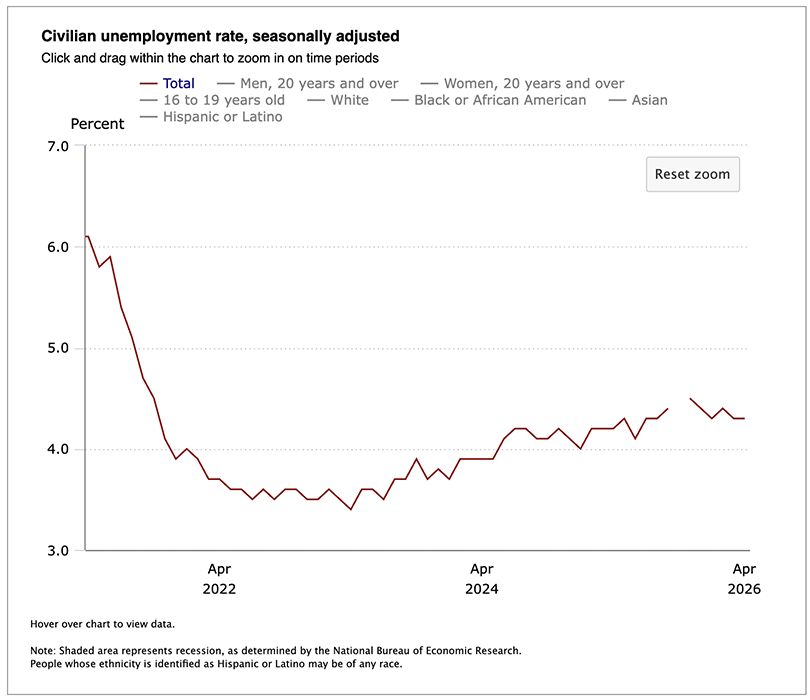
However, "several details point to softening at the margin," says Jason Pride, Chief of Investment Strategy and Research at Glenmede.
Related: 12 Easy Ways to Lower Your Gas Costs
April's hourly earnings figure, for instance, came in a little lower than forecasts. Growth of just 0.2% month-over-month, to $37.41, was even with March and below the 0.3% expected. Over the past year, average hourly earnings have increased by 3.6%.
"Labor force participation ticked down to 61.8% and the employment-population ratio fell to 59.1%—both signs of workers stepping out of the labor force rather than finding new roles," Pride adds.
Here's a brief look at the most pertinent details from the April jobs report:
- April payrolls: -115,000 MoM (estimate: +65,000)
- April unemployment: 4.3% (estimate: 4.3%)
- April hourly earnings: +0.2% MoM (estimate: +0.3%)
- March payrolls (revised): +185,000 (+178,000 previously)
- February payrolls (revised): -156,000 (-133,000 previously)
Healthcare employment, which has been one of the nation's greatest sources of payroll strength for years, remained robust, gaining 37,000 jobs, which is better than its average monthly gain of 32,000 over the past year. Transportation and warehousing employment was up by 30,000 last month, though the sector is still down 105,000 jobs since February 2025. Retail added 22,000 jobs, while social assistance gained 17,000.
Goldman Sachs said before the report that it expected a 5,000-job decline in government payrolls thanks to the ongoing federal government hiring freeze, but that number came in higher than they expected, to 9,000 jobs. Since October 2024, federal government employment has been reduced by 11.5%, or 348,000 jobs.
"The continued contraction in the federal workforce remains a meaningful headwind to overall payroll growth and helps explain why the bulk of April's gains came from health care, transportation and warehousing, and retail," Pride says.
Information employment was also reduced by 13,000 jobs—an expected outcome given the steady drumbeat of AI-headlined layoff announcements over the past few months.
Related: 10 Monthly Dividend Stocks for Frequent, Regular Income
The nonfarm payrolls report was the latest in a raft of employment data:
- ADP's report showed private payrolls rising by 109,000 last month, ahead of expectations.
- Initial jobless claims averaged a low 211,000 across April.
- The Challenger, Gray & Christmas report showed layoffs grew by 23,000 in April to 83,000, following a 12,000 increase in March, but a 60,000 downshift in February.
- The layoff rate, per JOLTS, was 10 basis points higher to 1.2%. (A basis point is one one-hundredth of a percentage point.)
Fed Unlikely to Change Path in June
The nonfarm payrolls report was the latest in a raft of generally positive employment data:
- ADP's report showed private payrolls rising by 109,000 last month, ahead of expectations.
- Initial jobless claims averaged a low 211,000 across April.
- The Challenger, Gray & Christmas report showed layoffs grew by 23,000 in April to 83,000, following a 12,000 increase in March, but a 60,000 downshift in February.
- The layoff rate, per JOLTS, was 10 basis points higher to 1.2%. (A basis point is one one-hundredth of a percentage point.)
That, combined with Friday's nonfarm payrolls report, has Wall Street convinced the Federal Reserve won't take any interest-rate action at the next Federal Open Market Committee (FOMC) meeting, set for June 16-17.
Related: 5 Best Silver ETFs You Can Own
"Not the job print that makes cutting more likely," says Lindsay Rosner, head of multi-sector fixed income investing at Goldman Sachs Asset Management. "The Fed will shift its focus to containing upside inflation risks now that the labor market appears back on track."
The CME FedWatch Tool, which uses Fed funds futures prices to track the probability of a change to the federal funds rate, shows a 95% chance that the central bank will keep its benchmark rate at 3.50%-3.75%. That's only slightly lower than the 96% chance implied yesterday.
"The FOMC could well feel compelled to remove the easing bias from its next post-meeting statement in June, which would suggest the hawks are gaining the upper hand on the committee for the time being," Rosner adds. "Strong data and inflation have likely put paid to any easing in the foreseeable future, though this could change depending on how energy prices and the situation in the Middle East develop."
Do you want to get serious about saving and planning for retirement? Sign up for Retire With Riley, Young and the Invested's free retirement planning newsletter.
More Expert Reactions to April's Jobs Report
Here's what other strategists, financial managers, and experts had to say about last month's employment situation:
Jeff Schulze, Head of Economic and Market Strategy, ClearBridge Investments
"The April jobs release broke the nearly year-long streak of alternative weak (negative) and strong (positive) prints, coming in at +115,000 jobs following last month's upwardly-revised +185,000. Private payrolls continued to show strength, suggesting that the economy is not yet feeling substantial strains resulting from elevated uncertainty in the Middle East. Wage gains at 3.6% year-over-year are running ahead of headline CPI (3.3%), which should help support consumer spending even in the face of elevated gasoline prices.
Related: U.S. GDP Rebounds in 2026's First Quarter, But Below Expectations
"Today's jobs report should provide reassurance for Federal Reserve officials that the labor market is on solid footing and could withstand a prolonged period of stable or even higher interest rates should the pickup in inflation warrant. The bar was high for this print to move markets, but we think today's data is a modest positive to risk assets given the supportive read-through to consumer spending and economic growth more broadly."
Scott Helfstein, Head of Investment Strategy, Global X
"Job growth remains low relative to economic growth, but unemployment was unchanged from last month. This is the low-hire, low-fire economy in action. Meanwhile, the economy is firing on all cylinders. We are all trying to understand what success looks like in this new age of automation. Companies are delivering record profitability, and the workforce is critical in that process. AI and automation matters, but so do people. Economies driven by innovation booms do not always create a lot of jobs in real time, but the labor market wins as the pie grows larger."
Steve Wyett, Chief Investment Strategist, BOK Financial
"For the second month in a row we got a new jobs number above expectations, and an upward revision to last month’s number adds even more evidence of at worst a stable labor market, and at best, an improving labor market. For this to have occurred during the Iran conflict induced oil price spike shows just how strong the forward momentum of our economy was coming into this year. We are seeing the result of past Fed easing’s, changes in the tax code which are leading to broad-based investments in productive capacity, and then ongoing impact of the AI capex super-cycle."
Related: The 13 Best Mutual Funds You Can Buy
Brad Conger, Chief Investment Officer, Hirtle & Co.
"The U.S. jobs market continues to idle just above a stall. The three-month trailing employment gain (48,000) appears just enough to absorb new supply—leaving the unemployment rate flat at 4.3%. The FOMC will just have to bide its time. Too soon to throttle up, too early to let off the choke."
Sonu Varghese, Chief Macro Strategist, Carson Group
"April payrolls say the labor market is no longer the downside risk it was. Payroll growth has firmed to a 48,000 three-month average, and unemployment is still sitting near a historically low 4.3%. With inflation elevated and rising, this backdrop would normally have the Fed thinking about rate hikes. Instead, under incoming Chair Kevin Warsh, the Fed is likely to hold steady. That means policy is effectively getting looser—another tailwind for stocks."
What If I Need Help Picking Stocks?
Among our favorite platforms for both data and picks is Seeking Alpha Premium, which gives you unlimited access to thousands of active authors who deliver stock analysis.
Seeking Alpha also provides you with stock research tools, real-time news updates, crowdsourced debates, and market data. Users can create their own portfolio of favorite stocks, see how they perform, and receive email alerts or push notifications about their investments.
Try out Seeking Alpha Premium free for seven days and get a discount on your first year's subscription.


/Advanced%20Micro%20Devices%20Inc_%20logo%20on%20phone%20and%20website-by%20T_Schneider%20via%20Shutterstock.jpg)
/Robinhood%20app%20on%20phone%20by%20Andrew%20Neel%20via%20Unsplash.jpg)
/The%20Shopify%20logo%20on%20a%20smartphone%20screen%20by%20IB%20Photography%20%20via%20Shutterstock.jpg)