




Looking back on automobile manufacturing stocks’ Q1 earnings, we examine this quarter’s best and worst performers, including Winnebago (NYSE:WGO) and its peers.
Much capital investment and technical know-how are needed to manufacture functional, safe, and aesthetically pleasing automobiles for the mass market. Barriers to entry are therefore high, and auto manufacturers with economies of scale can boast strong economic moats. However, this doesn’t insulate them from new entrants, as electric vehicles (EVs) have entered the market and are upending it. This has forced established manufacturers to not only contend with emerging EV-first competitors but also decide how much they want to invest in these disruptive technologies, which will likely cannibalize their legacy offerings.
The 10 automobile manufacturing stocks we track reported a strong Q1. As a group, revenues beat analysts’ consensus estimates by 0.7%.
In light of this news, share prices of the companies have held steady. On average, they are relatively unchanged since the latest earnings results.
Winnebago (NYSE:WGO)
Created to provide high-quality, affordable RVs to the post-war American family, Winnebago (NYSE:WGO) is a manufacturer of recreational vehicles, providing a range of motorhomes, travel trailers, and fifth-wheel products for outdoor and adventure lifestyles.
Winnebago reported revenues of $657.4 million, up 6% year on year. This print exceeded analysts’ expectations by 4.8%. Overall, it was a satisfactory quarter for the company with a solid beat of analysts’ adjusted operating income estimates.
CEO Commentary“Our team delivered a solid quarter and executed with diligence in a challenging market,” said President and Chief Executive Officer Michael Happe.
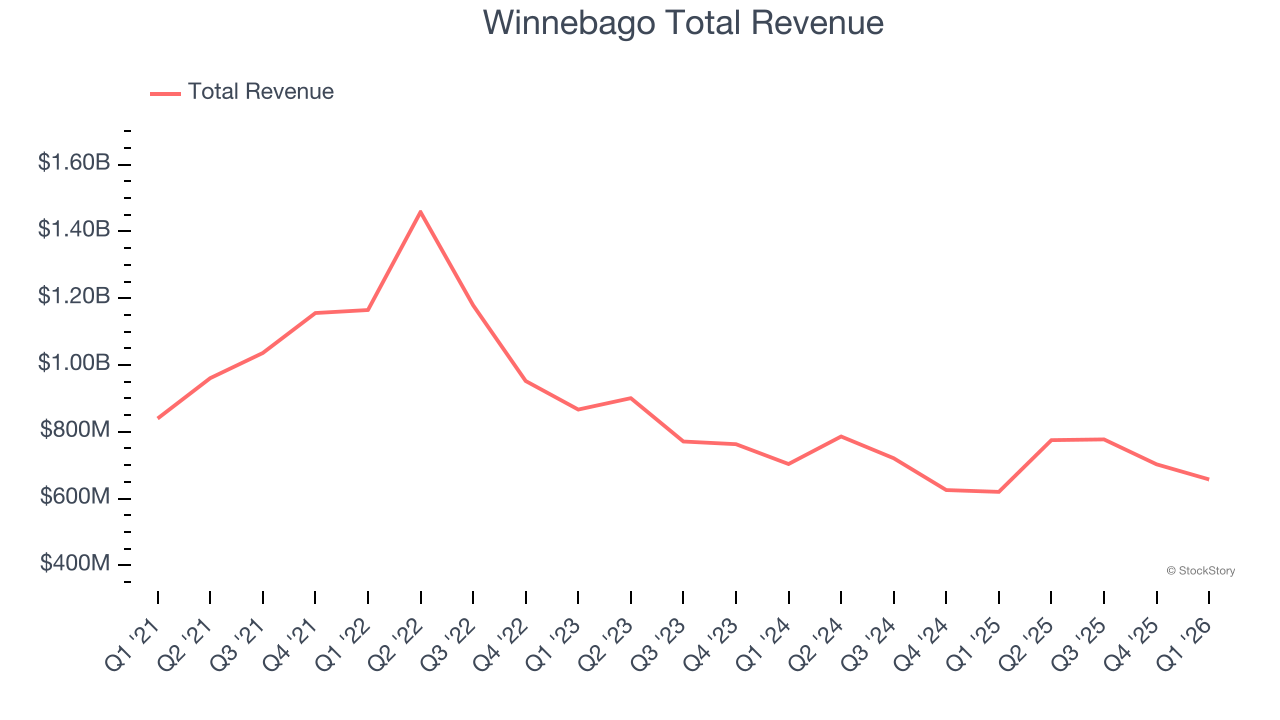
The stock is down 9.1% since reporting and currently trades at $31.88.
Is now the time to buy Winnebago? Access our full analysis of the earnings results here, it’s free.
Best Q1: Ford (NYSE:F)
Established to make automobiles accessible to a broader segment of the population, Ford (NYSE:F) designs, manufactures, and sells a variety of automobiles, trucks, and electric vehicles.
Ford reported revenues of $43.25 billion, up 6.4% year on year, outperforming analysts’ expectations by 3.7%. The business had an incredible quarter with a beat of analysts’ EPS and EBITDA estimates.
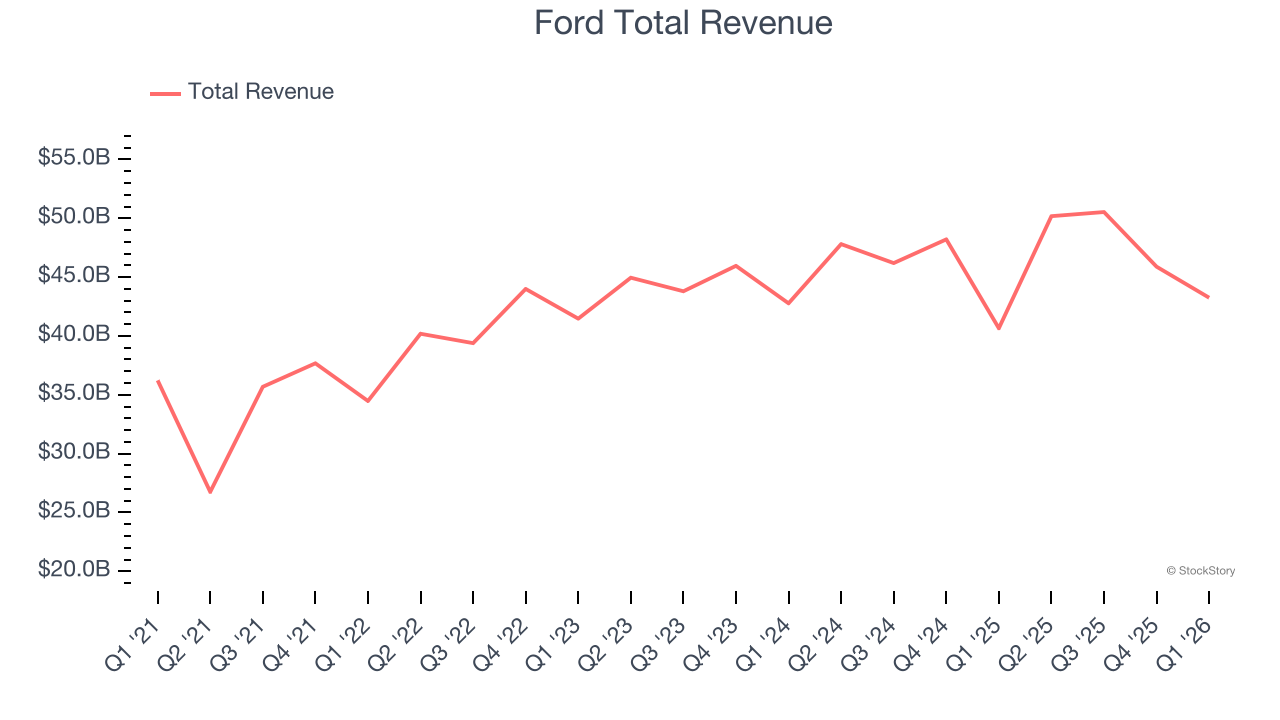
However, the results were likely priced into the stock as it’s traded sideways since reporting. Shares currently sit at $12.15.
Is now the time to buy Ford? Access our full analysis of the earnings results here, it’s free.
Weakest Q1: Lucid (NASDAQ:LCID)
Founded by a former Tesla Vice President, Lucid Group (NASDAQ:LCID) designs, manufactures, and sells luxury electric vehicles with long-range capabilities.
Lucid reported revenues of $282.5 million, up 20.2% year on year, falling short of analysts’ expectations by 25.1%. It was a disappointing quarter as it posted a significant miss of analysts’ revenue and adjusted operating income estimates.
Lucid delivered the weakest performance against analyst estimates in the group. As expected, the stock is down 4.9% since the results and currently trades at $5.99.
Read our full analysis of Lucid’s results here.
Mobileye (NASDAQ:MBLY)
With its EyeQ chips installed in over 200 million vehicles worldwide, Mobileye (NASDAQ:MBLY) develops advanced driver assistance systems and autonomous driving technologies that help vehicles detect and respond to road conditions.
Mobileye reported revenues of $558 million, up 27.4% year on year. This number surpassed analysts’ expectations by 7.8%. It was a stunning quarter as it also produced a beat of analysts’ EPS estimates and an impressive beat of analysts’ EBITDA estimates.
Mobileye scored the biggest analyst estimates beat, fastest revenue growth, and highest full-year guidance raise among its peers. The stock is up 11.8% since reporting and currently trades at $8.83.
Read our full, actionable report on Mobileye here, it’s free.
Autoliv (NYSE:ALV)
With products estimated to save over 30,000 lives annually in traffic accidents worldwide, Autoliv (NYSE:ALV) develops and manufactures passive safety systems for vehicles, including airbags, seatbelts, and steering wheels that protect occupants during crashes.
Autoliv reported revenues of $2.75 billion, up 6.8% year on year. This result beat analysts’ expectations by 4.8%. Overall, it was a stunning quarter as it also logged a solid beat of analysts’ EBITDA estimates and an impressive beat of analysts’ adjusted operating income estimates.
The stock is up 8.7% since reporting and currently trades at $121.
Read our full, actionable report on Autoliv here, it’s free.
Market Update
Late in 2025 into early 2026, there was hand wringing around artificial intelligence. For software companies, the fear was that AI would erode pricing power and compress margins as new tools made it easier to replicate what once required expensive enterprise platforms. Crypto investors had their own version of the same anxiety: if AI agents could trade, allocate capital, and manage wallets autonomously, what exactly was the long-term value of today’s crypto infrastructure?
These concerns triggered a noticeable rotation away from these sectors and into safer havens. But markets rarely dwell on one narrative for long. Spring 2026 came, and the focus shifted abruptly from technological disruption to geopolitical risk. The US’ conflict with Iran became the dominant driver of market psychology, and when geopolitics takes center stage, the script changes quickly. Investors stop debating growth rates and start worrying about oil supply, inflation, and global stability.
Want to invest in winners with rock-solid fundamentals? Check out our Top 5 Quality Compounder Stocks and add them to your watchlist. These companies are poised for growth regardless of the political or macroeconomic climate.
StockStory’s analyst team — all seasoned professional investors — uses quantitative analysis and automation to deliver market-beating insights faster and with higher quality.

/Advanced%20Micro%20Devices%20Inc_%20logo%20on%20phone%20and%20website-by%20T_Schneider%20via%20Shutterstock.jpg)
/Intel%20Corp_%20badge%20holder-by%20hasrul_rais%20via%20Shutterstock.jpg)
/Palantir%20by%20Hiroshi-Mori-Stock%20via%20Shutterstock.jpg)

/Robinhood%20app%20on%20phone%20by%20Andrew%20Neel%20via%20Unsplash.jpg)