




The Macro Ignition — What Has the Market Sensitive To
Corn has spent the past month repricing a stacked deck of supportive fundamentals and geopolitical risk, and the market is currently sensitive to developments on several fronts simultaneously.
The most consequential macro backdrop continues to be the U.S.-Iran conflict and its ripple effects through energy and fertilizer markets. While a ceasefire was announced on April 8, ship traffic through the Strait of Hormuz has remained far below pre-war levels even after that announcement, keeping the global fertilizer supply chain under stress. The Strait handles roughly one third of global fertilizer trade, including approximately 30% of urea exports from Gulf producers, and the disruption has pushed urea prices up roughly $80 per ton, adding as much as $35 per acre in input costs for U.S. corn farmers. In France, the EU's largest corn producer, planted area is projected to fall as much as 15% as farmers reduce application rates or switch to lower-input crops in response to surging fertilizer costs. This supply-side tightening in Europe has provided an additional layer of price support for U.S. corn on the global stage.
On the demand side, the U.S. export pace has been a consistent bullish underpinning. The USDA's Export Sales report for the week ending April 23 showed old crop corn sales of 1.6 million metric tons, coming in at the high end of trade expectations and marking the largest weekly total since late February. For the 2025 to 2026 marketing year to date, total corn commitments stand at approximately 30% above the same period a year ago. South Korea has been a particularly active buyer, appearing multiple times in recent weekly tender activity. The April WASDE, released April 9, showed largely unchanged corn balance sheets with ending stocks at 2.127 billion bushels, which did little to derail the bullish narrative given the strong export pace.
The biofuel channel has also been a meaningful price driver. With crude oil remaining elevated amid stalled Strait of Hormuz normalization, ethanol economics have improved and fund money has rotated back into corn as a biofuel proxy. Bunge Global recently raised its full-year 2026 profit forecast, explicitly citing an improved biofuel demand outlook and stronger oilseed processing margins tied to the energy market backdrop. The U.S. also raised its biofuel blending mandate, adding structural demand support to an already tight export balance.
On the domestic supply side, planting progress has been slightly ahead of schedule. As of April 27, the USDA reported the U.S. corn crop 25% planted, above the five-year average, with emergence at 7% versus a 4% normal pace. However, forecast models from NOAA show meaningful rainfall accumulation across the central Corn Belt over the next two weeks, which could slow fieldwork and inject some near-term weather premium back into new-crop prices. Iowa, the nation's top corn-producing state, was only 2% planted as of April 19, well below its 8% five-year average for that date, keeping the planting weather story very much alive.
What the Market Has Done
- When price returned to 448, which corresponds to the 2025 yearly VWAP, back in December, sellers defended that level and were able to achieve a rotation downwards.
- Buyers stepped up bids at 420 in January, and from there, price grinded back up to 448 by March, establishing a slow but deliberate recovery.
- Buyers were subsequently able to overcome sellers at 448 and price expanded further to 470, where sellers responded. This set up a two-way rotation between 470 (Daily Level 2) and 480 (Daily Level 1) from March through most of April, with the market establishing value within that range.
- The geopolitical risk premium from the U.S.-Iran conflict helped sustain the bid during this consolidation phase. While energy markets experienced sharp swings around the April 8 ceasefire announcement, the persistent closure of the Strait of Hormuz kept fertilizer costs elevated and maintained a supply-side floor under prices, supporting buyer interest on the lower end of the range.
- In the past week, the market was able to break above 470 and held, with July corn posting a 13-month high close at 480. This breakout reflects a shift in market character, with the weekly close being technically significant as it suggests continued speculative buying interest into the following week.
What to Expect in the Coming Weeks
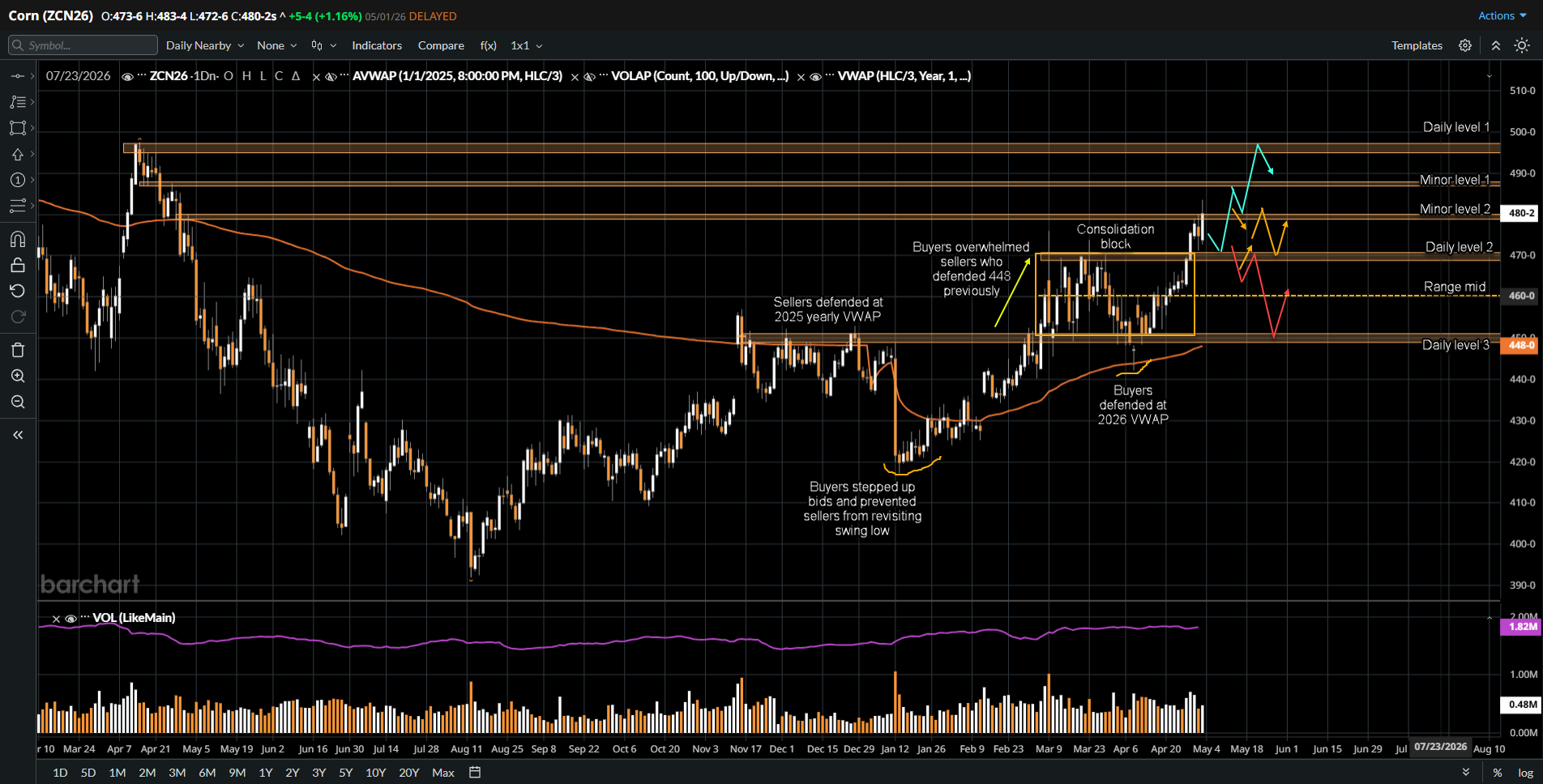
The key level to watch is 470 (Daily Level 2).
The market's ability or inability to defend that level on any pullback will possibly determine the directional path heading into the May WASDE on May 12, which will contain the first supply and demand estimates for the new 2026 to 2027 marketing year and is expected to be a significant market-moving event.
Bullish Scenario
- A possible pullback to 470 that holds would signal buyers are defending the prior resistance turned support, and from there, the expectation is for a bid back toward 480 (Minor Level 2) and subsequently to 490 (Minor Level 1).
- Expect some responsive sellers at those levels, but as long as buyers are stepping up and defending higher on the pullbacks, the market should eventually make a push toward the 496 area (Daily Level 1).
- The possible macro trigger for this scenario is a deterioration in Strait of Hormuz normalization, such as resumed hostilities or a breakdown of the post-ceasefire framework, which would reignite the fertilizer cost shock narrative, push crude back toward prior highs, and attract renewed fund buying across the grain complex. A strongly bullish May WASDE, whether through a cut to projected ending stocks or upward revision to the export forecast, would add additional fuel.
Neutral Scenario
- If sellers hold offers at 480 (Minor Level 2), expect continued rotation between 470 and 480 as the market works to establish value at a higher range.
- This scenario is possible and consistent with a period of geopolitical de-escalation, such as a formal reopening of the Strait of Hormuz with verified ship traffic normalization, which would reduce the risk premium in energy and fertilizer markets without fundamentally altering the strong export pace that has underpinned prices. The May WASDE coming in near trade expectations with no major surprises would reinforce this balanced two-sided environment.
Bearish Scenario
- If buyers fail to hold bids at 470, expect a move down through the consolidation block toward 460 (Range Mid) and subsequently to 450 (Daily Level 3), where buyers are expected to respond.
- The possible macro trigger here is a combination of faster-than-expected U.S. planting progress narrowing the weather premium, a stronger U.S. dollar weighing on export competitiveness, and a bearish May WASDE that surprises with higher projected 2026 to 2027 ending stocks or a downward revision to the export forecast.
- An acreage shift toward corn, should soybeans become less economically attractive following input cost normalization, could also add to downside pressure on new-crop prices.
Conclusion
Corn has earned its current perch above 470 through a combination of legitimate fundamental strength and geopolitically driven risk premium. Export commitments running 30% above year-ago levels, biofuel demand buoyed by still-elevated crude oil, and a European supply chain under fertilizer stress from the Strait of Hormuz disruption have all contributed to what is now a 13-month high close in July corn. Technically, the successful breakout above 470 is a meaningful development, but the market now faces the test of converting that breakout into acceptance. The 470 level becomes the new battleground, and how price behaves on the first meaningful pullback will reveal whether this is a genuine trend continuation or a false breakout ahead of a potentially market-moving May 12 WASDE. The next few weeks will separate the opportunists from the committed. Where do you think corn holds its ground?
We provide the infrastructure you need to quantify your discipline and ensure every decision is backed by the confidence of seeing exactly what drives your performance. Start trading with the clarity you deserve. Open an Account today.
Disclaimer:
This article is provided for informational and educational purposes only and does not constitute financial, investment, or trading advice. The analysis presented reflects the author’s market observations and opinions at the time of writing and is not a recommendation to buy or sell any futures contract, security, or financial instrument. Futures trading involves significant risk and is not suitable for all market participants. Losses may exceed initial margin deposits, and market conditions can change rapidly.
Any scenarios, levels, or market expectations discussed are hypothetical in nature and are intended solely to illustrate potential market behavior. They do not represent actual trading results and should not be interpreted as guarantees of future performance. Past performance, market behavior, or historical price action are not indicative of future outcomes.
Readers are solely responsible for their own trading decisions and risk management. Always conduct independent research, consider your financial situation and risk tolerance, and consult with a qualified financial professional, if necessary, before engaging in futures or derivatives trading.

/PayPal%20Holdings%20Inc%20sign%20on%20building-%20by%20Sundry%20Photography%20via%20Shutterstock.jpg)


/AI%20(artificial%20intelligence)/AI%20technology%20concept%20by%20NMStudio789%20via%20Shutterstock.jpg)
/Apple%20Inc%20logo%20on%20Apple%20store-by%20PhillDanze%20via%20iStock.jpg)