




Between a Soft Dollar and an Oil Shock
The past month has delivered a complex macro backdrop for the Canadian dollar, where the currency has been pulled in competing directions by a weakening US dollar on one side and an uncertain domestic policy environment on the other.
The most consequential driver of USD direction in April has been the broad erosion of confidence in the greenback. The DXY fell approximately 4% through April, weighed down by shifting Fed expectations and ongoing geopolitical risk premiums tied to the US conflict with Iran. That broad dollar softness provided a meaningful tailwind for CAD, helping lift the loonie to a seven-week high as speculative traders trimmed net short positions in the currency.
On the commodity side, oil prices have been a double-edged sword for Canada. Crude has been trading near US$90 per barrel in Q2 2026, elevated by Middle East supply risk. While Canada is a net oil exporter and benefits from higher export revenues, Governor Tiff Macklem of the Bank of Canada specifically noted on April 29 that the net impact on the broader Canadian economy is closer to neutral, as elevated gasoline prices are simultaneously squeezing consumers. The BoC's latest Monetary Policy Report projects CPI inflation rising to approximately 3% in April, up from 2.4% in March, with the assumption that oil prices will decline from around US$90 in Q2 to approximately US$75 per barrel by mid-2027.
The Bank of Canada held its policy rate at 2.25% for the fourth consecutive time on April 29, a decision that was widely anticipated. What was notably less expected was the degree of forward guidance Macklem offered. He stated that the current rate level is "probably about right" if economic projections hold, but he explicitly warned that consecutive rate hikes could follow if oil prices remain persistently elevated and begin feeding into broader core inflation. Conversely, if the United States imposes significant new trade restrictions on Canada under the CUSMA review, the BoC signaled it may need to cut rates further to support growth. This two-sided risk posture reflects the unusual degree of uncertainty the central bank is currently navigating.
Adding to the complexity, large speculative traders flipped to a net long position in Canadian dollar futures for the first time since July 2023, according to CFTC Commitments of Traders data. While this shift reflects improving sentiment, it also raises a note of caution, as gross long positions in CAD futures have extended to their highest level in over four years, which historically can act as a limiting factor on further upside momentum in the near term.
What the Market Has Done
- The past several months have seen 2-way price swings between the 0.740 area (Daily level 1 / consolidation range high) and the 0.720 area (Daily level 2 / consolidation range low), with neither side able to establish a sustained directional move outside this range.
- From February into March, buyers attempted to defend the 0.730 area, a level confluent with the consolidation range midpoint and the 2026 yearly VWAP. This level served as a structural anchor while the macro backdrop remained in flux, with the US-Iran war erupting on February 28 and driving a sharp spike in energy prices, a surge in safe-haven USD demand, and a corresponding bout of CAD selling pressure.
- Buyers failed to hold 0.730 in the final week of March, triggering a rotation back down toward the 0.720 area (Daily level 2 / consolidation range low). The breakdown was consistent with the broader macro environment at the time, as speculative CAD selling was at its most aggressive following the initial shock of conflict escalation and renewed safe-haven flows into the US dollar.
- In April, buyers were swift to respond at 0.720, staging a strong bid that pushed prices back up through the consolidation range, reclaiming the yearly VWAP and the 0.730 range midpoint. This recovery was supported by the broad reversal in USD sentiment as ceasefire negotiations between the US and Iran offered intermittent relief to safe-haven dollar demand. According to Saxo COT analysis, that ceasefire announcement caused the DXY to fall approximately 4% within a two-week window, which provided direct lift to the CAD.
- Buyers are currently holding the 0.730 area (range mid and yearly VWAP). Price action is consolidating near the upper end of the recent recovery, and the market is now watching whether buyers can sustain this level as a launching pad for a run at 0.740.
What to Expect in the Coming Weeks
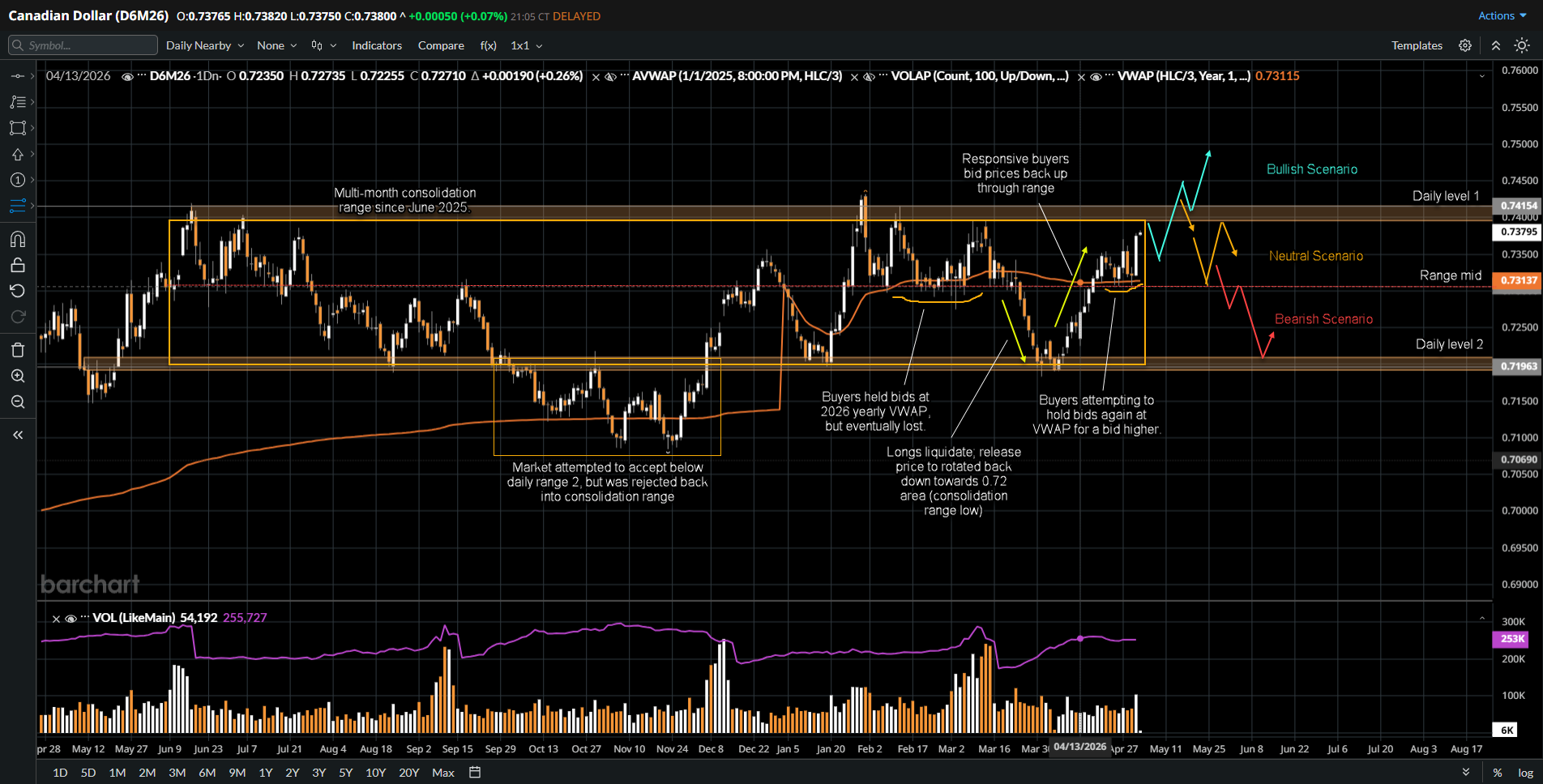
The key levels to watch are the 0.740 area (Daily level 1 / consolidation range high) and the 0.730 area (range mid and yearly VWAP).
Neutral Scenario
- Expect sellers to respond at 0.740, which aligns with Daily level 1 and the consolidation range high, and drive prices back down toward the 0.73 area.
- If buyers are able to defend and hold the 0.73 level, expect continued two way rotation between 0.74 and 0.73.
- This outcome is most consistent with the current macro backdrop: the Bank of Canada holding rates steady, oil prices stabilizing near their current range, and no significant escalation or de-escalation in US-Iran tensions. Under these conditions, the CAD lacks a clear catalyst in either direction and the range persists.
Bullish Scenario
- If buyers are able to break and accept above the 0.740 area (Daily level 1 / consolidation range high), a move up toward 0.750 becomes the next possible target.
- The possible macro trigger for this scenario would be a combination of meaningful US dollar weakness, potentially driven by dovish Fed speaker commentary in the coming weeks or a credible US-Iran ceasefire that unwinds the USD safe-haven premium, alongside continued oil price support that keeps the BoC's hawkish optionality alive.
Bearish Scenario
- If buyers fail to defend and hold 0.730 (range mid and yearly VWAP), expect a rotation back down through the consolidation range toward 0.720 (Daily level 2 / consolidation range low).
- This would likely be triggered by a resurgence in US dollar strength, whether from a hawkish Fed statement, a fresh deterioration in US-Canada trade relations under the CUSMA review, or a sustained spike in oil prices that paradoxically tightens financial conditions and weighs on global risk appetite.
- A scenario where oil sustains above US$100 per barrel would also increase the risk of BoC rate hikes, which could dampen Canadian economic growth expectations and weigh on the currency.
Conclusion
CAD futures sit at a technically important juncture, holding the 0.730 range mid and yearly VWAP after a strong April recovery, with the 0.740 resistance zone now squarely in focus. The macro and fundamental picture is equally poised at a crossroad: the Bank of Canada is on hold with a two-sided risk posture, oil prices are elevated but assumed to moderate, and the US dollar remains structurally vulnerable even as geopolitical risk keeps safe-haven demand alive. The next major directional move in the loonie will hinge on whether buyers can defend 0.730 on any pullback from 0.740 resistance. With large speculative longs at multi-year highs and central bank uncertainty running in both directions, this is a market that rewards patience and level-to-level thinking.
We believe that professional growth is impossible without the truth found in your own data. Our presence on Barchart bridges the gap between complex exchange data and professional execution. Open an Account and access the tools you need to see your performance clearly.
Disclaimer:
This article is provided for informational and educational purposes only and does not constitute financial, investment, or trading advice. The analysis presented reflects the author’s market observations and opinions at the time of writing and is not a recommendation to buy or sell any futures contract, security, or financial instrument. Futures trading involves significant risk and is not suitable for all market participants. Losses may exceed initial margin deposits, and market conditions can change rapidly.
Any scenarios, levels, or market expectations discussed are hypothetical in nature and are intended solely to illustrate potential market behavior. They do not represent actual trading results and should not be interpreted as guarantees of future performance. Past performance, market behavior, or historical price action are not indicative of future outcomes.
Readers are solely responsible for their own trading decisions and risk management. Always conduct independent research, consider your financial situation and risk tolerance, and consult with a qualified financial professional, if necessary, before engaging in futures or derivatives trading.

/A%20close-up%20of%20a%20SpaceX%20sign%20by%20Sundry%20Photography%20via%20Adobe%20Stock.jpeg)
/Microsoft%20France%20headquarters%20by%20JeanLuclchard%20via%20Shutterstock.jpg)

/A%20photo%20of%20a%20Sandisk%20Solid%20State%20Drive%20by%20Top%20Popular%20Vector%20by%20Shutterstock.jpg)