




The U.S. economy bounced back from lethargic levels during the first quarter, but still grew more slowly than economists expected.
On Thursday, the Commerce Department reported that 2026's first-quarter U.S. gross domestic product (GDP) grew at a 2% seasonally adjusted annualized pace. That's better than the 0.5% growth during 2025's final quarter, which capped the slowest annual growth in GDP since the COVID pandemic. But it didn't measure up to economists' estimates for 2.2% expansion.
Related: Fed Keeps Rates Steady as Expected, But With Decades-High Dissent
"Real GDP growth grew at a below trend pace of 2.0% in Q1, despite a big boost from [artificial intelligence]-related investment spending and reversal of the government shutdown," says Sonu Varghese, Chief Macro Strategist at Carson Group. "The problem is that consumer purchased fewer goods amid higher inflation, and a lot of the capex boom relies on imports (which doesn't count as 'domestic product').
"Yet, what matters for company revenue and profits is nominal GDP growth [unadjusted for inflation], which rose at an above-trend pace of 5.6% in Q1. That is why the stock market is near all-time highs despite higher inflation and consumer angst."
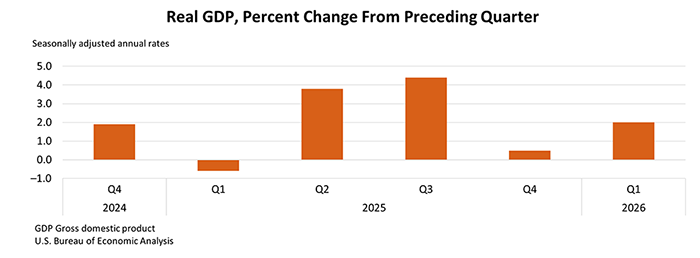
Contributing to the increase in real GDP were consumption, a return to government spending following the shutdown, and investment, the last of which came in well above estimates.
"The investment trends reflected in the GDP report provide continued support for cyclical stocks in areas like infrastructure, electrification, and energy," says Scott Helfstein, Head of Investment Strategy at Global X ETFs. "Typically, these stocks do well in early in economic cycles, but in this case, adoption of automation technologies is elongating the existing cycle, almost like a reset button without the economic downturn. We believe this trend can continue."
Make sure you sign up for The Weekend Tea, Young and the Invested's free weekly newsletter that over 10k monthly readers use to level up their money know-how.
Indeed, private-sector demand looks to be on the mend. Real final sales to private domestic purchasers (the sum of consumer spending and gross private fixed investment) grew by 2.5% during Q1, which was an improvement on Q4 2025's 1.8% growth.
"At face value, the GDP number understates the strength of domestic demand in Q1," says Michael Reynolds, Vice President of Investment Strategy at Glenmede. "As anticipated following the Supreme Court's February ruling striking down IEEPA tariffs, businesses appear to have taken advantage of temporarily lower duties by pulling forward imports. Since imports are a subtraction in the GDP calculation, that surge in import activity weighed on the headline figure.
"The bounce-back in activity that drove the acceleration was real, but the headline 2.0% likely understates where underlying momentum actually sits."
Related: 15 Best Investment Apps and Platforms [Free + Paid]
Also Thursday, the Commerce Department reported that March's reading of the core personal consumption expenditures price (PCE) index—the Fed's preferred gauge of inflation—climbed to its highest point since November 2023.
On a seasonally adjusted basis, core PCE, grew 0.3% last month, putting the 12-year inflation rate at 3.2%. Headline PCE, which includes food and energy, grew by 0.7% for the month, while the annual rate rose to 3.5%.
All of these readings were in line with Dow Jones consensus estimates.
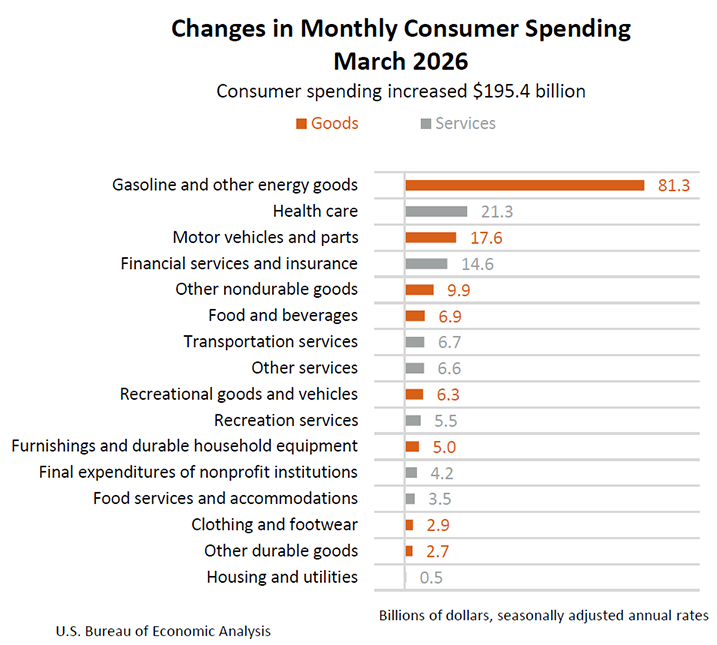
"All this print can be taken as a sign that the U.S. economy remains robust, even in the face of an oil price shock that was anticipated to pressure consumer pocketbooks starting in the month of March," says Bradford Smith, Portfolio Manager at Janus Henderson Investors. "The Fed puts long-run trend real GDP growth at 2.0%, placing the economy on track despite the conflict.
"The modest demand destruction created by the closure of the Strait should dissipate by the back half of the year, allowing the economy to return to above trend growth, buoyed by AI [capital expenditures], tax rebates, rising corporate profits and loose financial conditions."
Related: 9 Best Fidelity ETFs to Buy Now [Invest Tactically]



/Advanced%20Micro%20Devices%20Inc_%20logo%20and%20chart%20data-by%20Poetra_%20RH%20via%20Shutterstock.jpg)

/Cisco%20Systems%2C%20Inc_%20HQ-by%20Sundry%20Photography%20via%20iStock.jpg)