




Regional banking company Prosperity Bancshares (NYSE:PB) beat Wall Street’s revenue expectations in Q1 CY2026, with sales up 19.6% year on year to $367.6 million. Its non-GAAP profit of $1.50 per share was 3.8% above analysts’ consensus estimates.
Is now the time to buy Prosperity Bancshares? Find out by accessing our full research report, it’s free.
Prosperity Bancshares (PB) Q1 CY2026 Highlights:
- Net Interest Income: $321.2 million vs analyst estimates of $312.8 million (21% year-on-year growth, 2.7% beat)
- Net Interest Margin: 3.5% vs analyst estimates of 3.4% (8 basis point beat)
- Revenue: $367.6 million vs analyst estimates of $359.5 million (19.6% year-on-year growth, 2.3% beat)
- Efficiency Ratio: 59.2% vs analyst estimates of 47.6% (1,160.2 basis point miss)
- Adjusted EPS: $1.50 vs analyst estimates of $1.44 (3.8% beat)
- Tangible Book Value per Share: $42.39 vs analyst estimates of $43.24 (2.2% year-on-year growth, 2% miss)
- Market Capitalization: $7.01 billion
"The first quarter of 2026 was impactful for the company and I am excited to announce that during the quarter we completed the merger of American Bank Holding Corporation on January 1, 2026, completed the merger of Southwest Bancshares, Inc. on February 1, 2026 and announced the merger of Stellar Bancorp, Inc. on January 28, 2026, for which we have now received all necessary regulatory approvals and expect to complete on July 1, 2026. Additionally, we completed a core system conversion in February," said David Zalman, Prosperity's Senior Chairman and Chief Executive Officer.
Company Overview
With a network of banking centers spanning the Lone Star State and beyond, Prosperity Bancshares (NYSE:PB) operates full-service banking locations throughout Texas and Oklahoma, offering a wide range of financial products and services to businesses and consumers.
Sales Growth
Net interest income and and fee-based revenue are the two pillars supporting bank earnings. The former captures profit from the gap between lending rates and deposit costs, while the latter encompasses charges for banking services, credit products, wealth management, and trading activities. Regrettably, Prosperity Bancshares’s revenue grew at a sluggish 2.3% compounded annual growth rate over the last five years. This fell short of our benchmarks and is a poor baseline for our analysis.
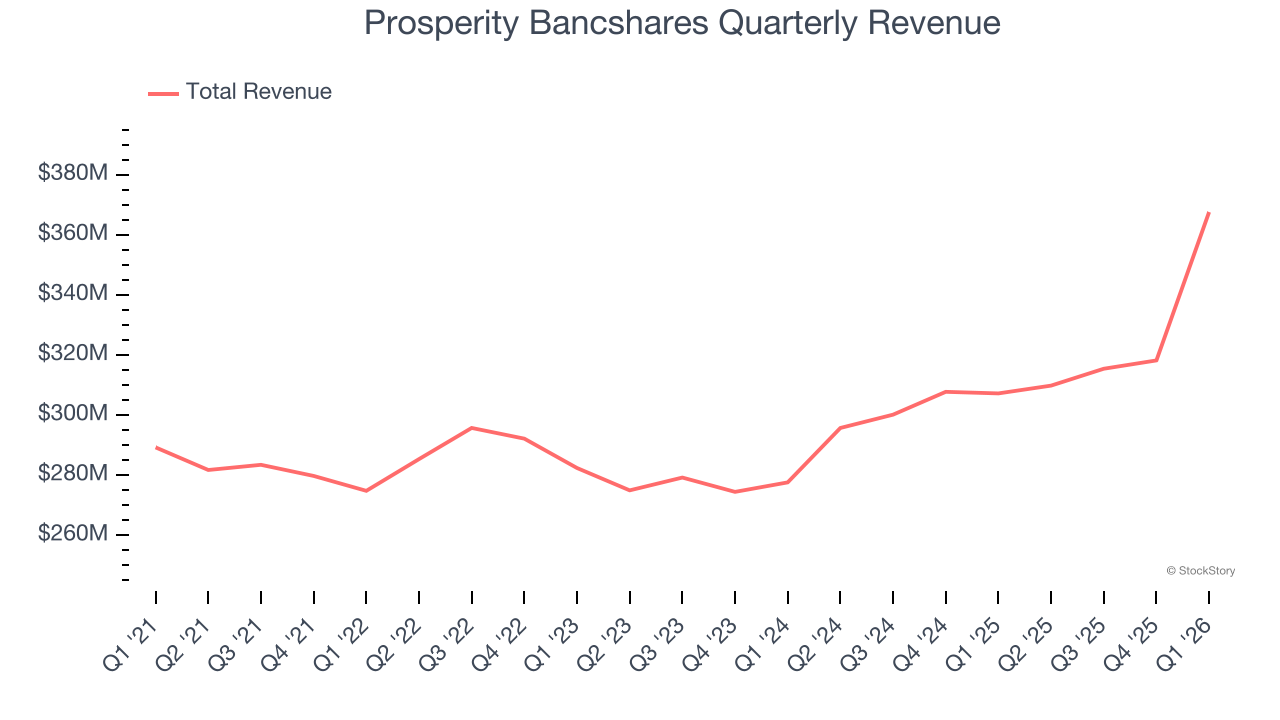
Long-term growth is the most important, but within financials, a half-decade historical view may miss recent interest rate changes and market returns. Prosperity Bancshares’s annualized revenue growth of 8.9% over the last two years is above its five-year trend, which is encouraging. 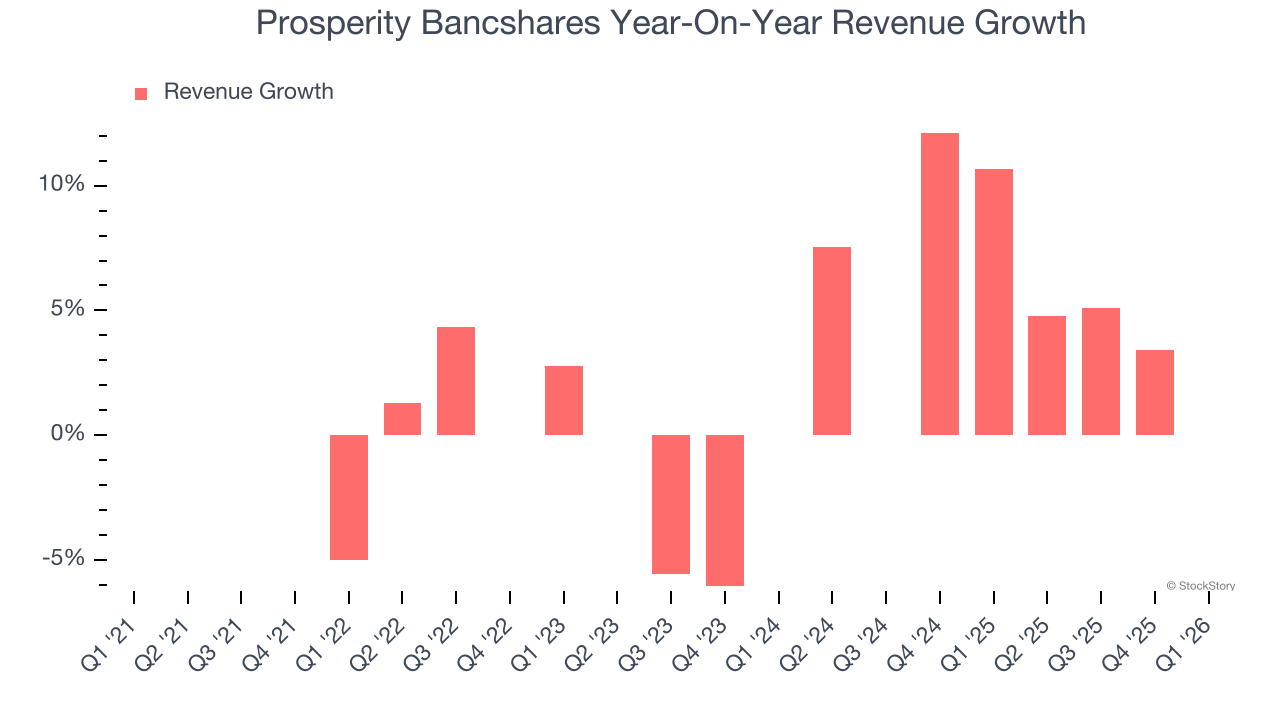 Note: Quarters not shown were determined to be outliers, impacted by outsized investment gains/losses that are not indicative of the recurring fundamentals of the business.
This quarter, Prosperity Bancshares reported year-on-year revenue growth of 19.6%, and its $367.6 million of revenue exceeded Wall Street’s estimates by 2.3%.
Net interest income made up 86.9% of the company’s total revenue during the last five years, meaning Prosperity Bancshares barely relies on non-interest income to drive its overall growth.
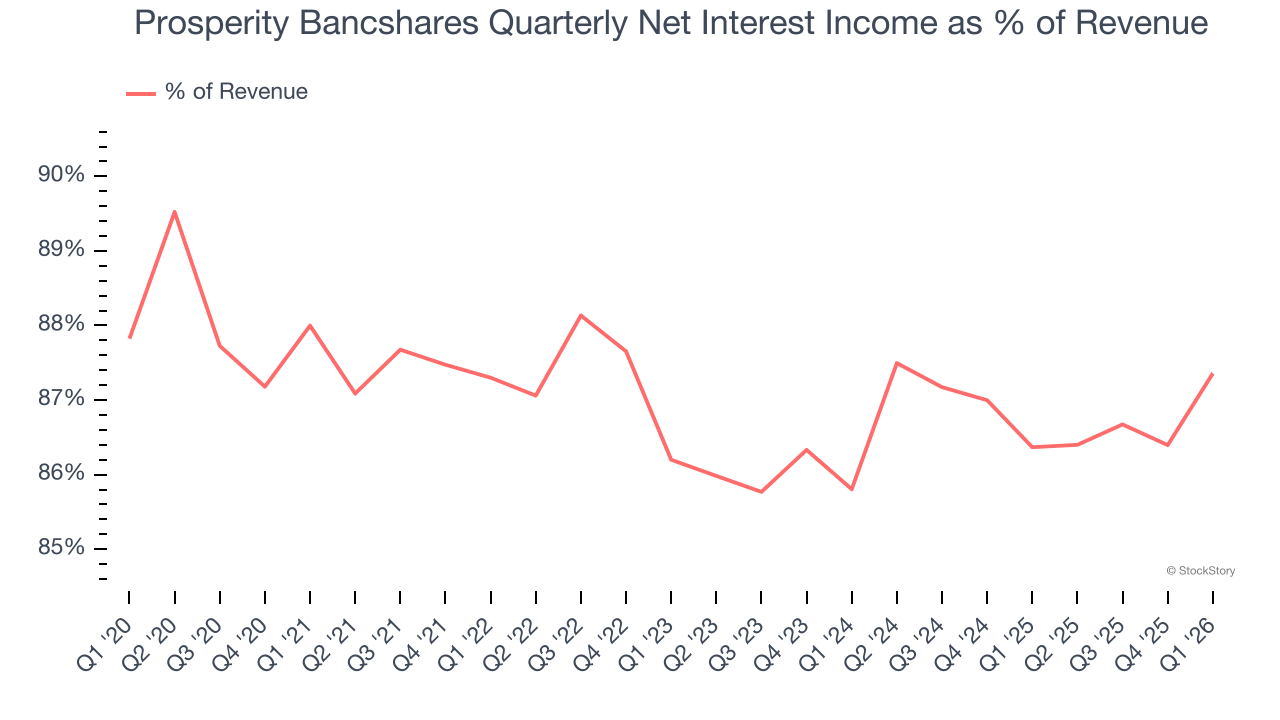
Markets consistently prioritize net interest income growth over fee-based revenue, recognizing its superior quality and recurring nature compared to the more unpredictable non-interest income streams.
ONE MORE THING: 3 Hidden Platforms Growing 3X Faster than Amazon, Google, and PayPal. Amazon, Google, and Meta all followed the same playbook: Dominate an ignored market. Build an unbeatable moat. Scale until you’re unstoppable.
These three platforms are running that exact playbook right now. The early investors in Amazon made fortunes. The early investors in these could do the same. Get All 3 Stocks Here for FREE.
Tangible Book Value Per Share (TBVPS)
Banks operate as balance sheet businesses, with profits generated through borrowing and lending activities. Valuations reflect this reality, emphasizing balance sheet strength and long-term book value compounding ability.
When analyzing banks, tangible book value per share (TBVPS) takes precedence over many other metrics. This measure isolates genuine per-share value by removing intangible assets of debatable liquidation worth. Other (and more commonly known) per-share metrics like EPS can sometimes be murky due to M&A or accounting rules allowing for loan losses to be spread out.
Prosperity Bancshares’s TBVPS grew at a solid 6.2% annual clip over the last five years. However, TBVPS growth has recently decelerated a bit to 4.3% annual growth over the last two years (from $39.00 to $42.39 per share).
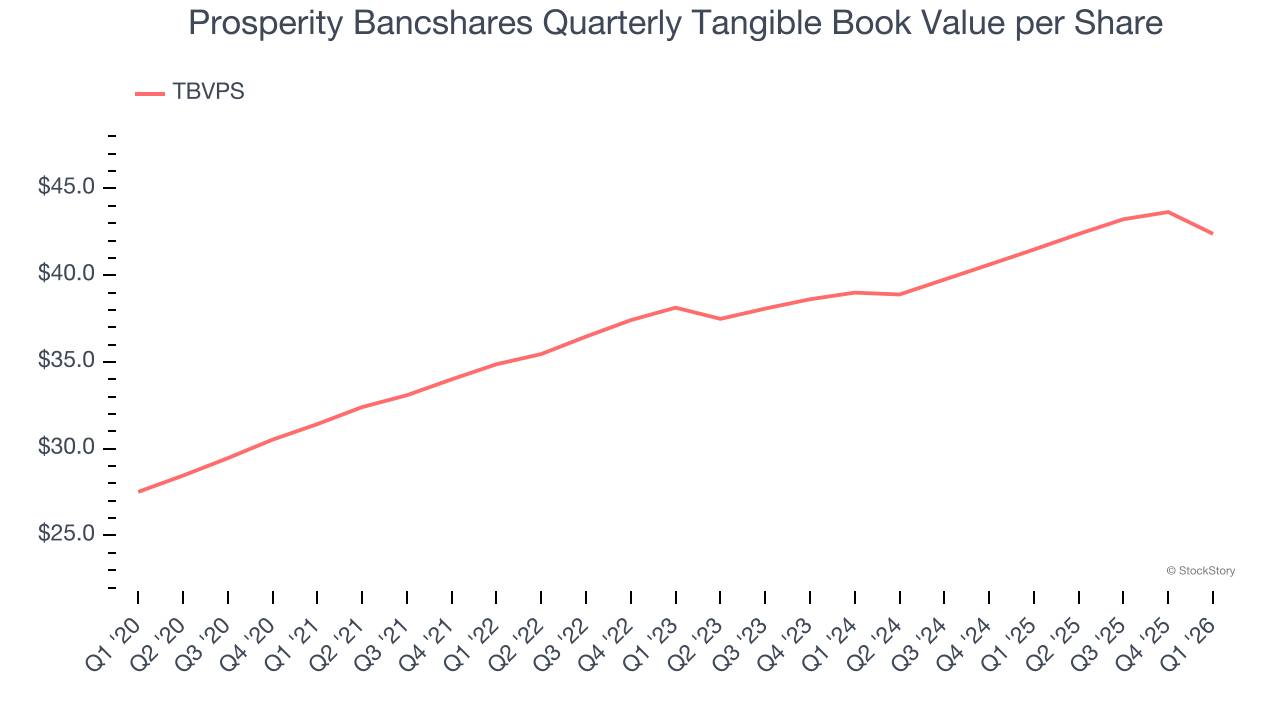
Over the next 12 months, Consensus estimates call for Prosperity Bancshares’s TBVPS to shrink by 1% to $41.96, a sour projection.
Key Takeaways from Prosperity Bancshares’s Q1 Results
We enjoyed seeing Prosperity Bancshares beat analysts’ net interest income expectations this quarter. We were also happy its revenue outperformed Wall Street’s estimates. On the other hand, its tangible book value per share missed and its EPS slightly exceeded Wall Street’s estimates. Overall, this print was mixed but still had some key positives. The stock remained flat at $69.61 immediately after reporting.
Is Prosperity Bancshares an attractive investment opportunity right now? What happened in the latest quarter matters, but not as much as longer-term business quality and valuation, when deciding whether to invest in this stock. We cover that in our actionable full research report which you can read here (it’s free).


/Advanced%20Micro%20Devices%20Inc_%20logo%20and%20chart%20data-by%20Poetra_%20RH%20via%20Shutterstock.jpg)


/Cisco%20Systems%2C%20Inc_%20HQ-by%20Sundry%20Photography%20via%20iStock.jpg)