On August 26th, 2022, Jerome Powell walked up to the podium at the Annual Jackson Hole Symposium and issued a staunch warning about inflation: “Reducing inflation is likely to require a sustained period of below-trend growth. Moreover, there will very likely be some softening of labor market conditions. While higher interest rates, slower growth, and softer labor market conditions will bring down inflation, they will also bring some pain to households and businesses.”
In the 7 months since that statement, some of his prognostications have come true others have yet to bear fruit. Let’s look at the 3 factors addressed by Chairman Powell: slowing growth, higher interest rates and softer labor markets.
It is important to note that the Federal Reserve has set expectations for these three data points, and any deviation from these expectations may alter the course of the Fed's policy in the future.
Let’s start with slowing growth. The primary measure of this is going to be Gross Domestic Product or GDP. With Powell’s comments one would be led to believe that growth in the US is on a downward trajectory, thus negatively impacting the economy. As a benchmark for what is considered "normal," let's use the average GDP growth rate in the US between 1948 and 2022, which is 3.13%, as indicated by the horizontal red line on the chart below. Although GDP figures for Q1 and Q2 were negative, we have recently witnessed an upward shift with Q3 recording 3.2% growth and Q4 slightly lower at 2.7%.
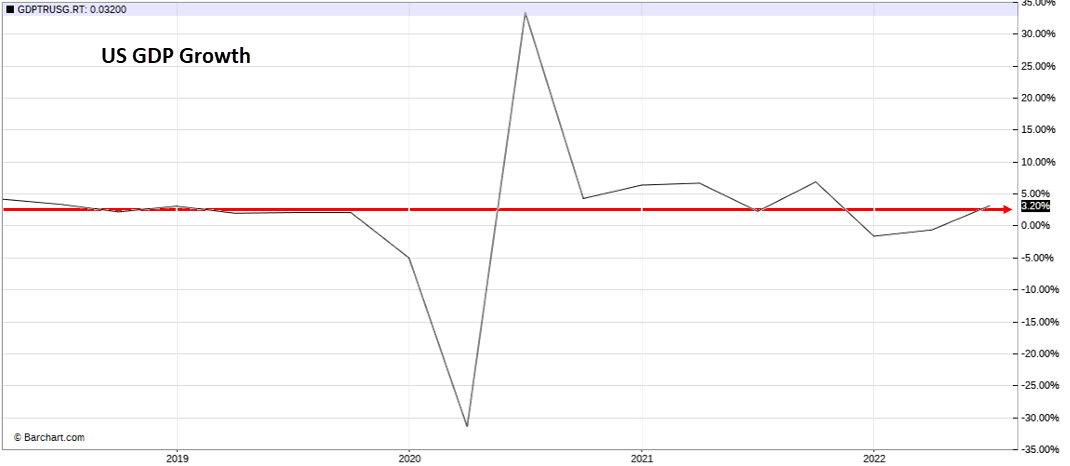
One could argue that we are right back to normal GDP levels and not experiencing a slowdown as the Fed has anticipated.
Interest rates on the other hand have been witnessing steady increases across all maturities. At the time of the above referenced speech, the Fed Funds rate was sitting at 2.5%, today 4.75%. That’s a 90% increase in just over 7 months. Of course, this was a very aggressive assault on the high inflation data at the time, and more hikes are expected going forward. Even longer-term maturities have witnessed sharp increases. As you can see here, the 10-year treasury has increased from 3.045% to 3.97%, a 30% increase.
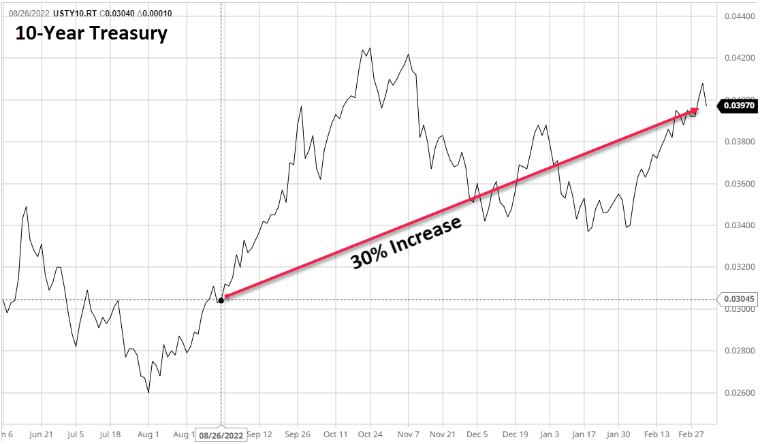
These increases essentially raise the cost of capital. The higher they go, the more pressure it will put on businesses, consumers, real estate and much more! If bond yields continue to rise, expect bearish moves on the broad markets. Jerome Powell’s aggressive comments during his testimony on Capitol Hill on Tuesday vaulted the probability of a 50-basis point rate hike at the March 22nd FOMC meeting to 79%. It was only 31% on Monday!
Now for the biggie, Unemployment. When I watched the Jackson Hole speech, I was surprised to hear him say it was going to bring some “Pain” to businesses and households. Nobody wanted to hear that. From his tone, you got the sense that unemployment was going to skyrocket, and the depression was imminent. And why not? Surely the colossal rate hikes, and increased cost of capital would have a profound impact on employers, right? When you look at the data, strip out the fear and focus on the facts, it paints a very different picture. As you can see from this chart, we have seen the unemployment rate plummet from the pandemic highs of 14.7% in May of 2020, to just 3.4% at the most recent reading in February of 2023.

How does this stack up historically? You may recall Ben Bernanke repeating over and over during the financial crisis that the Fed had a “Full Employment” target of 5.5%. The reason for selecting this target is that the average unemployment rate between 1948 and 2023 is 5.73%. As of today, were sitting at 3.4%, far below the historical average. In keeping with the theme of this article, what happened since the Jackson Hole speech? Did we feel “Pain” in the jobs market? You be the judge. In the chart above, I’ve drawn an arrow to the unemployment rate at the time of the speech, which was 3.5%. Even if we jumped to 5.5%, we would simply be back to “normal”. To say the labor market is strong would be an understatement. The last time we have had a lower unemployment rate was in 1952, 71 years ago. The next unemployment report will be released this coming Friday, March 10th.
For now, it seems that the actions taken by the Federal Reserve have been effective. Inflation has decreased from 9.1% to 6.4% over the past eight months. While there is still a significant decline in inflation required to meet the Fed's target of 2%, their actions have not had a significant impact on GDP or unemployment. However, this will most likely change in the future. Typically, it takes 9-12 months for the effects of interest rate hikes impact market data. For the long-term investors, stay the course and use protective stops on your positions. This way, you can benefit should there be a soft landing and markets rally. If you’re nervous, think about options as a way to hedge your positions and protect from sudden downside moves. Keep your eye on the data, look for trend changes and plan accordingly. While the current economic data looks relatively positive, I’m still in the bearish camp for the next year. The hawkish tone of Jerome Powell leads me to believe more rate hikes are in order. At some point, the Feds aggressive policy should have a negative impact on data other than inflation. The next 2 weeks we have the latest releases for unemployment, CPI, PPI as well as the March 22nd FOMC meeting where rates are expected to rise another 50 basis points! Brace yourselves, more volatility is just around the corner.
More Stock Market News from Barchart
- Investors Search for Value as Mega-cap Tech Stocks Get Pricey
- Stocks Mixed After Powell Says No Decision Made Yet on Pace of Rate Hikes
- Vivid Seats (SEAT) May Be Controversial But It's No Villain
- Markets Today: Stock Indexes Slightly Higher as Bond Yields Fall
On the date of publication, Merlin Rothfeld did not have (either directly or indirectly) positions in any of the securities mentioned in this article. All information and data in this article is solely for informational purposes. For more information please view the Barchart Disclosure Policy here.


/A%20Palantir%20office%20building%20in%20Tokyo_%20Image%20by%20Hiroshi-Mori-Stock%20via%20Shutterstock_.jpg)
/Elon%20Musk%2C%20founder%2C%20CEO%2C%20and%20chief%20engineer%20of%20SpaceX%2C%20CEO%20of%20Tesla%20by%20Frederic%20Legrand%20-%20COMEO%20via%20Shutterstock.jpg)
/Microsoft%20sign%20at%20the%20headquarters%20by%20VDB%20Photos%20via%20Shutterstock.jpg)