



As the global economy had enjoyed one of the longest economic expansions in history, it didn't come without repercussions. During the pandemic, the government shut down our country and the economy. Then the government issued free money to its citizens. The economy was in such dire need that to get a pulse, the Federal Reserve (FED) broke out the automated external defibrillator (AED) and began to cut interest rates to zero and buy long-dated mortgages and securities.
The US saw the savings rate increase to near-record levels during this time. This led to a country whose citizens were now flush with cash. The economy eventually came roaring back, but now all this free money went into the economy and created inflation that hasn't been experienced for 40-plus years.
Unfortunately, our commodity markets could not escape this event and began a super-cycle in the commodity markets. Live cattle prices were not spared as supply chain disruptions drove them up, droughts impacted livestock feed, worker shortages as Covid kept workers home, and consumers were flush with cash creating excessive demand.
When markets get overly bullish or bearish for an extended period, it usually doesn't end well, especially for the latecomers to the market. Hence, the perception of the live cattle market going to the moon. Like all other bubbles, this will pop, too, as nothing goes straight up forever.
But when?
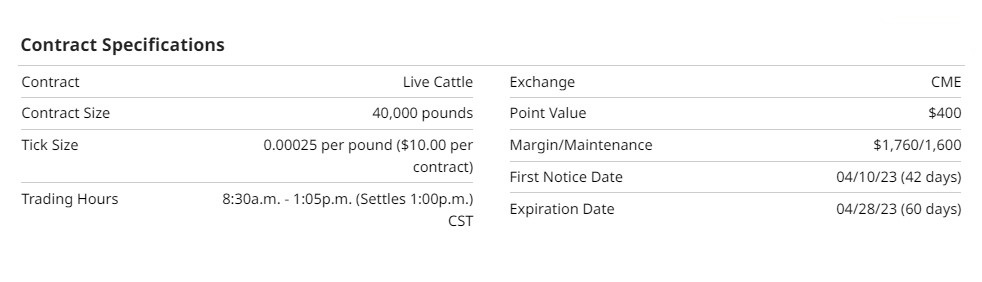
Specifications, Description, & Performance
The beef cycle begins with the cow-calf operation, which breeds the new calves. Most ranchers breed their herds of cows in summer, thus producing a new crop of calves in spring (the gestation period is about nine months). This allows the calves to be born during the milder spring weather and provides ample forage through the summer and early autumn. The calves are weaned from the mother after 6-8 months, and most are then moved into the "stocker" operation. The calves usually spend 6-10 months in the stocker operation, growing to near full-sized by foraging for summer grass or winter wheat. When the cattle reach 600-800 pounds, they are typically sent to a feedlot and become "feeder cattle." The feedlot feeds the cattle with a unique food mix to encourage rapid weight gain. The mix includes grain (corn, milo, or wheat), a protein supplement (soybean, cottonseed, or linseed meal), and roughage (alfalfa, silage, prairie hay, or an agricultural by-product such as sugar beet pulp). The animal is considered "finished" when it reaches its total weight and is ready for slaughter, typically at around 1,200 pounds, which produces a dressed carcass of about 745 pounds. After gaining total weight, the cattle are sold for slaughter to a meatpacking plant. Futures and options on live cattle and feeder cattle are traded at the CME Group. The live and feeder cattle futures contracts trade in cents per pound.
Source: Barchart CRB Yearbook
Could cattle prices look forward like crude oil and see a slowing economy with the upcoming recession? The prior three months saw live cattle prices appreciate 4%. This, considering how closely live cattle prices are correlated to the economy (a strong economy equals higher beef demand.) Comparatively, the past 52 weeks saw an 8% appreciation as the 2020 low to the current peak was 116%! These recent performance numbers could show some signs of the upside momentum slowing.
Seasonal Pattern
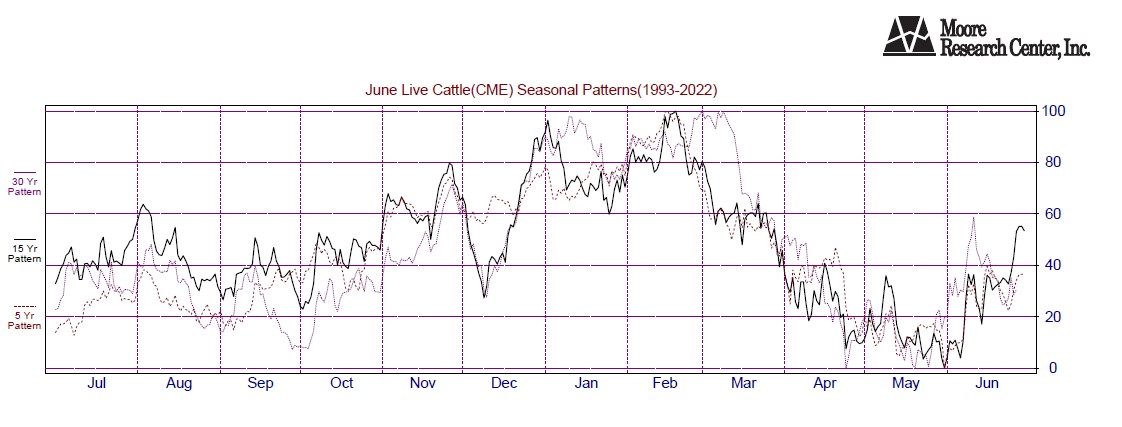
Source: Moore Research Center, Inc. (MRCI)
MRCI research has revealed that June live cattle futures prices peak in February-March, leading to a downtrend that typically carries prices down to their seasonal lows. Unlike the grain markets that exhibit seasonal patterns based on crop years (old crop-new crop), the seasonality for live cattle prices is derived from patterns occurring within a year, primarily because live cattle in non-storable compared to grains.
Many factors influence livestock supply, including market changes, cost of inputs, weather, and price of substitute goods. A change in market price can cause a short-term change in quantity; as prices increase, a farmer may move to bring more animals to market to capitalize on advantageous pricing.
Source: CMEGroup
The statement above from the CMEGroup enforces the market adage, "The best cure for high prices is high prices." When prices go up, we need to stop paying for those goods if we want them to go down." The term "we" does not refer to retail purchases only but also to wholesale merchants.
Beef can easily be substituted with pork, poultry, seafood, and, in some extreme situations, no meat.
Technical

The weekly live cattle chart above illustrates the massive 116% rally off the 2020 low. To the left (shaded red) is an all-time high for live cattle futures prices at 172.75.
Factors contributing to a "potential" price correction:
- A dominant seasonal high period
- An over-extended multi-year price move
- Upcoming anticipation of a recession (period of lower demand for beef)
- Families struggling to feed their families due to the recession
- And the idea that live cattle would not be happy on the moon
For clarity, I'm not forecasting a top that will cause prices to drop to production costs. But, merely advocating that buying at this level is not prudent. If the live cattle market does have a price correction, I have identified two possible support areas for a price reversal. Both locations are from prior resistance areas that have been broken and should act as support as prices return.
Products to Trade the Live Cattle Market
Live cattle futures only trade a standard-size contract, symbol (LE). There are options available on these futures contracts.
There is an Exchange-Traded Fund (ETF) symbol (MOO) for equity traders. MOO is not just live cattle. A portion of the fund holds lean hog futures contracts as well.
Summary
The live cattle market has had significant changes over the years. Many meat packers have been bought out or run out of business, as today, there are only four primary meatpackers, often referred to as the "Big Four": Tyson Foods, JBS, Cargill, and Marfrig. Together they control about 85 percent of feedlot cattle in the US.
With only the Big Four meat packers, this has dramatically impacted the CMEGroups live cattle futures market liquidity due to the absence of hedging needs.
Globex live cattle traded 17 hours daily, providing liquidity for a good portion of the day. With little demand for hedging today, the market is only open 4.5 hours daily. Leading to consistent gap openings in a leveraged asset, traders beware.
More Stock Market News from Barchart
- Concerns Have Resurfaced About Chinese Technology Stocks
- Stocks Climb on Increased M&A Activity and Lower Bond Yields
- Markets Today: Stock Indexes Push Higher on M&A Activity
- Chevron Stock Is Down But Value Investors See It as Cheap
On the date of publication, Don Dawson did not have (either directly or indirectly) positions in any of the securities mentioned in this article. All information and data in this article is solely for informational purposes. For more information please view the Barchart Disclosure Policy here.

/Micron%20Technology%20Inc_%20logo%20on%20building-by%20vzphotos%20vis%20iStock.jpg)

/AI%20(artificial%20intelligence)/AI%20engineer%20working%20on%20laptop%20by%20ART%20STOCK%20CREATIVE%20via%20Shutterstock.jpg)
/A%20corporate%20office%20for%20IBM%20by%20HJBC%20via%20Adobe%20Stock.jpeg)