




A bear put spread is a vertical spread that aims to profit from a stock declining in price. It has a bearish directional bias as hinted in the name. Unlike the bear call spread, it suffers from time decay so traders need to be correct on the direction of the underlying and also the timing.
A bear put spread is created through buying an out-of-the-money put and selling a further out-of-the-money put.
The maximum profit is equal to the distance between the strikes, less the premium paid. The loss is limited to the premium paid.
Let’s take a look at Barchart’s Short Bear Put Spread Screener for today:

Some interesting trades here with impressive Max Profit Percentage. Let’s take a look at the first item in the table – a bear put spread on Verizon (VZ).
Verizon Bear Put Spread Example
Using the April 21 expiry, this trade involves buying the 40 put and selling the 30 put.
The price for the trade is $1.54 which means the trader would pay $154 to enter the trade. This is also the maximum loss. The maximum gain be calculated by taking the width between the strikes and subtracting the premium paid:
10 – 1.54 x 100 = $846.
The breakeven price for the trade is equal to the long put strike, less the premium. In this case, that gives us a breakeven price of 38.46.
Let’s strengthen our bearish screener by adding a parameter for any stock with a Sell rating greater than 49%. Here are the results:
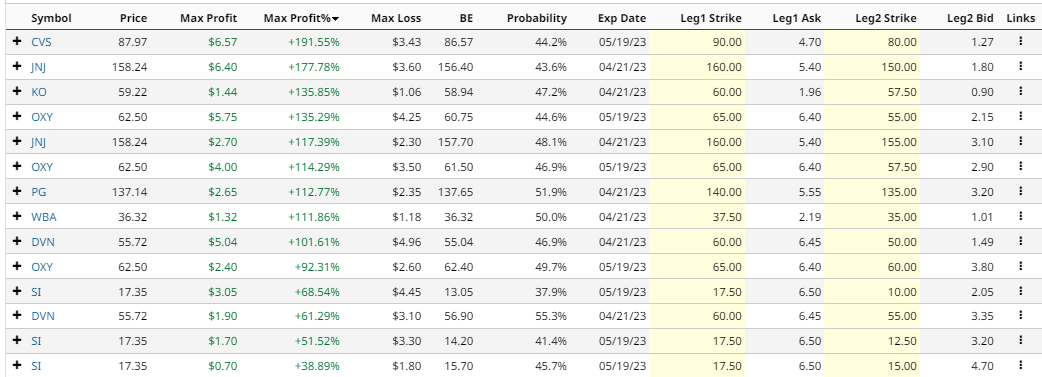
Let’s look at the first example on CVS.
CVS Bear Put Spread Example
The first line item on CVS stock is using the May expiry and involves buying the 90 strike put and selling the 80 strike put.
The cost of the trade is $343 which is also the maximum loss with the maximum possible gain being $657. The maximum gain would occur if CVS stock fell below 80 on the expiration date.
The Barchart Technical Opinion rating is an 88% Sell with a strongest short term outlook on maintaining the current direction. Long term indicators fully support a continuation of the trend.
CVS is showing an IV Percentile of 1% and an IV Rank of 1.98%. The current level of implied volatility is 19.53% compared to a 52-week high of 36.93% and a low of 19.17%.
Of the 18 Analysts following CVS there are 11 Strong Buy, 3 Moderate Buy and 4 Hold recommendations.
Let’s look at another example, this time on Johnson & Johnson (JNJ).
JNJ Bear Put Spread Example
The JNJ example is using the April 21 expiry and involves buying the 160 strike put and selling the 150 strike put.
The cost of the trade is $360 which is also the maximum loss with the maximum possible gain being $640. The maximum gain would occur if JNJ stock fell below 150 on the expiration date.
The Barchart Technical Opinion rating is a 72% Sell with a strongest short term outlook on maintaining the current direction. Long term indicators fully support a continuation of the trend.
JNJ is showing an IV Percentile of 8% and an IV Rank of 13.88%. The current level of implied volatility is 15.77% compared to a 52-week high of 25.03% and a low of 14.28%.
Of the 17 Analysts following JNJ there are 7 Strong Buy, 1 Moderate Buy and 9 Hold ratings.
Mitigating Risk
Thankfully, bear put spreads are risk defined trades, so they have some build in risk management. The most the CVS example can lose is $343 while the JNJ trade has risk of $360.
For each trade consider setting a stop loss of 30% of the max loss.
Please remember that options are risky, and investors can lose 100% of their investment.
This article is for education purposes only and not a trade recommendation. Remember to always do your own due diligence and consult your financial advisor before making any investment decisions.
More Stock Market News from Barchart
- Stocks Slump as Fed Officials Mention Bigger Rate Hikes
- Profit Estimates for Tech Stocks Continue to Fall
- The CRUZ ETF- A Bearish Trend and Reversal
- Strength in U.S. Producer Prices and Hawkish Fed Speak Weighs on Stocks
On the date of publication, Gavin McMaster did not have (either directly or indirectly) positions in any of the securities mentioned in this article. All information and data in this article is solely for informational purposes. For more information please view the Barchart Disclosure Policy here.


/NVIDIA%20Corp%20video%20chip-by%20Antonio%20Bordunovi%20via%20iStock.jpg)

/Space/Rocket%20lift%20off%20by%20Alones%20via%20Shutterstock.jpg)
/A%20close-up%20of%20an%20AMD%20office%20by%20gehapromo%20via%20Adobe%20Stock.jpeg)