Chart of the Day
The information and opinions expressed below are based on my analysis of price behavior and chart activity
Sign Up to receive Walsh Trading’s 1st Half of 2026 Market Outlook First Half of 2026 Outlook for the Livestock and Grain markets.
Tuesday, February 10, 2026
If you like this article and would like to receive more information on the commodity markets from Walsh Trading, please use the link to join our daily email list -Click here
April Live Cattle (Daily)
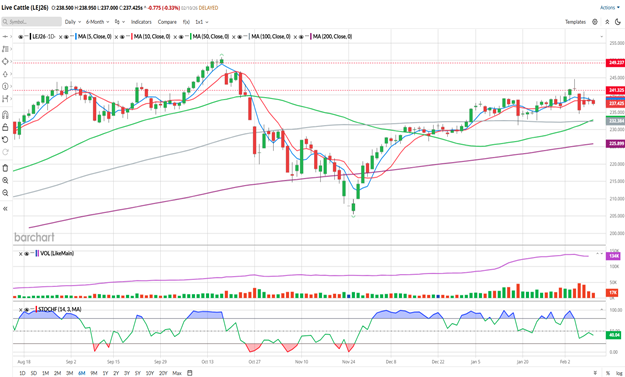
Today, April Live Cattle futures closed down 0.775, to settle at 237.425. Following a large spike higher last week, Wednesday, the market has been struggling to find its bullish footing. The lower opening on Thursday has left a gap to 241.325, which the market attempted to fill on Friday. Price didn’t quite get there, so now there are 2 overhead gaps in Cattle prices. The first one remains from October 16th and both of those are shown on the chart denoted by the red horizontal lines. Prices appear to have been sideways since the beginning of the year. There is a very mild uptrend, perhaps, but it hasn’t been a very strong bullish trend since late-November to early-December, to my eye.
Recent news in the Cattle trade has been sparse, I think. There was the announcement that the New World Screwworm dispersal facility in TX has been completed and the sterile fly production facility is in progress, of some sort, expected to open in 2027. But that’s not “new” news, as those plans were announced months ago. As were the increased Argentinian beef imports. Last Thursday and Friday, much talk was circulating about those imports being increased 4-5x what they were. That’s going to amount to about 100,000 of beef being imported, which is about 20% of our DAILY US production. Seems like a drop in the bucket to me. Like the Screwworm news, the increase was announced months ago, but the agreement was finalized and they put pen to paper last week. Nothing new has come out of either situation.
Cash trade remains strong, with sale barns across the country still setting records for prices. The number of calves here have been declining (down another 500k+ in 2025) and I don’t think there’s anywhere near the heifer retention to rebuild the herd. The beef packers and slaughterhouses are still underwater, with latest estimates suggesting that they’re losing upwards of $250/head. I don’t think the cattle producers and feedlots carry much concern for those negative margins. There are still less cattle here in the US and we still have more people to feed. Next Friday’s Cattle on Feed report, due on the 20th, should confirm the data again.
I’m still bullish Cattle prices, in the long run, but have some concerns in the short-term outlook.
It’s tough to discern on the chart above, but the 5-and 10-day moving averages made a bearish crossover with today’s trade in both April Live Cattle and April Feeder Cattle contracts. The 5-day (blue) is offering potential resistance near 363.055 and the 10-day (red) is near 363.112. Not a huge divergence yet, as it’s only the first day of a possible short-term trend shift. The 50- and 100-day moving averages also made a bullish crossover today, those are the green (232.790) and grey (232.384) lines on the chart above. Those levels may offer some potential support, along with the 200-day moving average (purple) near 225.899. Stochastics (bottom sub-graph) have hit their lowest levels since November 26th. The market is not currently oversold, but does seem to be heading in that direction.
Aggressive and well-margined traders may do well to consider short futures positions, should prices rebound to 238.000 this week. I would suggest a risk/reversal Buy Stop near last Thursday’s high of 240.425. That works out to a potential risk of $970 per contract, before your commissions/fees. I would suggest a potential profit target near the December 22nd high of 231.700. That would work out to a potential profit of $2,520 per contract, before your commissions/fees.
Cattle producers, I believe your risk is entirely to the downside. I would suggest April 235 Puts. There are 51 days until those options expire. Today, those Puts settled at 4.75 or $1,900 before your commissions/fees. Place a GTC order at 2x what you paid for the option. If the market is still weak, repeat the strategy, but take care to not spend more money than you did on the first group of Put options.
For those looking to spend less out of pocket, I also would suggest selling the April 225 Put, to make that a bearish Put Spread. That will reduce your out-of-pocket costs, as that spread closed at 2.925 today, or $1,170 before your commissions/fees. Same as I mentioned above, place a GTC order to exit the position at 2x what you paid for it.
Again, I’m still bullish cattle in the long run. However, the charts have gotten a bit weaker and there are some technical signals the market wants to turn lower in the short-term.
April Live Cattle (Weekly)
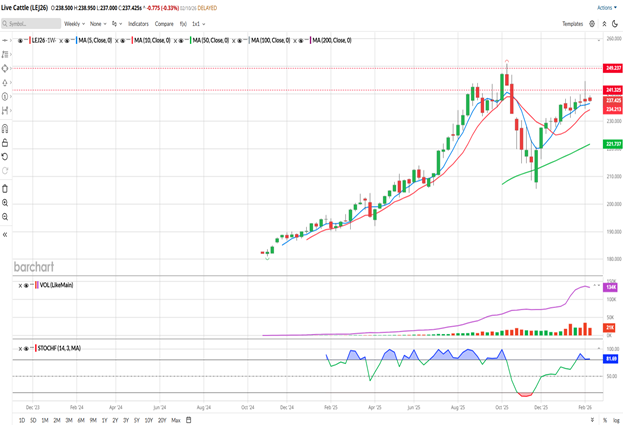
So far this week (I know it’s only Tuesday) the April Live Cattle are up 0.175 from Friday’s close. The 5-week average (blue) is offering potential support near 236.475, as is the 10-week moving average (red) near 234.213. The 50-week (green) is near 221.737, which should offer bullish trend support. Weekly Stochastics are still in overbought territory, as they have been trough the life of this contract. Should the market retrace the November low to February high, the 50% retracement (not pictured) should be right near 225.000. That’s why I selected the 225 Puts that I mentioned above.
You can view Barchart’s seasonal data here. The seasonal charts that I use, suggest a short-term top right around mid-February, lasting until the first week or so of March. Usually, the market resumes a rally through the rest of March and into April.
Sign Up to receive Walsh Trading’s 1st Half of 2026 Market Outlook First Half of 2026 Outlook for the Livestock and Grain markets.
If you like what you’ve read here and would like to see more like this from Walsh Trading, please Click here and sign up for our daily futures market email.
Jefferson Fosse Walsh Trading
Direct 312 957 8248 Toll Free 800 556 9411
jfosse@walshtrading.com www.walshtrading.com
Walsh Trading, Inc. is registered as a Guaranteed Introducing Broker with the Commodity Futures Trading Commission and an NFA Member.
Futures and options trading involves substantial risk and is not suitable for all investors. Therefore, individuals should carefully consider their financial condition in deciding whether to trade. Option traders should be aware that the exercise of a long option will result in a futures position. The valuation of futures and options may fluctuate, and as a result, clients may lose more than their original investment. The information contained on this site is the opinion of the writer or was obtained from sources cited within the commentary. The impact on market prices due to seasonal or market cycles and current news events may already be reflected in market prices. PAST PERFORMANCE IS NOT NECESSARILY INDICATIVE OF FUTURE RESULTS. All information, communications, publications, and reports, including this specific material, used and distributed by Walsh Trading, Inc. (“WTI”) shall be construed as a solicitation for entering into a derivatives transaction. WTI does not distribute research reports, employ research analysts, or maintain a research department as defined in CFTC Regulation 1.71.

/Microsoft%20sign%20at%20the%20headquarters%20by%20VDB%20Photos%20via%20Shutterstock.jpg)