



Alphabet (NASDAQ:GOOG) (NASDAQ:GOOGL) this month announced it was cutting 12,000 jobs as part of a plan to lower costs and pivot to new opportunities like AI, but one investor isn't satisfied. Activist investor Christopher Hohn of TCI Fund Management, which had pushed the tech giant to trim its workforce back in November and argued the company would be more efficient with fewer employees, is now calling for Alphabet to go even further with its cost-cutting.
In a letter to Alphabet CEO Sundar Pichai, Hohn said, "The decision to cut 12,000 jobs is a step in the right direction, but it does not even reverse the very strong headcount growth of 2022." Hohn noted that prior to the recent layoffs announcement, the company added 30,000 jobs in 2022 alone, and it has doubled its headcount over the last five years.
Hohn called on the company to reduce its headcount by another 25,000 people, bringing the total workforce to 150,000, in line with where it finished in 2021. He also said that employee compensation was too high, noting the median salary at the company was $300,000 and that the average was much higher. He also claimed that competition for talent in the tech industry had cooled, and given the decline in the stock price, he called on Alphabet to limit stock-based compensation.

Image source: Getty Images.
Investors seem to agree
Layoffs are an unfortunate consequence of the "creative destruction" in a free market, but investors often cheer layoff announcements, seeing them as an indicator that profits will grow. That's exactly what happened with Alphabet last Friday, as the stock jumped 5.3% after the company announced its cost-cutting plan.
Investors may have been anticipating those layoffs after fellow FAANG stocks like Meta Platforms, Amazon, and Microsoft all made similar announcements, but they also bid the stock higher because they thought it was the right move.
Alphabet, whose headcount had grown 24% year over year in the third quarter, faced questions about excessive hiring on its last earnings call, and management promised to slow hiring in the fourth quarter and in 2023. The headcount growth was also a clear contrast from recent revenue growth, which slowed to just 6% in the third quarter and was expected to decelerate further.
Net income per employee at Alphabet surged in 2021, but prior to that surge, it had been flat for most of the last decade, as the chart below shows. Though full-year results for 2022 aren't in yet, it's clear that net income per employee fell significantly last year.
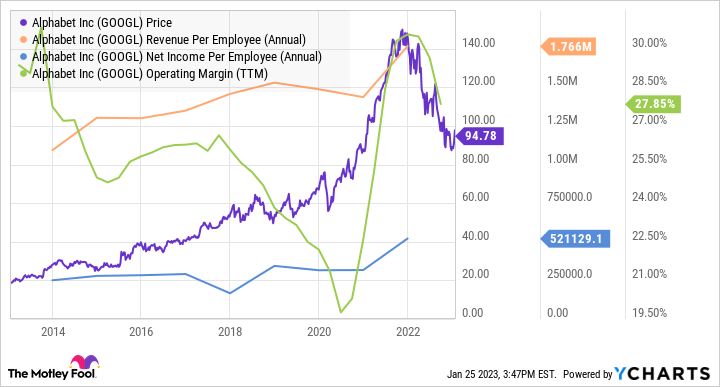
What's also telling about that chart is that the company's operating margin declined for most of the last decade even as its advertising business put up monstrous growth. You'd expect margins at a business like Alphabet, whose profits are nearly all driven by digital advertising, to expand as it gets bigger, as advertising is a scalable business and prices are determined by demand rather than costs.
However, for the most part, the opposite happened as the company spent on projects like Google Cloud and other bets like Waymo that yielded losses rather than profits.
Why more cuts could be on the way
Taking Hohn's statement as a starting point, if each job represents $300,000 (likely more with benefits), that means Alphabet just cut its budget by at least $3.6 billion a year. If the company can do that without significant damage to its operations, then the justification for further cuts becomes clearer.
There's also the reality of the macroeconomic headwinds facing the company. Management doesn't give guidance, but after its revenue growth slowed to just 6% in the third quarter, the analyst consensus calls for top-line growth of 1.6% in the fourth quarter and 3.2% in the first quarter of 2023. Those estimates could go down, as Microsoft reported just 2% revenue growth in its fourth quarter, prompting Alphabet stock to fall 2.5% on Wednesday.
As CEO Sundar Pichai said in his letter on the first round of layoffs, the company hired for a different economic reality than the one it currently faces, and further deterioration in the economy could lead to more cost cuts coming. If Hohn is right, there's still a lot of room for the company to improve its profitability, and that's good news for investors, whether the company does it through cost cuts or reaccelerating revenue growth.
10 stocks we like better than Alphabet
When our award-winning analyst team has a stock tip, it can pay to listen. After all, the newsletter they have run for over a decade, Motley Fool Stock Advisor, has tripled the market.*
They just revealed what they believe are the ten best stocks for investors to buy right now... and Alphabet wasn't one of them! That's right -- they think these 10 stocks are even better buys.
*Stock Advisor returns as of January 9, 2023
Randi Zuckerberg, a former director of market development and spokeswoman for Facebook and sister to Meta Platforms CEO Mark Zuckerberg, is a member of The Motley Fool's board of directors. Suzanne Frey, an executive at Alphabet, is a member of The Motley Fool's board of directors. John Mackey, former CEO of Whole Foods Market, an Amazon subsidiary, is a member of The Motley Fool's board of directors. Jeremy Bowman has positions in Amazon.com and Meta Platforms. The Motley Fool has positions in and recommends Alphabet, Amazon.com, Meta Platforms, and Microsoft. The Motley Fool has a disclosure policy.



/Netflix%20open%20on%20tablet%20by%20rswebsols%20via%20Pixabay.jpg)
/Netflix%20on%20tv%20with%20remote%20by%20freestocks%20via%20Unsplash.jpg)