WINNIPEG - A report from a major credit-rating agency is raising questions about the Manitoba government's plan to reduce the deficit this year and balance the budget next year.
Moody's, in a report issued last week, said the province's plan to slash annual deficits, last estimated at more than $1.6 billion for the fiscal year that ended in March, does not appear to line up with the government's own economic growth projections. Economic growth leads to more tax revenue.
"The budget expects slow but steady economic performance, with real (gross domestic product) growth of 1.3 per cent in 2026 and 1.7 per cent in 2027, although we note that the rapid pace of projected fiscal improvement appears inconsistent with this slow growth," the report says.
Moody's also raises a cautionary note about the budget's projections for a big turnaround and profit at Crown-owned Manitoba Hydro.
For the last two years, government budgets have predicted a net income at the utility. In both years, the utility ended up losing money, largely due to drought and reduced water levels used to generate power.
Hydro's net loss was last pegged at $502 million for the fiscal year that ended in March. This year, the government is predicting net income of $140 million.
"The province's forecast of a rapid fiscal improvement relies in part on its expectation of a significant year-over-year improvement in Manitoba Hydro's performance," the Moody's report says.
"However, recent forecast misses by the public utility indicate significant uncertainty around its fiscal contribution."
Another credit rating agency, Morningstar DBRS, also issued a report last week. It, too, raised concerns about economic uncertainties, but said the Manitoba government's plan to balance the budget "appears intact."
"The New Democratic Party government appears committed to its goal of returning to balance by 2027-28, although we believe that a softer economic outlook, extreme weather events, and trade disruptions could challenge the government's ability to achieve its fiscal targets," the report says.
"That said, the budget incorporates modest contingencies, and a well-diversified economy will help mitigate potential financial pressures that could arise from trade disruptions."
The NDP made a balanced budget by 2027-28 part of its election platform in 2023. Manitoba has recorded deficits in every year but two since 2009.
The government has missed its targets since the election. Expenditures are running about $2 billion higher than what was laid out in the NDP's initial path to balance.
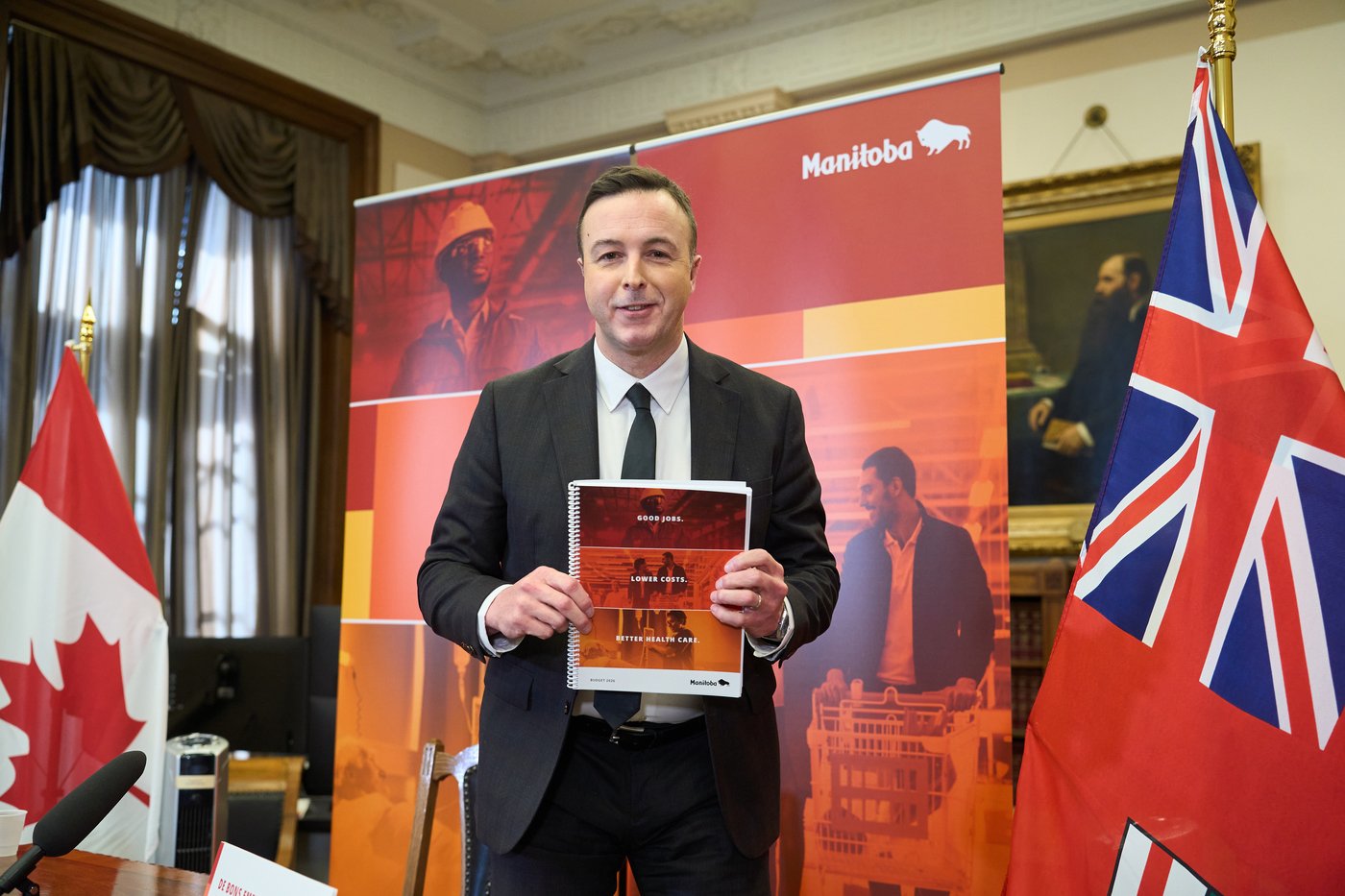
Finance Minister Adrien Sala said the government's revenue projections are accurate and the province will have a balanced budget next year as promised.
"Like all provinces in Canada, Manitoba continues to face some uncertainty related to the impacts of tariffs, but fortunately we've got a strong and resilient economy that's very diverse and tends to fare well during these periods where we face headwinds," Sala said Thursday.
As for the expected profit at Manitoba Hydro, Sala said the budget has taken into account the dry conditions from the last two years.
"This year's Hydro net-income forecast acknowledges that our reservoirs are low by historical standards, and then from there, builds a forecast based on average precipitation over the course of the year."
Debt-servicing costs are dropping, Sala added, which should free up $240 million this year for other spending.
The government is predicting a surplus of $8 million for the 2027-28 fiscal year — the year in which voters are scheduled to go to the polls again. Moody's said the $8 million planned surplus is "thin," equal to less than 0.1 per cent of the government's annual revenues.
This report by The Canadian Press was first published April 3, 2026.

/Nvidia%20logo%20and%20sign%20on%20headquarters%20by%20Michael%20Vi%20via%20Shutterstock.jpg)

/Intel%20Corp_%20Santa%20Clara%20campus-by%20jejim%20via%20Shutterstock.jpg)