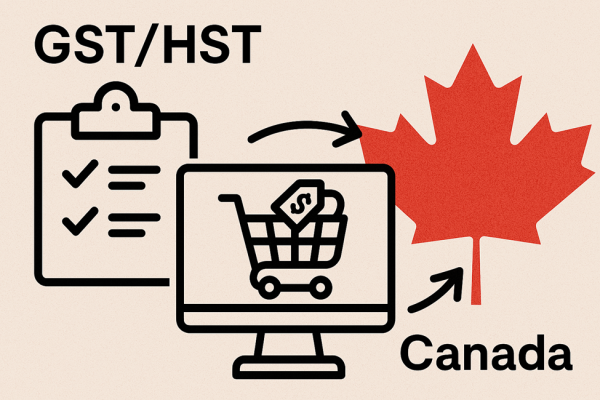
Dropshipping has become a popular business model in Canada due to its low-cost entry, minimal inventory requirements, and ease of setup. However, as simple as starting a dropshipping business might seem, navigating Canadian tax obligations--especially those around GST/HST--can get complicated. Understanding these obligations is crucial not only for compliance but also for ensuring the long-term success of your e-commerce venture.
If you're running a dropshipping business and are unsure about your GST/HST obligations, this guide simplifies everything you need to know. You can ask any questions and free consultation from the Award-Winning accounting firm "SAL", for various accounting and bookkeeping services in Toronto and Mississauga.
What is GST/HST and How Does It Apply to Dropshipping?
GST (Goods and Services Tax) and HST (Harmonized Sales Tax) are value-added taxes applied to goods and services in Canada. While GST is fixed at 5% federally, HST combines GST with the provincial sales tax (PST) in specific provinces, resulting in varying rates. For example:
Ontario applies a 13% HST.
British Columbia maintains the 5% GST and adds a separate PST of 7%.
Alberta charges GST only since it has no provincial sales tax.
The tax system varies based on your province of operation and where your customers are located.
How Does GST/HST Apply to Dropshipping?
For dropshipping businesses, GST/HST applies to sales made within Canada. If your business income surpasses CAD $30,000 annually, you're required to register for GST/HST. Once registered, you're obligated to collect GST/HST from Canadian customers, file returns, and remit the amounts collected to the Canada Revenue Agency (CRA).
Key points include:
Businesses shipping products within Canada must charge the appropriate provincial tax rate based on the customer's shipping address.
For international customers, GST/HST generally doesn't apply, making exports eligible for a "zero-rated" tax classification.
When Does a Dropshipping Business Need to Register for GST/HST?
Threshold for GST/HST Registration
The CRA requires businesses to register for GST/HST once their revenue from taxable supplies exceeds $30,000 over four consecutive calendar quarters. Here are two important categories:
Mandatory Registration:
If your gross revenue is over CAD $30,000, registration becomes obligatory.
Failure to register on time may result in penalties and interest charges.
Voluntary Registration:
Even if you don't meet the $30,000 threshold, voluntarily registering can offer benefits, such as claiming Input Tax Credits (ITCs) on business expenses (more on this below).
How to Register for GST/HST
To register:
Visit the CRA's online portal.
Create a CRA My Business Account.
Follow the registration steps for getting your GST/HST number.
Start collecting and remitting GST/HST from Canadian customers.
For step-by-step guidance, visit the CRA's official GST/HST registration page.
How Does GST/HST Affect Your Dropshipping Business?
Collecting GST/HST on Sales
Domestic Sales: You must charge GST/HST on all sales made within Canada. The applicable rate will depend on the customer's location. For example, if your business is based in Ontario and you ship to a customer in Quebec, you'll charge the 5% GST rate, not Ontario's 13% HST rate.
International Sales: Sales outside Canada are "zero-rated," meaning you don't charge GST/HST. However, you should still document these transactions for accounting purposes.
Input Tax Credits (ITCs)
Input Tax Credits allow you to recover the GST/HST paid on eligible business expenses. For example, if you pay taxes on shipping costs, online tools, or imported goods, you can claim these as credits on your GST/HST return.
Eligible ITCs include:
Shipping fees.
Supplier charges.
Paid advertising expenses (e.g., Facebook or Google Ads with GST).
Software tools like Shopify or inventory management systems.
Properly tracking these expenses is crucial to maximizing your tax credits.
GST/HST Compliance and Record-Keeping
The Importance of Accurate Records
Maintaining detailed records is essential for GST/HST compliance and auditing purposes. Records should include:
Customer invoices with tax breakdowns.
Expense receipts for business-related purchases.
Documents confirming exports for zero-rated sales.
Filing GST/HST Returns
Frequency depends on your annual taxable sales:
More than $1.5 million: File monthly.
Between $1.5 million and $6 million: File quarterly.
Less than $1.5 million: File annually.
Ensure timely submissions to avoid penalties. The CRA's online services make filing straightforward, though accounting software like QuickBooks simplifies the process even further.
For full filing instructions, visit the CRA's filing guide.
Common GST/HST Mistakes Dropshipping Businesses Make
Not Registering on Time
Missing the $30,000 threshold for registration can lead to penalties. Register proactively to avoid unnecessary fines.
Incorrectly Charging GST/HST
Charging the wrong rate for a customer's province can complicate your records. Use tax automation tools, such as those offered by Shopify or WooCommerce, to apply correct rates.
Ignoring ITC Claims
Neglecting to claim Input Tax Credits on business expenses leaves potential savings unutilized.
Poor Record-Keeping
Failing to organize invoices, receipts, and sales data makes compliance difficult and increases audit risks.
Forgetting About Zero-Rated Sales
Misclassifying zero-rated exports as taxable sales can lead to incorrect filings.
Tip: Using software like Wave or Xero can make compliance much easier by automating tax rate calculations and compiling necessary reports.
GST/HST and International Dropshipping
Selling to International Customers
Exports are generally exempt from GST/HST, so you won't need to charge tax to customers outside Canada. However, keeping documentation like shipping confirmations or customs declarations is essential to support the zero-rated classification.
GST/HST for Foreign Suppliers
Dropshipping often involves ordering products from international suppliers. While you won't pay GST/HST on these purchases at checkout, customs duties or import charges may apply. These amounts could be eligible for ITC claims, so keep records of such costs.
Understanding GST/HST in Cross-Border Dropshipping Between Canada and the U.S.
For dropshipping businesses operating between Canada and the U.S., it's crucial to understand how GST/HST impacts cross-border transactions. Since exports to the U.S. are generally zero-rated for GST/HST, you don't need to charge Canadian tax on goods shipped across the border. However, the U.S. imposes its own set of tax rules and import duties, which may vary depending on the state or product type. It's important to track all transactions and document them properly for both Canadian and U.S. tax purposes.
Additionally, if you're importing goods from the U.S. to Canada, GST/HST may apply to those purchases, and you can claim Input Tax Credits (ITCs) on the Canadian side to recover those taxes. For detailed guidance on cross-border taxation between Canada and the U.S., consider consulting with a tax professional specializing in cross-border e-commerce.
How to Stay GST/HST Compliant as a Dropshipping Business
Monitor CRA Updates
Tax laws change. Subscribe to CRA newsletters or consult professionals to stay informed about updates to GST/HST policies.
Leverage Professional Help
Given the complexities of dropshipping tax obligations, having a tax professional by your side can save you both money and time. Whether you hire a CPA or opt for consulting services, their expertise helps you maintain compliance while focusing on growing your business.
FAQs
What is the GST/HST threshold for dropshipping businesses?
You must register if you earn over CAD $30,000 in four consecutive calendar quarters. Voluntary registration is also available.
How do I claim Input Tax Credits?
Track GST/HST paid on eligible business expenses, such as shipping and software fees. Claim them when filing your GST/HST return.
Is GST/HST charged on international sales?
No. Exports are zero-rated, meaning you don't charge GST/HST. Keep documentation for proof.
What happens if I miss a GST/HST filing deadline?
Late filings can result in penalties and interest. File by the CRA's specified due dates to avoid fines.
Can dropshipping businesses hire professionals for tax compliance?
Yes, hiring a CPA or tax consultant is highly recommended if you're unsure about GST/HST rules or filing processes.
GST/HST for Canadian Dropshippers
Understanding and implementing GST/HST compliance is an essential part of running a successful dropshipping business in Canada. Whether you're collecting tax, claiming Input Tax Credits, or filing returns, it's critical to get it right from the start.
Remember, navigating taxes doesn't have to be overwhelming. With proper planning and professional support, you can meet your tax obligations confidently and focus your energy on growing your business.
"Knowledge is power--and understanding GST/HST obligations helps grow your business while avoiding financial pitfalls."
For more information or professional advice, start by consulting the CRA or booking a session with a tax expert today.
Ready to simplify your bookkeeping? Book your free bookkeeping consultation today and experience the SAL Accounting difference firsthand!
Media Info
Organization: Sal Accounting
Email: tax@salaccounting.ca
Website: https://salaccounting.ca/
Address: 55 Village Centre Pl, Suite 734, Toronto, ON L4Z 1V9 | 330 Bay St, Unit 1401, Toronto, ON M5J 0B6
COMTEX_464317795/2908/2025-04-07T15:47:20

/CPU%20Chip.jpg)
/AI%20(artificial%20intelligence)/Hands%20of%20robot%20and%20human%20touching%20on%20big%20data%20network%20connection%20by%20PopTika%20via%20Shutterstock.jpg)