




When Tokyo Pulls the Trigger and It Still Doesn't Stick
The dominant driver of Yen sentiment over the past month has been the persistent tug-of-war between BOJ intervention and the structural weight of the US-Japan interest rate differential. The Fed Funds rate currently sits at 3.50%-3.75% against the BOJ's policy rate of 0.75%, a gap of up to 300 basis points that continues to fuel the Yen carry trade and keeps the currency structurally offered.
On April 30, Japan's Ministry of Finance confirmed it conducted a yen-buying, dollar-selling intervention after the Yen weakened past the 160 per dollar level for the first time since April 2026. The Yen surged by as much as 3% on the day, according to LSEG data. A second suspected intervention followed within days during Japan's Golden Week holiday. Despite these operations, the Yen gave back all gains within weeks, with prices returning to the 160 handle by early June. Finance Minister Satsuki Katayama responded with fresh verbal warnings on June 3, stating the government will "respond appropriately at any time as necessary."
Adding urgency to the macro picture, Japan's producer price index rose 6.3% year-on-year in May, the fastest pace since March 2023, driven by soaring energy and raw material costs tied to the effective closure of the Strait of Hormuz following the Middle East conflict. Japan's yen-based import price index was up 25.5% year-on-year in May, underscoring how much the weak Yen is amplifying import-cost pressures domestically. BOJ Governor Kazuo Ueda delivered a hawkish signal last week, and markets have now nearly fully priced in a rate hike to 1.0% at the June 15-16 policy meeting. Separately, US Treasury Secretary Scott Bessent is scheduled to meet his Japanese counterpart Satsuki Katayama, with currency issues expected to be on the agenda. Stalled US-Japan trade negotiations, with Japan's lead negotiator Ryosei Akazawa returning from a seventh round of Washington talks without a breakthrough, have added an additional layer of Yen-negative uncertainty.
What the Market Has Done
- Since the start of 2025, JPYUSD futures have been in a broad compression lower, grinding steadily toward 0.00625 (Daily Level 3). For the majority of this move, price has traded below the yearly VWAP, which has acted as a consistent overhead reference and ceiling on any attempted recoveries.
- On April 30, the confirmed BOJ intervention triggered an aggressive one-day bid in the Yen, with price spiking from the 0.00625 area up to approximately 0.00645 (Daily Level 2). Sellers stepped in firmly at that level and defended it, capping the recovery and rejecting price back lower within days. The Daily Level 2 area has now established itself as clear resistance.
- Through May, the Yen gave back all of the intervention-driven move. Price grinded lower through the yearly VWAP with sellers stepping down offers, ultimately returning to the 0.00625 area. There was no sustained buying response at any intermediate level during the grind down, suggesting the path of least resistance remained to the downside while below the yearly VWAP.
- This week, buyers have responded at 0.00625 (Daily Level 3) and price has held the level for now. The structure at this point is a market that has twice tested this floor. The quality of the buyer response here, whether it is a decisive hold and bid higher or a slow bleed through, will define the next leg.
What to Expect in the Coming Weeks
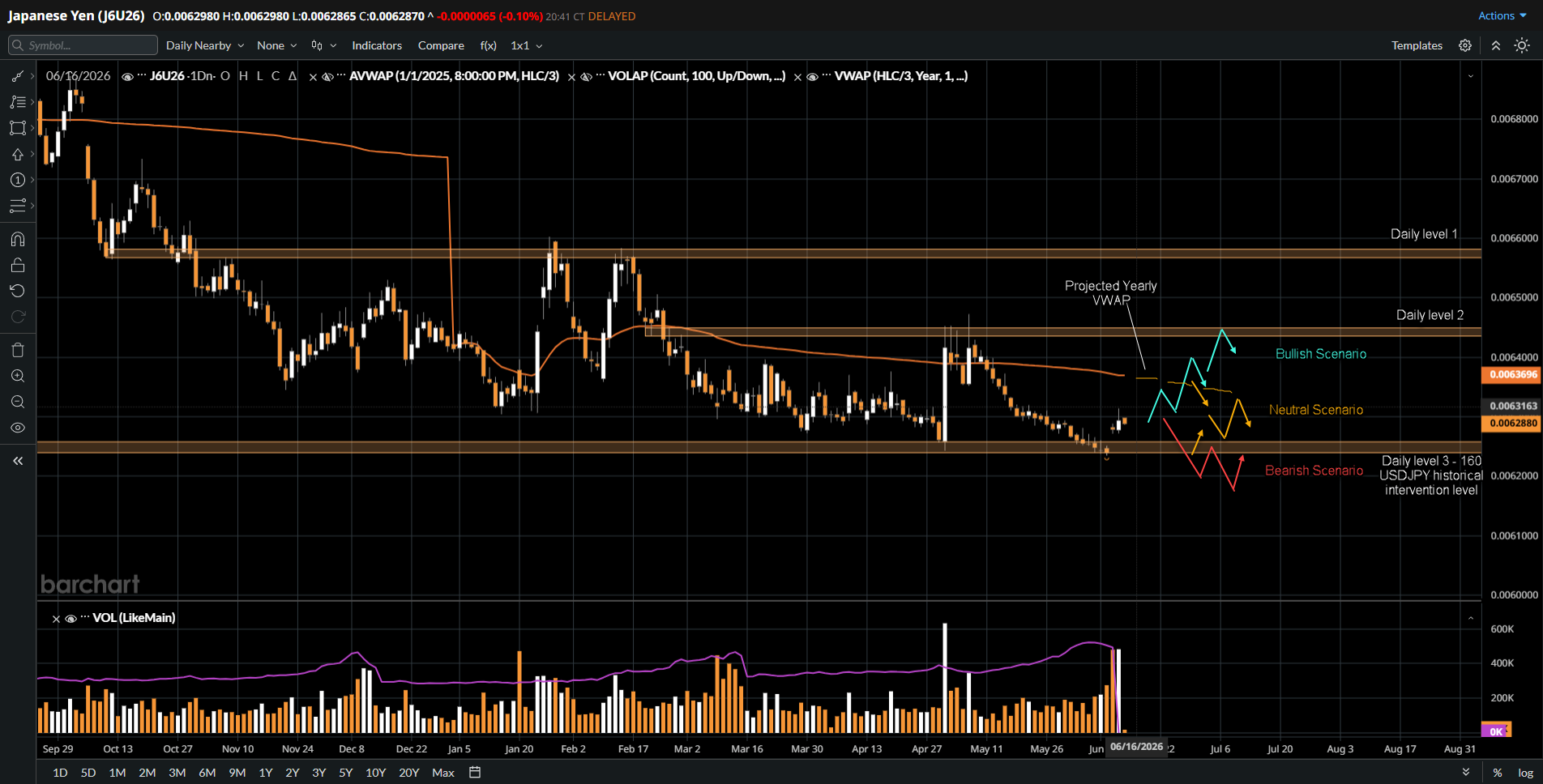
The key level to watch is 0.00625 (Daily Level 3), the 160 floor at which the BOJ has demonstrated a willingness to defend the Yen.
Bullish Scenario:
- If buyers successfully defend 0.00625 and price bids back above 0.0063, expect a move back toward the yearly VWAP and potentially to 0.0064. With no sustained seller response at that area, price could extend back up to retest 0.00645 (Daily Level 2), the level sellers defended following the April 30 intervention.
- The possible macro trigger here is a BOJ hike at the June 15-16 meeting paired with hawkish forward guidance from Governor Ueda signaling further tightening is on the table. A concurrent softening in US data that revives Fed rate cut expectations would compress the rate differential and add fuel to Yen strength. A breakthrough in US-Japan trade negotiations that removes the tariff overhang on Japanese autos could also provide an additional Yen-positive catalyst.
Neutral Scenario:
- If sellers defend at the yearly VWAP on any bounce, expect a two-way auction to develop between the yearly VWAP and the 0.00625 level, with neither side able to establish sustained directional control.
- This scenario materializes if the BOJ hikes as expected but delivers a dovish, data-dependent tone that disappoints expectations for an accelerated tightening cycle. A market that has already priced in the June hike would have little new information to trade off, resulting in range-bound price action as participants wait for the next catalyst, likely the September BOJ meeting or further developments in US-Japan trade talks.
Bearish Scenario:
- If buyers fail to defend 0.00625, expect a break below with an initial target at 0.0062, and potentially an extension down to 0.00617 where a buying response is expected as the BOJ may be compelled to intervene again.
- The trigger for this outcome would be a BOJ that hikes but signals a pause, reinforcing the view that the rate differential stays wide with the Fed parked at 3.50%-3.75% and no cuts priced for 2026. With markets already assigning roughly a 79% probability of zero Fed cuts this year following persistent US inflation, any BOJ hesitation would simply entrench the carry trade and keep the Yen offered. Escalating Middle East tensions that drive further energy cost increases, compounding Japan's import bill and growth headwinds, would reinforce the bearish case. A BOJ perceived as moving too slowly against a Fed on hold indefinitely would embolden carry traders to push the Yen through the 160 floor.
Conclusion
The Yen sits at one of the most consequential levels of the year, and the outcome of this week's price action at 0.00625 (Daily Level 3) sets the tone heading into what could be the BOJ's most significant policy decision in years. Technically, the structure remains bearish below the yearly VWAP, and the April 30 intervention only managed a temporary reprieve before sellers reasserted. Fundamentally, the BOJ is being pushed toward policy normalization by inflation running at multi-year highs, but the same energy shock driving that inflation is a real constraint on how aggressively they can act. The June 15-16 BOJ meeting is now the single most important event for the Yen in the near term. A hike paired with credible hawkish guidance could be the catalyst that finally shifts the technical structure, while a dovish hike risks handing carry traders another entry point. Whether 0.00625 holds or breaks, the Yen is not staying quiet. Drop your view in the comments below. Are buyers finally making a stand, or is this floor about to give way?
EdgeClear is designed for traders who refuse to guess. We deliver unfiltered tick data via Rithmic, competitive pricing starting at $0.22 per side, and performance analytics that transform your trade log into a roadmap. The serious trader’s next move is clear. Open an Account today.
Disclaimer:
This article is provided for informational and educational purposes only and does not constitute financial, investment, or trading advice. The analysis presented reflects the author’s market observations and opinions at the time of writing and is not a recommendation to buy or sell any futures contract, security, or financial instrument. Futures trading involves significant risk and is not suitable for all market participants. Losses may exceed initial margin deposits, and market conditions can change rapidly.
Any scenarios, levels, or market expectations discussed are hypothetical in nature and are intended solely to illustrate potential market behavior. They do not represent actual trading results and should not be interpreted as guarantees of future performance. Past performance, market behavior, or historical price action are not indicative of future outcomes.
Readers are solely responsible for their own trading decisions and risk management. Always conduct independent research, consider your financial situation and risk tolerance, and consult with a qualified financial professional, if necessary, before engaging in futures or derivatives trading.

/Space/Planet%20earth%20with%20flying%20rocket%20by%20Sergey%20Mironov%20via%20Shutterstock.jpg)

/Robinhood%20app%20on%20phone%20by%20Andrew%20Neel%20via%20Unsplash.jpg)

/Alphabet%20(Google)%20Image%20by%20Markus%20Mainka%20via%20Shutterstock.jpg)