The Federal Reserve's favored gauge of inflation came in under estimates but still hit multiyear highs last month, showing a continued pinch on consumers and likely keeping America's central bank on the monetary policy sidelines.
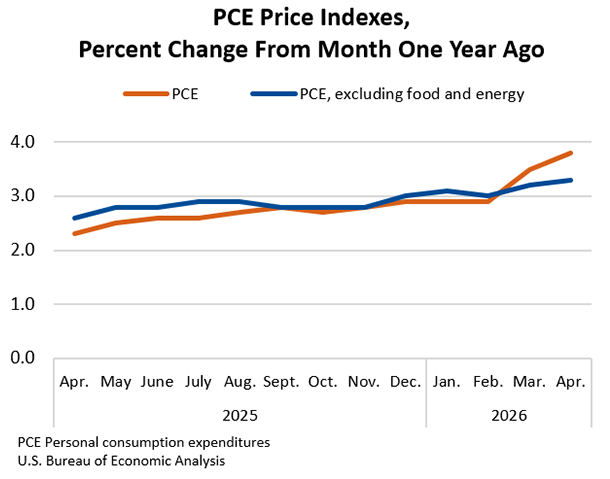
The Commerce Department on Thursday reported that the personal consumption expenditures (PCE) increased at a seasonally adjusted rate of 0.4% month-over-month in April, which was below Dow Jones-surveyed economists' estimates for 0.5% PCE growth. The year-over-year rate of 3.8% was in line with estimates.
"Core" PCE, which backs out food and energy prices, also increased more slowly than expected on a month-over-month basis, coming in at 0.2% against estimates for 0.3%. But the 3.3% year-over-year gain was both on target and marked the highest such rate since October 2023, when core PCE inflation expanded at a 3.5% clip.
The PCE data follows a similarly hot April consumer price index (CPI) report.
"As year-on-year headline and core measures continue to read well into the 3% range, above the Fed's comfort zone, a critical factor in the forward path may well be the duration of elevated oil prices as the Middle East conflict continues," says Adam Hetts, Global Head of Multi-Asset and Portfolio Manager at Janus Henderson Investors.
Here's a quick look at April's key PCE figures:
- MoM PCE: +0.4% (estimate: +0.5%)
- YoY PCE: +3.8% (estimate: +3.8%)
- MoM Core PCE: +0.2% (estimate: +0.3%)
- YoY Core PCE: +3.3% (estimate: +3.3%)
Costs for energy goods and services were unsurprisingly higher, up 18.3% year-over-year as the impacts from America's war with Iran filter down to consumers. Higher housing costs remain sticky, up 3.2% year-over-year. People are also paying 3.5% more for recreational goods and vehicles, and 3.4% more for clothing and footwear. Motor vehicle costs were actually down 4.2% YoY.
Related: 7 Best AI ETFs for the Artificial Intelligence Era
Given some of the inputs driving inflation higher, the Fed's hands appear somewhat tied right now.
“As expected, inflation accelerated in April driven by higher fuel prices and shelter costs," says Scott Helfstein, Head of Investment Strategy at Global X ETFs. "This does not come as a surprise. The higher fuel costs are being driven by the Iran conflict while increasing shelter prices have been a structural issue for the past two years.
"The irony is that the Fed has limited ability to tame inflation in this scenario. Higher energy prices are driven by supply side constraints due to the Iran conflict. Higher shelter prices are a structural reality in the economy. Interest rate policy is a side show for now. Markets and the Fed largely have to let this shock play out."
Also Thursday, the Commerce Department also released the second reading for first-quarter gross domestic product. GDP only grew at an annualized rate of 1.6% in Q1, which came in below the initial reading of 2%. Downward revisions to consumer spending and investment contributed to the downward revision.
Hetts says the report "at least [confirms] the expected bounce-back from a near-zero Q4 reading. In conjunction with healthy economic data so far into Q2, the readings point to a resilient economy withstanding a prolonged war and inflationary pressures."
Do you want to get serious about saving and planning for retirement? Sign up for Retire With Riley, Young and the Invested's free retirement planning newsletter.
Fed Likely to Keep Rates Steady in June
Wall Street's expectations for rates to remain level in June hardly budged.
The CME FedWatch Tool, which uses trading in federal-funds futures to determine Wall Street's expectations for future Federal Reserve actions, shows a 98% chance that the target range for the federal funds rate will stay at its current 3.50%-to-3.75% range at the conclusion of the next Federal Open Market Committee (FOMC) meeting, scheduled for June 16-17. That's less than a percentage point lower than where it was Wednesday.
"The rising inflation and market expectations for rate hikes next year actually provides some air cover for the new Fed chair. [Kevin] Warsh now has justification to take his time before trying to push through a cut," Helfstein says. "Higher inflation allows the new Fed chair to take a wait-and-see approach that should allow him to focus on building consensus around other policies like reducing the balance sheet and changing Fed communication policy."
Related: UBS: Micron (MU) Stock Has More Than 100% Upside
What If I Need Help Picking Stocks?
Motley Fool Stock Advisor is a stock picking service that espouses our favorite, plain-vanilla trading style: buy-and-hold. Fool analysts provide recommendations for both "Steady Eddies" and potential high-flying stocks with sound fundamentals—exactly the combination of holdings you want to generate strong performance without risking extremely high volatility.
Importantly, Stock Advisor doesn't just give you a list of tickers and call it a day—it also provides investment rationales and research for each pick to help educate you before you buy.
For more than two decades, Stock Advisor stock picks have performed exceptionally well. Indeed, the service has greatly outperformed the S&P 500 since launching in 2022.
Sign up for Stock Advisor today and enjoy a discounted rate for the first year, as well as a 30-day membership-fee-back period.

/Micron%20Technology%20Inc_billboard-by%20Poetra_RH%20via%20Shutterstock.jpg)
/Palantir%20(PLTR)%20by%20Piotr%20Swat%20via%20Shutterstock.jpg)

/NVIDIA%20Corp%20logo%20on%20phone%20and%20AI%20chip-by%20Below%20the%20Sky%20via%20Shutterstock.jpg)