




As the Q4 earnings season comes to a close, it’s time to take stock of this quarter’s best and worst performers in the online marketplace industry, including Shutterstock (NYSE:SSTK) and its peers.
Marketplaces have existed for centuries. Where once it was a main street in a small town or a mall in the suburbs, sellers benefitted from proximity to one another because they could draw customers by offering convenience and selection. Today, a myriad of online marketplaces fulfill that same role, aggregating large customer bases, which attracts commission-paying sellers, generating flywheel scale effects that feed back into further customer acquisition.
The 12 online marketplace stocks we track reported a mixed Q4. As a group, revenues beat analysts’ consensus estimates by 1.5% while next quarter’s revenue guidance was in line.
Thankfully, share prices of the companies have been resilient as they are up 8.5% on average since the latest earnings results.
Weakest Q4: Shutterstock (NYSE:SSTK)
Originally featuring a library that included many of founder Jon Oringer’s photos, Shutterstock (NYSE:SSTK) is now a digital platform where customers can license and use hundreds of millions of pieces of content.
Shutterstock reported revenues of $220.2 million, down 12% year on year. This print fell short of analysts’ expectations by 12.7%. Overall, it was a disappointing quarter for the company with a significant miss of analysts’ revenue and EBITDA estimates.
Commenting on the Company's performance, Paul Hennessy, the Company's Chief Executive Officer, said, "I'm thrilled to announce that Shutterstock achieved record setting Revenue and Adjusted EBITDA in 2025. Revenue grew 6% driven by double digit growth of our Data, Distribution, and Services business, while Adjusted EBITDA margins for the year matched a previous high of 27.5% and Adjusted Free Cash Flow significantly expanded year over year. These achievements were despite continued challenges in our Content business. I want to thank our employees and contributors for their focus and commitment during this past year."
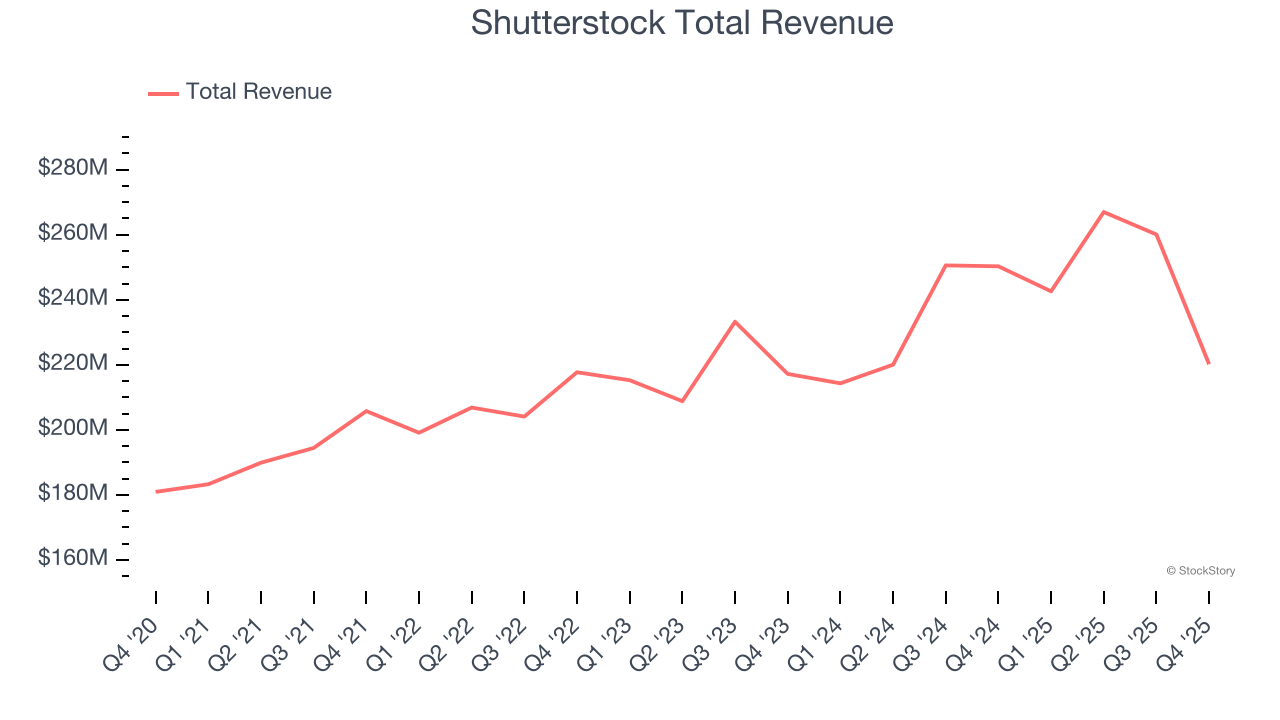
Shutterstock delivered the weakest performance against analyst estimates and slowest revenue growth of the whole group. Interestingly, the stock is up 1.2% since reporting and currently trades at $17.80.
Read our full report on Shutterstock here, it’s free.
Best Q4: eBay (NASDAQ:EBAY)
Originally known as the first online auction site, eBay (NASDAQ:EBAY) is one of the world’s largest online marketplaces.
eBay reported revenues of $2.97 billion, up 15% year on year, outperforming analysts’ expectations by 3%. The business had an exceptional quarter with revenue guidance for next quarter exceeding analysts’ expectations and EPS guidance for next quarter beating analysts’ expectations.
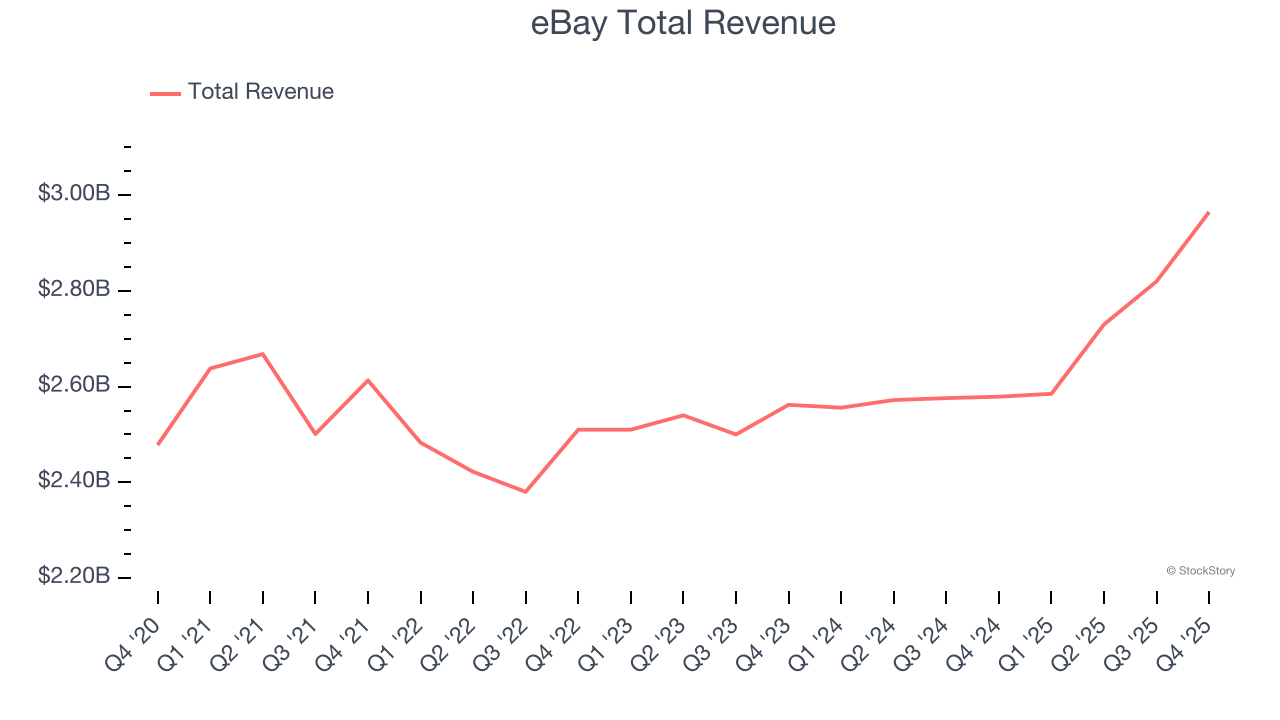
The market seems happy with the results as the stock is up 19% since reporting. It currently trades at $97.81.
Is now the time to buy eBay? Access our full analysis of the earnings results here, it’s free.
Teladoc (NYSE:TDOC)
Founded to help people in rural areas get online medical consultations, Teladoc Health (NYSE:TDOC) is a telemedicine platform that facilitates remote doctor’s visits.
Teladoc reported revenues of $642.3 million, flat year on year, exceeding analysts’ expectations by 1%. Still, it was a softer quarter as it posted revenue and EBITDA guidance for next quarter missing analysts’ expectations.
Interestingly, the stock is up 22.9% since the results and currently trades at $5.72.
Read our full analysis of Teladoc’s results here.
MercadoLibre (NASDAQ:MELI)
Originally started as an online auction platform, MercadoLibre (NASDAQ:MELI) is a one-stop e-commerce marketplace and fintech platform in Latin America.
MercadoLibre reported revenues of $8.76 billion, up 44.6% year on year. This print surpassed analysts’ expectations by 3.2%. It was a strong quarter as it also put up impressive growth in its users and a decent beat of analysts’ revenue estimates.
MercadoLibre pulled off the fastest revenue growth among its peers. The company reported 83 million daily active users, up 23.9% year on year. The stock is down 4.7% since reporting and currently trades at $1,833.
Read our full, actionable report on MercadoLibre here, it’s free.
Etsy (NYSE:ETSY)
Founded by a struggling amateur furniture maker Robert Kalin and his two friends, Etsy (NYSE:ETSY) is one of the world’s largest online marketplaces, focusing on handmade or vintage items.
Etsy reported revenues of $881.6 million, up 3.5% year on year. This result was in line with analysts’ expectations. Zooming out, it was a mixed quarter as it also produced a solid beat of analysts’ EBITDA estimates but a decline in its buyers.
The company reported 93.54 million active buyers, down 2% year on year. The stock is up 43.2% since reporting and currently trades at $63.08.
Read our full, actionable report on Etsy here, it’s free.
Market Update
Late in 2025 into early 2026, there was hand wringing around artificial intelligence. For software companies, the fear was that AI would erode pricing power and compress margins as new tools made it easier to replicate what once required expensive enterprise platforms. Crypto investors had their own version of the same anxiety: if AI agents could trade, allocate capital, and manage wallets autonomously, what exactly was the long-term value of today’s crypto infrastructure?
These concerns triggered a noticeable rotation away from these sectors and into safer havens. But markets rarely dwell on one narrative for long. Spring 2026 came, and the focus shifted abruptly from technological disruption to geopolitical risk. The US’ conflict with Iran became the dominant driver of market psychology, and when geopolitics takes center stage, the script changes quickly. Investors stop debating growth rates and start worrying about oil supply, inflation, and global stability.
Want to invest in winners with rock-solid fundamentals? Check out our Top 5 Growth Stocks and add them to your watchlist. These companies are poised for growth regardless of the political or macroeconomic climate.
StockStory’s analyst team — all seasoned professional investors — uses quantitative analysis and automation to deliver market-beating insights faster and with higher quality.

/Quantum%20Computing/A%20concept%20image%20of%20a%20green%20and%20yellow%20motherboard_%20Image%20by%20Gorodenkoff%20via%20Shutterstock_.jpg)
/Tesla%20Inc%20logo%20by-%20baileystock%20via%20iStock.jpg)
/Intel%20Corp_%20badge%20holder-by%20hasrul_rais%20via%20Shutterstock.jpg)
/Advanced%20Micro%20Devices%20Inc_%20office%20sign-by%20Poetra_RH%20via%20Shutterstock.jpg)
/Super%20Micro%20Computer%20Inc%20logo%20on%20building-by%20Poetra_RH%20via%20Shutterstock.jpg)