



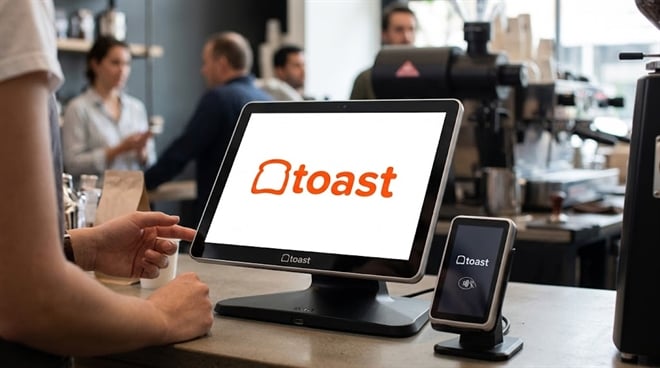
Sit down in an American restaurant and there’s a good chance Toast Inc. (NYSE: TOST) is keeping you company at your table.
This fintech-as-a-service company, launched simply to help you open a tab at your local bar, has now captured as much as 20% of the restaurants in the United States.
And along the way, it has turned a money-losing growth bet into a genuinely profitable business.
With rapidly growing revenue, a convincing jump in income, strong cash flow, and an ecosystem that keeps restaurants humming, Toast should seem appetizing for almost any portfolio. If that is, enough people keep eating out.
Recurring Revenue and Payments Drive Growth
Toast's model is simple in concept but elaborate in practice. A restaurant signs up for Toast's point-of-sale system and plugs into its software and payments infrastructure. From there, it can take customer orders, process payments, handle payroll, provide marketing tools, help manage suppliers, and automate back-office tasks. The more deeply a restaurant uses Toast, the harder it becomes to leave.
For Toast, this is precisely what it counts on: recurring subscription fees from software licenses and a slice of every payment processed through the platform. In the fourth quarter alone, gross payment volume rose 22% year over year to $51.4 billion.
Financial Performance Shows Real Profitability
These twin revenue streams are what’re powering the company’s rise. Last year’s revenue jumped $1.2 billion to $6.2 billion, as the company added a record 30,000 net locations. Net income surged to $342 million, compared to just $19 million in 2024. That year of barely breaking even came after two years of steep losses following its initial public offering.
In the fourth quarter, revenue came in at $1.63 billion, up 22% year over year. Net income for the quarter tripled to $101 million, and adjusted earnings before interest, taxes, depreciation, and amortization (EBITDA) rose to $163 million, up 47%. Annualized recurring revenue, that is, the subscription-based portion, reached $2 billion by year's end, up 26% YOY, from which recurring gross profit was up 33% for the year.
This was not a company that just squeaked by. Toast generated $608 million in free cash flow in 2025, up from $306 million the year before. The company's board responded by authorizing an additional $500 million in share repurchases, over the $235 million it bought back over the prior two years.
The company expects the good times to continue. For 2026, management has said it expects 20% to 22% growth in recurring profit, and it guided for adjusted EBITDA of $775 million to $795 million. All this, if it pans out, suggests Toast is building durable profitability, not just enjoying one banner year before sliding back to losses.
The Restaurant Industry Remains a Core Risk
In short, there is nothing wrong with the business model—if only it weren’t so dependent on the fate of all the restaurants. Notoriously sensitive to recessions, food costs, consumer habits, and especially a pandemic, restaurants are inherently risky. A meaningful slowdown in traffic could directly hit payment volumes, IT budgets, and the very existence of many restaurants, each of which is core to Toast’s business.
The company is also not the provider in the market. Square, the payments arm of Block Inc. (NYSE: XYZ), targets many of the same small and mid-sized restaurant operators with similar hardware and software bundles. Clover, Lightspeed, and other vendors in the sector are also fighting for a share.
Analysts See Upside, But With Wide Opinions
Despite the clear risks given the industry Toast depends on, analysts generally are positive on the stock with an overall Moderate Buy rating. Of 25 analysts covering the stock, 17 rate it a Buy and eight rate it a Hold, with an average 12-month price target of nearly $40.
With Toast trading these days at a little less than $30, that’s a one-third upside. The highest price target is $54, but the lowest is just $26, below where it currently trades.
Execution Looks Strong, But Dining Risks Remain
For investors, there seems to be little doubt whether the company can execute. With more than $6 billion in annual revenue, $342 million in net income, $608 million in free cash flow, and a recurring revenue base of $2 billion growing above 20%, it has shown that it can. The question is whether its client base can also.
It does not pay a dividend, it operates in a cyclical industry, and it faces well-funded competitors. And despite more than tripling its fourth-quarter earnings per share YOY, the 16 cents did come in below analyst expectations.
Looking forward, some volatility can be expected. But for investors comfortable with risk and a longer time horizon, Toast offers an attractive entry into restaurant digitization with a product penetration that continues to grow. Toast has popped up fast. The question is whether it can continue to stay hot.
Where Should You Invest $1,000 Right Now?
Before you make your next trade, you'll want to hear this.
MarketBeat keeps track of Wall Street's top-rated and best performing research analysts and the stocks they recommend to their clients on a daily basis.
Our team has identified the five stocks that top analysts are quietly whispering to their clients to buy now before the broader market catches on... and none of the big name stocks were on the list.
They believe these five stocks are the five best companies for investors to buy now...
The article "Toast Finally Cracks Profit—But a Bigger Risk Looms" first appeared on MarketBeat.


/Super%20Micro%20Computer%20Inc%20logo%20on%20building-by%20Poetra_RH%20via%20Shutterstock.jpg)
/Close-up%20shot%20of%20Rivian%20R1T_%20Image%20by%20Trong%20Nguyen%20via%20%20Shutterstock_.jpg)

/Amazon%20shopping%20page%20on%20computer%20by%20Thaspol%20Sangsee%20via%20Shutterstock.jpg)