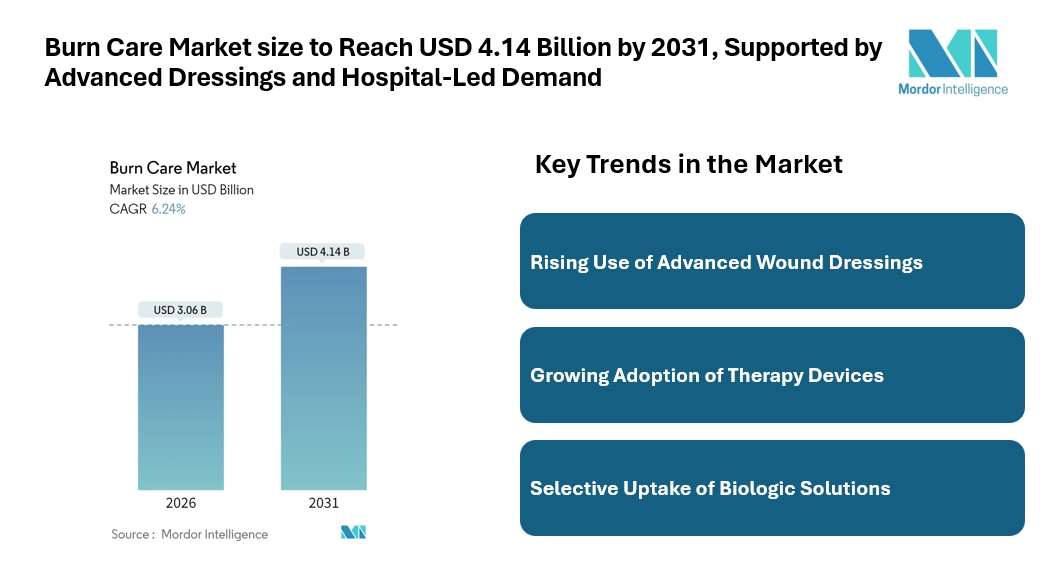
Burn Care Market Analysis:
According to Mordor Intelligence, the burn care market size was valued at USD 2.88 billion in 2025, reached USD 3.06 billion in 2026, and is projected to touch USD 4.14 billion by 2031, reflecting consistent burn care market growth during the forecast period.
This outlook highlights sustained demand across hospitals, specialised burn centres, and outpatient facilities, supported by the increasing use of advanced dressings, therapy devices, and biologic solutions. The burn care industry benefits from improved clinical protocols, wider reimbursement coverage in developed regions, and gradual adoption of structured burn management practices in emerging economies.
Burn Care Market Trends Shaping the Industry Landscape
Rising Use of Advanced Wound Dressings
Advanced dressings such as foam, hydrogel, and antimicrobial silver are preferred for minor and partial burns due to reliable healing, infection control, and ease of use across hospital and outpatient settings.
Growing Adoption of Therapy Devices
Portable negative-pressure wound therapy systems are increasingly used to shorten hospital stays and support home-based recovery while maintaining treatment effectiveness.
Selective Uptake of Biologic Solutions
Skin substitutes and dermal matrices are gaining use in complex burn cases, supporting long-term burn care market share growth within specialised care environments.
Check out more details and stay updated with the latest industry trends, including the Japanese version for localized insights: https://www.mordorintelligence.com/ja/industry-reports/burn-care-market?utm_source=abnewswire
Burn Care Market Segmentation and Scope Analysis
By Product Type
Advanced Dressings
Foam Dressings
Hydrocolloid Dressings
Hydrogel Dressings
Alginate Dressings
Antimicrobial Silver Dressings
Collagen & Silicone Dressings
Traditional Dressings
Biologics
Therapy Devices
Topical Agents
Other Product Types
By Depth of Burn
Minor Burns
Partial-Thickness Burns
Full-Thickness Burns
By End User
Hospitals & Clinics
Specialised Burn Centres
Ambulatory Surgery Centres
Home-Care Settings
Military & Emergency Services
By Geography
North America
Europe
Asia-Pacific
Middle East & Africa
South America
Competitive Landscape of the Burn Care Industry
The burn care industry features a mix of global healthcare companies and focused wound-care specialists. Market participants compete on product reliability, clinical evidence, distribution reach, and alignment with hospital procurement standards.
Key players include:
Johnson & Johnson
Mölnlycke Health Care AB
3M Company
Smith & Nephew plc
Cardinal Health Inc.
Burn Care Market Conclusion
The global burn care market growth outlook remains positive as healthcare systems prioritize structured wound management and disaster readiness. Demand for reliable dressings, supportive therapy devices, and specialised care solutions underpins steady expansion across both developed and developing regions.
While cost and reimbursement variability influence adoption speed, the overall burn care market forecast reflects sustained investment in burn treatment infrastructure and clinical capability. As hospitals and ambulatory centres continue to refine care pathways, suppliers that align with efficiency, safety, and consistent outcomes are positioned to strengthen their role in the evolving burn care market.
Industry Related Reports:
Mouth Ulcer Treatment Market:The mouth ulcer treatment market covers therapies across antimicrobial, antihistamine, analgesic, and corticosteroid drug classes, delivered through sprays, mouthwashes, gels, and related formulations, with market forecasts presented in value terms (USD).
Get more insights: https://www.mordorintelligence.com/industry-reports/mouth-ulcer-treatment-market?utm_source=abnewswire
substance Abuse Treatment Market Size: The substance abuse treatment market is estimated at USD 12.38 billion in 2026 and is projected to reach USD 16.07 billion by 2031, growing steadily over the forecast period from its USD 11.75 billion valuation in 2025.
Get more insights: https://www.mordorintelligence.com/industry-reports/substance-abuse-treatment-market?utm_source=abnewswire
Hyoscine Market Share: The hyoscine market was valued at USD 464.65 million in 2025 and is expected to grow from USD 486.87 million in 2026 to USD 614.91 million by 2031, reflecting consistent demand across multiple therapeutic indications.
Get more insights: https://www.mordorintelligence.com/industry-reports/hyoscine-market?utm_source=abnewswire
About Mordor Intelligence:
Mordor Intelligence is a trusted partner for businesses seeking comprehensive and actionable market intelligence. Our global reach, expert team, and tailored solutions empower organizations and individuals to make informed decisions, navigate complex markets, and achieve their strategic goals.
With a team of over 550 domain experts and on-ground specialists spanning 150+ countries, Mordor Intelligence possesses a unique understanding of the global business landscape. This expertise translates into comprehensive syndicated and custom research reports covering a wide spectrum of industries, including aerospace & defense, agriculture, animal nutrition and wellness, automation, automotive, chemicals & materials, consumer goods & services, electronics, energy & power, financial services, food & beverages, healthcare, hospitality & tourism, information & communications technology, investment opportunities, and logistics.
For any inquiries or to access the full report, please contact:
media@mordorintelligence.com https://www.mordorintelligence.com/
Media Contact
Company Name: Mordor Intelligence Private Limited
Contact Person: Jignesh Thakkar
Email: Send Email
Phone: +1 617-765-2493
Address:11th Floor, Rajapushpa Summit, Nanakramguda Rd, Financial District, Gachibowli
City: Hyderabad
State: Telangana 500008
Country: India
Website: https://www.mordorintelligence.com/
Press Release Distributed by ABNewswire.com
To view the original version on ABNewswire visit: Burn Care Market size to Reach USD 4.14 Billion by 2031, Supported by Advanced Dressings and Hospital-Led Demand

/Nvidia%20logo%20and%20sign%20on%20headquarters%20by%20Michael%20Vi%20via%20Shutterstock.jpg)


/Intel%20Corp_%20Santa%20Clara%20campus-by%20jejim%20via%20Shutterstock.jpg)