

Subscribe to our email marketing list
Dry conditions across Texas, Oklahoma, and Kansas are taking a toll on the cotton crop, with Texas facing some of the most significant pressure. Approximately 34% of the state’s cotton crop is currently rated poor or very poor.
Barchart’s new cotton yield forecast model is also highlighting the impact of challenging growing conditions. The model provides daily county-level forecasts for U.S. upland cotton, giving market participants a more localized view of where production risks are developing.
The map below compares Barchart’s current county-level non-irrigated upland cotton yield forecast with the 10-year average, highlighting where production is trending above or below historical levels. Orange areas represent below-average yield forecasts, while blue areas indicate above-average forecasts.
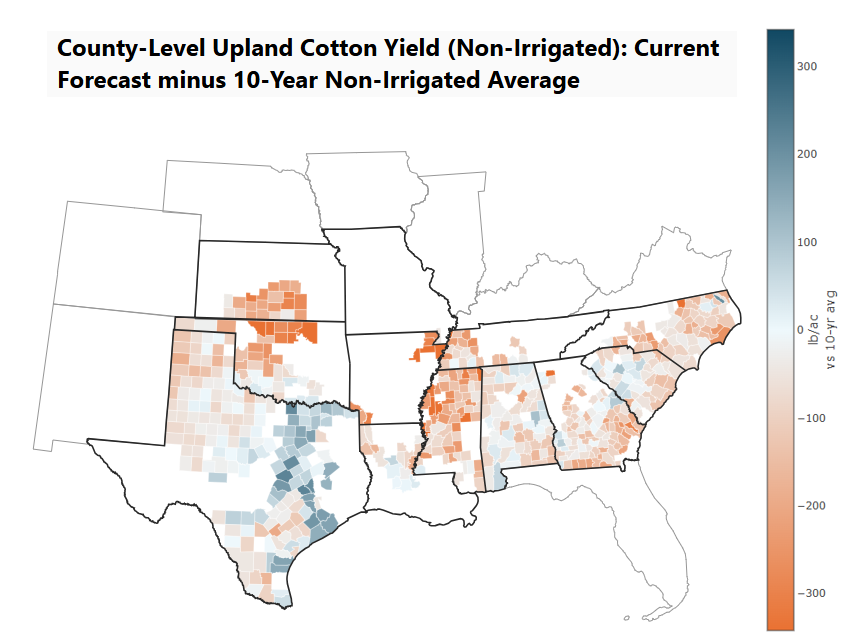
The latest forecasts show notable downside pressure across portions of the Southern Plains and Southeast, underscoring how significantly yield conditions can vary by region.
The USDA reinforced broader production concerns in its August WASDE report, reducing its forecast for the U.S. average cotton yield to 798 pounds per harvested acre, an 8.5% decline from its July estimate.
Weather forecasts are providing little relief. West Texas, one of the country’s most important cotton-producing regions, is expected to receive minimal rainfall over the next two weeks, potentially adding further pressure to crop conditions and yields.
What Lower Yields Could Mean for Cotton Prices
As production expectations decline, cotton prices have been moving higher. Energy prices had been a significant driver of cotton price movement for much of the year, but deteriorating crop conditions are bringing U.S. supply concerns into greater focus.
The effects could eventually extend beyond the commodity market. Tariffs on imported textiles have already contributed to higher U.S. apparel prices, while rising cotton prices could add another layer of cost pressure for textile mills.
If those higher input costs are passed through the supply chain, brands and retailers could ultimately face pressure to raise consumer prices.
Tracking Cotton Production Risk with Barchart
Barchart’s cotton yield forecast model targets RMA yields for U.S. upland cotton, producing forecasts at the county level and aggregating them into state-level estimates. The model is trained to focus on downside yield deviations, making it particularly useful for identifying emerging production risks.
With drought conditions continuing to affect key growing regions, daily county-level forecasts can provide an earlier and more granular view of changing crop potential than broader national estimates alone.
Learn more about Barchart’s data and yield forecasting solutions and get started here.

.png)

