


Addressing climate change is a critical policy path in the US, Europe, and many other countries worldwide. US energy policy has shifted as the Biden administration’s policies favor alternative and renewable energy sources and aim to reduce fossil fuel production and consumption over the coming years. Most countries and companies have emissions targets looking to reduce their carbon footprints. In the world of cryptocurrencies, Tesla’s Elon Musk spotlighted energy-intensive cryptocurrency mining when he reversed a decision to accept Bitcoin for his company’s EVs in 2021. Mr. Musk felt that Bitcoin mining runs counter to his corporate mission to reduce emissions by increasing the market for Teslas, which have become synonymous with EVs.
Cryptocurrencies are a generational asset class. Those who grew up during the computer revolution are far more likely to understand and participate in the asset class that is around a dozen years old. The ascent of Bitcoin from five cents per token in July 2010 to a high of over $68,900 in November 2021 created a speculative frenzy in the asset class. Meanwhile, declining faith and trust in governments that issue legal tender have only fostered the rise of the means of exchange where individuals establish value by their buying and selling activities.
Blockchain and Bitcoin were born around a dozen years ago. As of December 29, 2021, they gave birth to over 16,150 more cryptocurrencies, with more coming to market each day. The cryptocurrencies market cap rose from $767.482 billion at the end of 2020 to over $2.249 trillion as of December 29, as it nearly tripled over the past year. As we head into 2022, expect the greener cryptos that do not leave a substantial carbon footprint to attract lots of interest, which is likely to cause them to outperform the energy-intensive cryptocurrencies.
PoW versus PoS determines energy consumption
What separates the environmentally friendly cryptocurrencies from the energy-consuming hogs are the consensus mechanisms that verify new transactions, add them to the blockchain, and create or uncover tokens that are rewards.
Proof of work is the older mechanism used by Bitcoin, Ethereum 1.0, and many other cryptos that burst on the scene over the past decade. Proof of work and mining are closely related as the network requires vast processing power, making it a massive energy consumer. Proof of work blockchains are secured and verified by virtual miners worldwide racing to solve a math puzzle or equation. The winner of the race gets the privilege of updating the blockchain with the latest verified transactions. The rewards are crypto tokens. Proof of work leaves a significant carbon footprint as electricity comes from fossil fuels, including oil, natural gas, and coal.
Proof of stake uses a network of “validators,” contributing their “stake” of crypto holdings in exchange for a chance of validating new transactions, updating the blockchain, and earning the tokens. Proof of stake rewards the most invested validators with the most substantial stake hold for the most prolonged period. Proof of stake leaves a far lower carbon footprint than proof of work.
Ethereum 2.0 will be a green version of the second-leading cryptocurrency
Ethereum 2.0 began its rollout in December 2020. The developers expect the completion of the protocol in 2022. Ethereum 2.0 is a faster, more efficient, and less energy intensive proof of stake consensus mechanism.
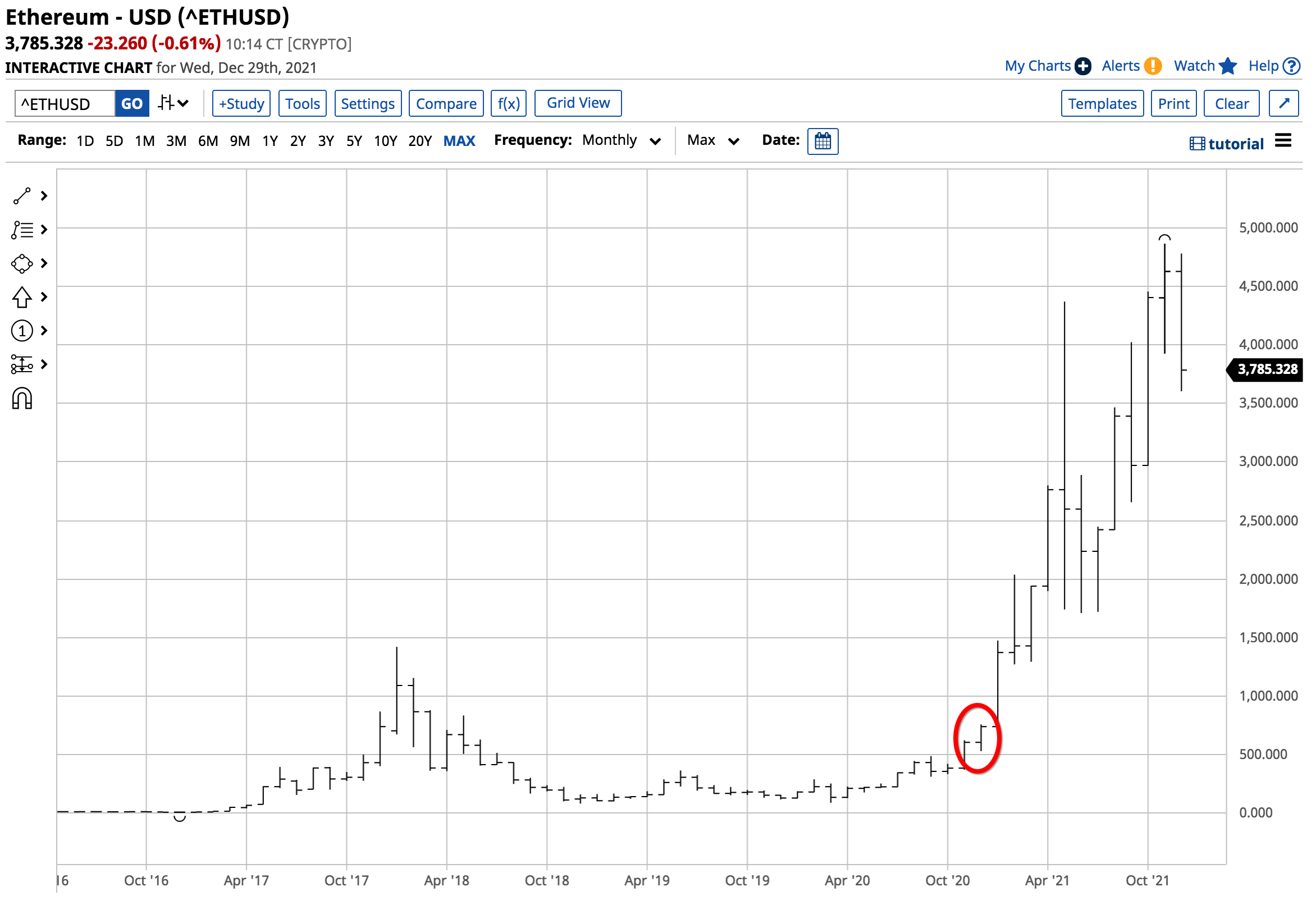
The chart shows that Ethereum tokens rose from $738.912 at the end of 2020 to the $3,785.328 level on December 29, as Ethereum’s value increased by over five times since the end of last year.
Ethereum far outperformed Bitcoin in 2021, likely a function of Ethereum 2.0, a greener version of the second-leading cryptocurrency.
Cardano (ADA) is a leading token, and it is environmentally friendly
Cardano (ADA) was the fifth leading cryptocurrency with a market cap of over $47.85 billion at the $1.39 level in late December.
ADA is the native token of Cardano’s blockchain, which is a flexible, sustainable, and scalable platform for running smart contracts, allowing for many decentralized financial apps. Charles Hoskinson, Ethereum’s co-founder, developed Cardano. Cardano is a next-generation evolution of the Ethereum protocol.
Cardano is more energy efficient than Bitcoin as it uses the proof of stake consensus mechanism.
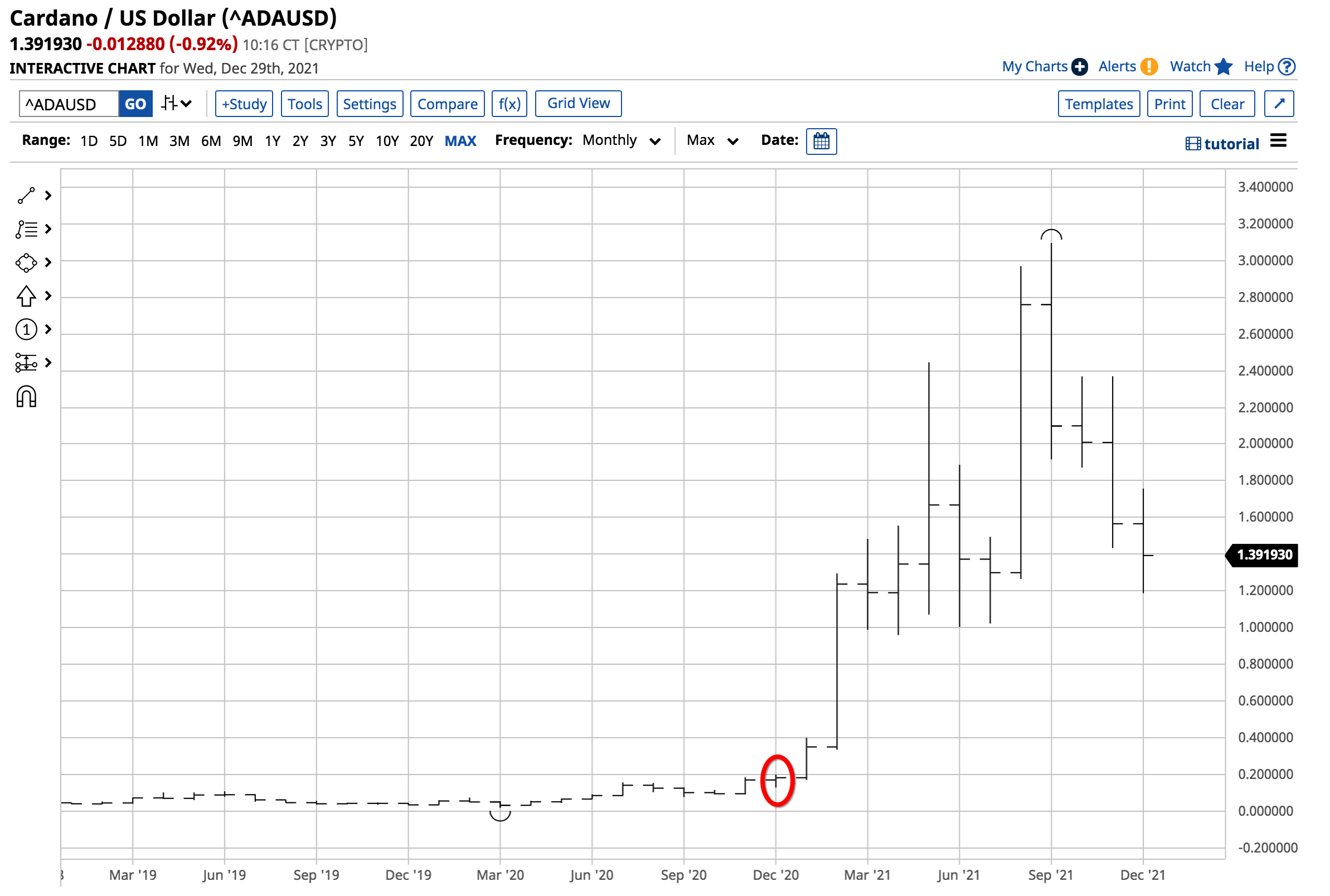
The chart shows ADA’s ascent from $0.180668 on December 31, 2020, to the $1.39 level on December 29 as it moved over seven times higher from the 2020 closing level. ADA traded to a high of $3.096462 in September 2021. ADA outperformed both Bitcoin and Ethereum in 2021.
Stellar (XLM) is another green choice in the asset class
Stellar (XLM) was the eighteenth leading cryptocurrency with an over $6.88 billion market cap at the 27.74 cents per token level. Stellar forked off from Ripple (XRP) in 2014 to bridge the gap between traditional financial institutions and digital currencies.
The Stellar Development Foundation, a non-profit organization, operates XLM. Stellar enables exchanges of US dollars, Bitcoin, Yen, and many traditional currencies and cryptos. The native token, Lumens (XLM), facilitates the trades on the blockchain-based distributed ledger at a fraction of a cent efficiently, making for a lower carbon footprint. The network allows individuals and institutions to create tokens for use on the network. Some market participants have used the network for sustainability initiatives such as investing in renewable energy.
Stellar’s network uses neither a proof of work nor a proof of stake consensus mechanism. Stellar is open-source and relies on the authentication of transactions through a set of trustworthy nodes. The authentication cycle is shorter and faster, making for low costs and energy requirements.
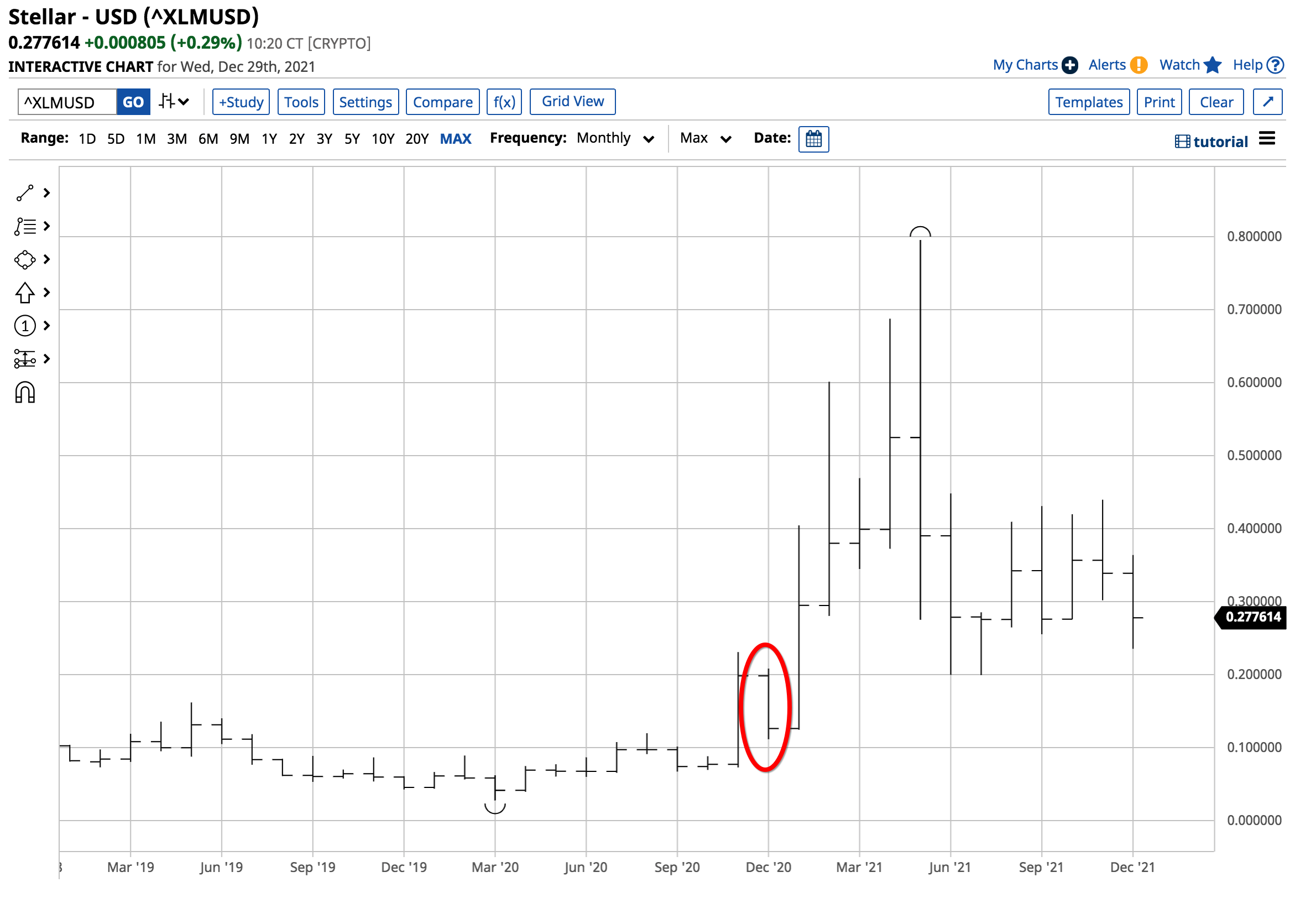
The chart illustrates that XLM rose from 12.5812 cents on December 31, 2020, to the 27.7614 level on December 28, as the token’s value more than doubled. XLM outperformed Bitcoin in 2021 but underperformed Ethereum and Cardano’s native token.
There are other green choices- Stick with the leaders as they offer liquidity in a very volatile asset class
Ethereum 2.0, ADA, and XLM are green cryptocurrencies. Other environmentally friendly tokens include SolarCoin (SLR), BitGreen (BITG), Nano (NANO), IOTA (MIOTA), EOSIO (EOS), TRON (TRX), Burstcoin (BURST), and there are others.
All cryptos, including the greener asset class members, are highly volatile assets. Any investment should only involve capital that is 100% at risk. The shift towards protecting the environment favors the green cryptos as we move into 2022.
Cryptos have offered incredible returns, but the risk is always a function of potential rewards, making the crypto arena volatile and dangerous.

/A%20concept%20image%20of%20space_%20Image%20by%20Canities%20via%20Shutterstock_.jpg)
/A%20concept%20image%20of%20a%20flying%20car_%20Image%20by%20Phonlamai%20Photo%20via%20Shutterstock_.jpg)

/Oracle%20Corp_%20office%20logo-by%20Mesut%20Dogan%20via%20iStock.jpg)