





Wireless carrier T-Mobile US (TMUS) shares have struggled to capture investors’ attention over the past year as competition in the wireless market has intensified. Giants like AT&T (T) and Verizon (VZ) have stepped up promotions, discounts, and lower-priced plans to attract cost-conscious customers.
Meanwhile, cable operators are increasingly bundling mobile services with internet and TV to win subscribers. So, with competition coming from almost every direction, Elon Musk-led SpaceX’s (SPCX) growing wireless ambitions might seem like one more problem for T-Mobile. But surprisingly, Wall Street sees it differently.
Bank of America recently said SpaceX’s push into wireless could actually be a positive for T-Mobile, as well as tower operators and the value of wireless spectrum. The investment bank’s reasoning is simple. SpaceX may have deep pockets, but building a nationwide wireless network from scratch is no easy task. In fact, to compete directly with established carriers, SpaceX would need much more than satellites. It would need cellular spectrum, thousands of terrestrial sites, and extensive supporting infrastructure, including towers, small cells, fiber, power, and local permits. And building that network could take years.
One proposed solution is using customer-hosted femtocells, or small cellular devices in homes, which also looks difficult to scale. T-Mobile CTO John Saw estimated that matching T-Mobile’s outdoor coverage could require between 500 million and 1.5 billion femtocells, with each costing around $1,000. That is a massive undertaking. Crown Castle (CCI), a major U.S. wireless infrastructure company, also said femtocells are better suited for filling small coverage gaps, while traditional towers can provide the power, fiber, and infrastructure needed for a broader rollout.
SpaceX could potentially deploy terrestrial sites faster because of its financial resources. However, matching established carriers on coverage, capacity, indoor performance, and mobility would still require significant spectrum, capital, and years of execution.
That could give T-Mobile an advantage. Rather than replacing traditional wireless networks, SpaceX’s direct-to-device satellite service is more likely to complement them, particularly in remote and rural areas where building cell towers can be difficult or expensive. With that backdrop in mind, here’s a closer look at T-Mobile stock.
About T-Mobile Stock
T-Mobile US has grown from a relatively small wireless player into one of America’s biggest connectivity companies. The company provides wireless plans, smartphones, connected devices, broadband, and 5G Home Internet to millions of consumers and businesses, serving customers through its T-Mobile, Metro by T-Mobile, and Mint Mobile brands. The company’s roots go back to 1994, when it was founded as VoiceStream Wireless. After Deutsche Telekom acquired a controlling stake, the business was rebranded as T-Mobile.
Today, T-Mobile US is headquartered in Bellevue, Washington, and its network reaches customers across the country through one of the largest 5G footprints in the U.S. But T-Mobile is no longer just about smartphones and cell towers. It is steadily expanding its connectivity empire, moving into 5G broadband and satellite services. Its T-Satellite offering is designed to extend connectivity to areas where traditional cell towers struggle to reach, giving the company another way to keep Americans connected, whether they are in a major city or far beyond the reach of traditional wireless networks.
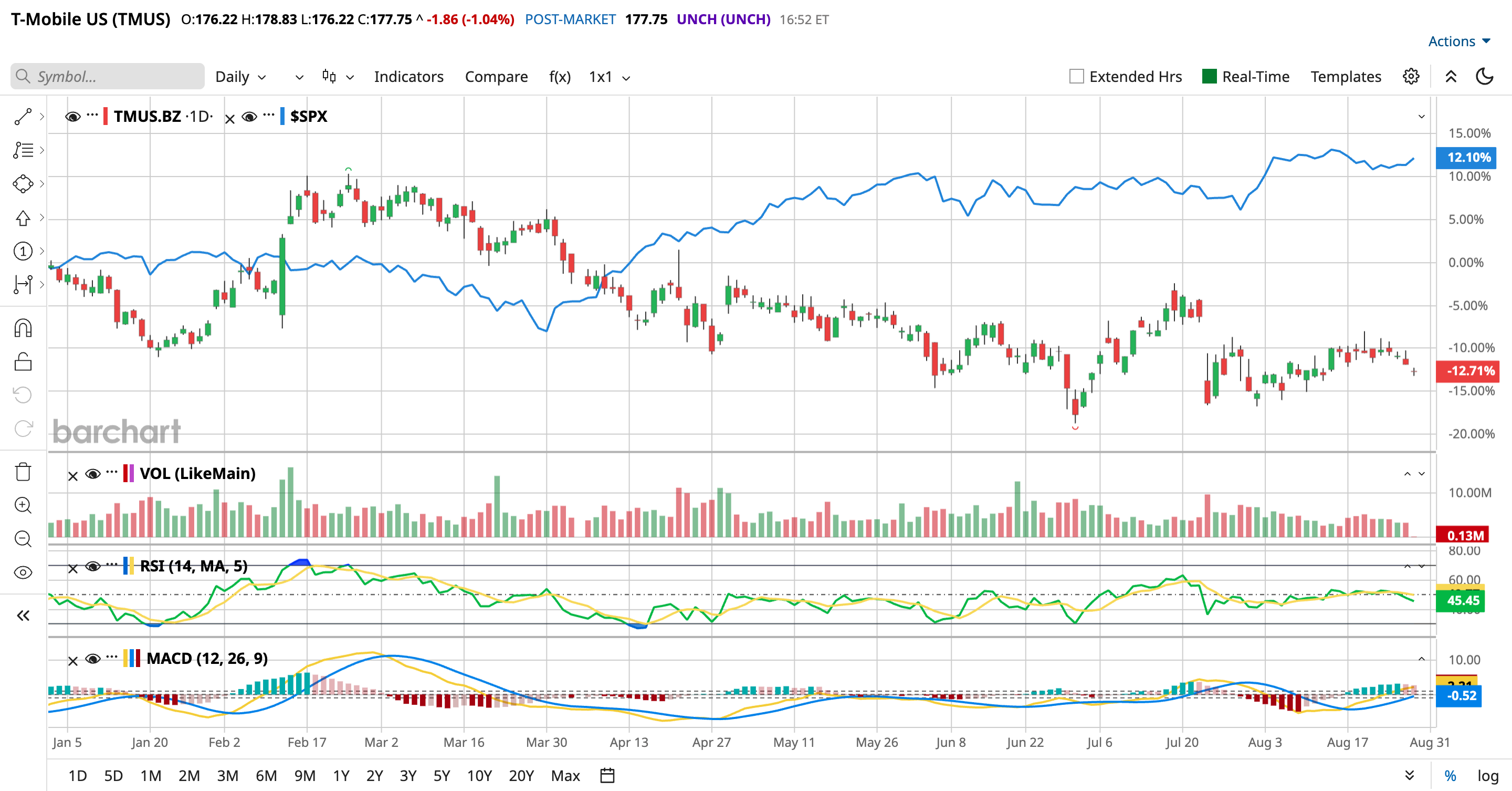
But despite T-Mobile’s scale, strong market position, and nationwide reach, Wall Street hasn’t been giving the stock much love lately. The biggest concern is intensifying competition from rivals such as AT&T and Verizon, which have been leaning heavily on promotions and lower-priced plans to win customers. With a market capitalization of $192.7 billion, T-Mobile shares have fallen 29.3% over the past year and 12.5% so far in 2026.
That performance stands in sharp contrast to the broader S&P 500 Index ($SPX), which has gained 19.3% during the past year and 12.9% year-to-date (YTD). Moreover, the sell-off has taken the stock well below its 52-week peak. T-Mobile touched a 52-week high of $258.66 in September 2025, but has since dropped 31.3% from that level, leaving investors wondering whether the pullback is a warning sign or a potential opportunity.
Inside T-Mobile’s Q2 Earnings Report
T-Mobile shares went on a wild ride after the company reported its fiscal 2026 second-quarter results on July 23. The stock plunged 10.75% on the earnings day, only to rebound 5.67% in the following trading session. And interestingly, the results themselves were hardly disappointing. T-Mobile’s total revenue climbed about 8% year-over-year (YOY) to $22.79 billion, slightly topping Wall Street’s estimate of $22.74 billion. Service revenues rose 9% YOY to $19 billion, while postpaid service revenues jumped 13% to $15.9 billion.
The company also continued to make progress on the customer front. Postpaid Average Revenue Per Account (ARPA) increased 2% YOY to $152.91, while T-Mobile added 277,000 net postpaid accounts during the quarter. Postpaid account churn remained low at 0.99%. Customer satisfaction also reached a new milestone, with T-Mobile recording a wireless NPS score of 46, its highest ever and the best among the Big Three U.S. carriers, according to HarrisX survey data.
Meanwhile, Core adjusted EBITDA rose 12% YOY to $9.5 billion, while adjusted free cash flow increased 4% to $4.8 billion. Net cash provided by operating activities also climbed 7% to $7.5 billion. The strength extended to the bottom line. EPS rose 5% YOY to $2.99, and adjusted EPS of $3.13 comfortably beat Wall Street’s estimate of $2.49. T-Mobile was also generous with shareholders. The company returned $3.3 billion to stockholders during the second quarter, including $2.2 billion in share repurchases and $1.1 billion in cash dividends, under its current authorization to return up to $18.2 billion through December 31, 2026.
So, if the numbers were this solid, why did investors hit the sell button? The answer came down to the outlook. Management expects to add only about $250,000 postpaid accounts in the third quarter, a noticeable slowdown from the 277,000 additions recorded in the second quarter. The company also sees a moderation in revenue growth. After delivering 9% service revenue growth in Q2, T-Mobile expects roughly 6% growth in Q3 and 8% for the full year, with service revenues expected to reach approximately $77 billion this year.
On the investment front, T-Mobile kept its 2026 cash capital expenditure forecast unchanged at approximately $10 billion. The company maintained its full-year guidance for core adjusted EBITDA of $37.1 billion to $37.5 billion, representing roughly 10% YOY growth at the midpoint.
But there was a brighter spot for investors. T-Mobile raised its full-year free cash flow outlook. Management now expects adjusted free cash flow of $18.4 billion to $18.8 billion, increasing the midpoint by $200 million. In short, T-Mobile delivered a strong quarter, but investors appeared more focused on what comes next than on what just happened.
How Do Analysts View T-Mobile Stock?
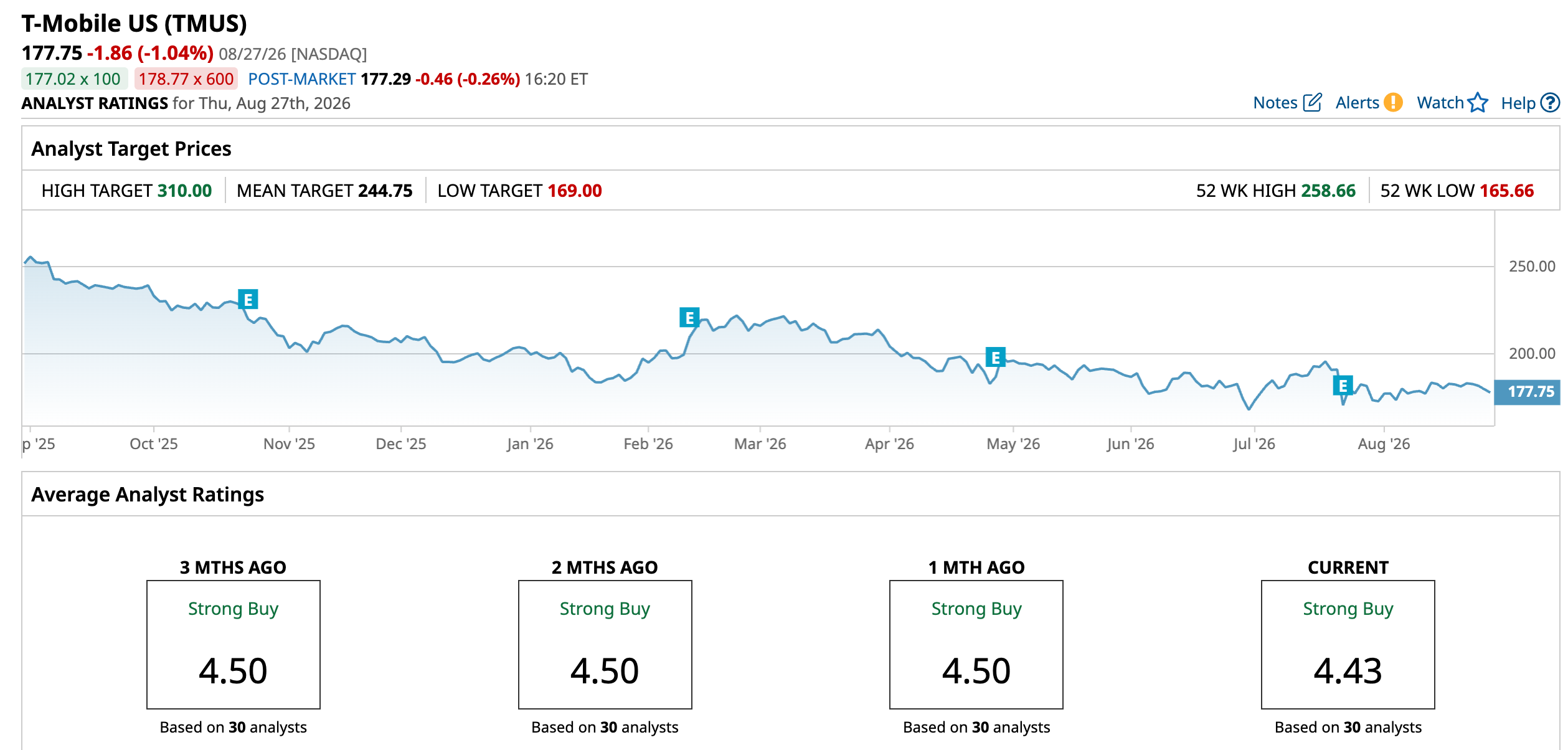
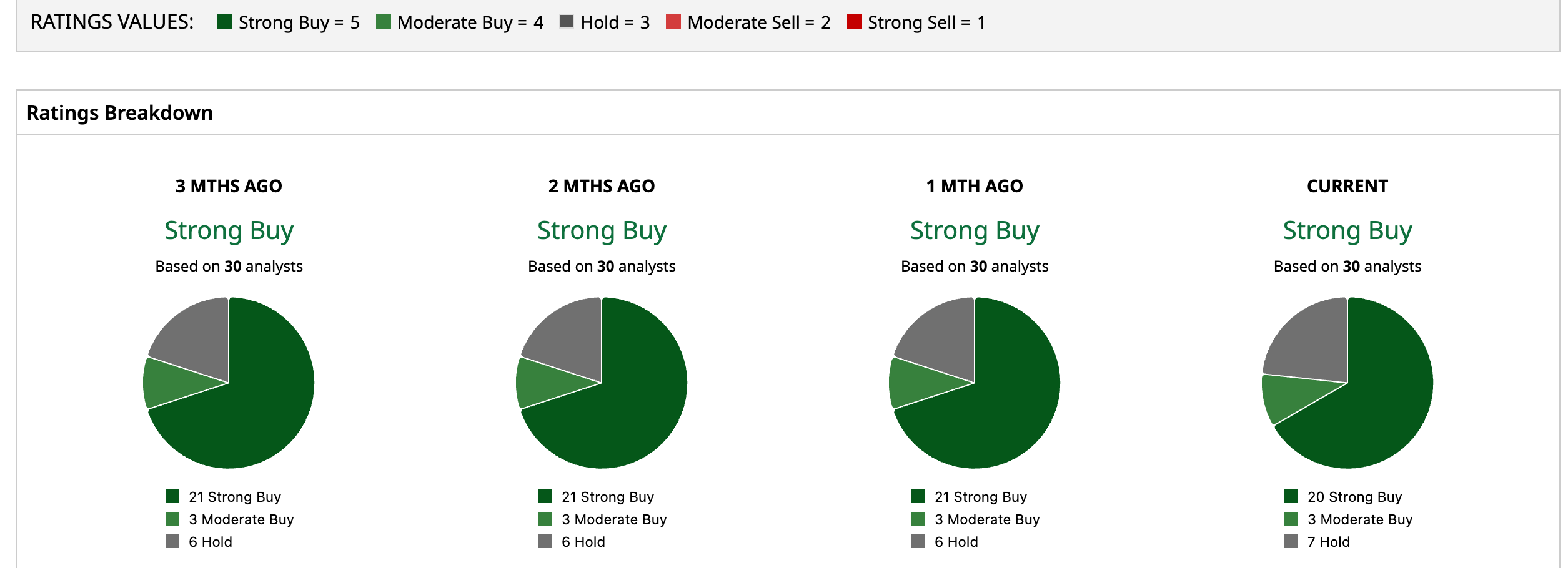
Despite the stock’s recent struggles, Wall Street hasn’t lost faith in T-Mobile. The shares currently carry a consensus “Strong Buy” rating, with 20 of 30 analysts recommending a “Strong Buy,” three calling it a “Moderate Buy,” and just seven rating it a “Hold.” The optimism is also reflected in analysts’ price targets. The average target of $244.75 points to 37.7% upside, while the Street-high target of $310 suggests a potential rally of as much as 74.4% from current levels. In other words, while investors have been selling the stock, Wall Street appears to see plenty of room for a comeback.
On the date of publication, Anushka Mukherji did not have (either directly or indirectly) positions in any of the securities mentioned in this article. All information and data in this article is solely for informational purposes. For more information please view the Barchart Disclosure Policy here.



/AI%20(artificial%20intelligence)/Ai%20chip%20by%20Quality%20Stock%20Arts%20via%20Shutterstock.jpg)

/A%20close-up%20of%20the%20Broadcom%20logo%20on%20a%20smartphone%20by%20Timon%20via%20Adobe%20Stock.jpeg)