/Microsoft%20headquarters%20By%20Peter.jpeg)
Microsoft Corporation (MSFT) is one of the world’s largest technology companies, with a broad ecosystem spanning cloud computing, artificial intelligence, productivity software, operating systems, cybersecurity, gaming, and business applications. Headquartered in Redmond, Washington, the company generates revenue through three core segments: Productivity and Business Processes, Intelligent Cloud, and More Personal Computing.
With a market capitalization of $3.7 trillion, Microsoft stands as one of the world’s most valuable companies and a true titan of the mega-cap universe. From Windows and Microsoft 365 to Azure, Xbox, LinkedIn, and artificial intelligence, Microsoft has built a diversified ecosystem that helps cushion weakness in any single market while creating powerful cross-selling opportunities across its platforms. Its globally recognized brands provide meaningful pricing power, while heavy investment in R&D keeps the company at the forefront of AI, cloud computing, and quantum technologies.
Despite its notable strength, MSFT slipped 8.8% from its 52-week high of $553.72, achieved on Oct. 25, 2025. Over the past three months, MSFT stock has gained 22.4%, underperforming the State Street SPDR S&P Software & Services ETF (XSW) 27.3% gains during the same time frame.
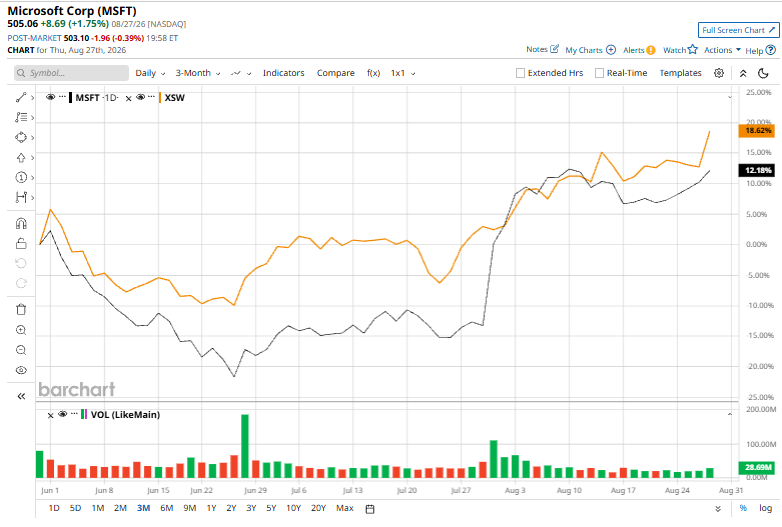
Shares of MSFT fell 4.4% on a YTD basis and dipped marginally over the past 52 weeks, underperforming XSW’s YTD gains of 12.4% and 11.3% returns over the last year.
To confirm the bullish trend, Microsoft has been trading above its 50-day moving average since late April, with slight fluctuations. The stock is trading above its 200-day moving average since early May.
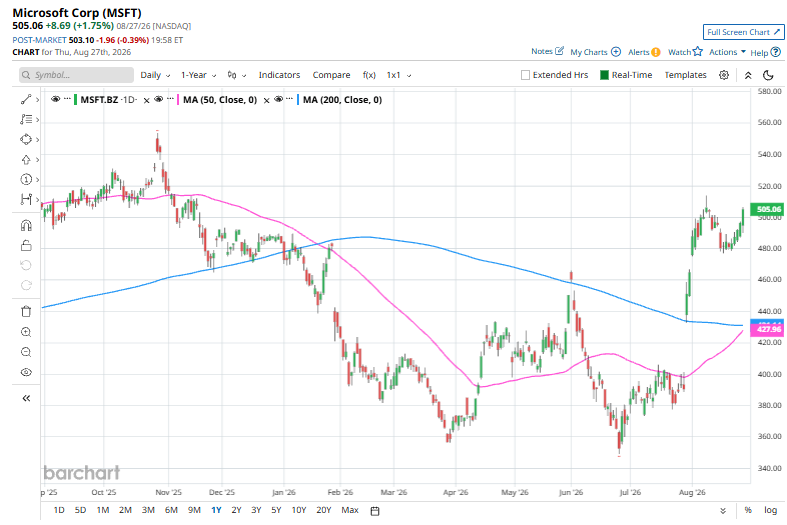
Microsoft has underperformed the broader market over the past year largely because investors have grown increasingly cautious about the massive cost of its AI ambitions. While Azure and AI-related demand remain strong, the company’s heavy spending on data centers, chips, and other infrastructure has pressured free cash flow and cloud margins, raising questions about how quickly these investments will translate into meaningful returns. At the same time, MSFT’s already premium valuation has left little room for disappointment, while concerns about AI monetization, competitive pressures, and limited visibility into the profitability of its AI and OpenAI-related businesses have further weighed on sentiment.
Microsoft shares soared more than 15% on July 30, adding nearly $450 billion in market value, the largest one-day gain ever recorded for a company, after the tech giant forecast stronger-than-expected cloud growth and signaled continued strong cash generation when it released its second-quarter earnings. Microsoft reported $90 billion in quarterly revenue, up 17.7% year over year, while non-GAAP net income rose 22.8% to $4.74.
In the competitive arena of software services, Oracle Corporation (ORCL) has lagged behind MSFT, with a 22.1% downtick on a YTD basis and 35.6% gains over the past 52 weeks.
Nevertheless, Wall Street analysts are very bullish on Microsoft’s prospects. The stock has a consensus “Strong Buy” rating from 51 analysts covering it, and the mean price target of $554.76 suggests a potential upside of 9.8% from current price levels.
On the date of publication, Kritika Sarmah did not have (either directly or indirectly) positions in any of the securities mentioned in this article. All information and data in this article is solely for informational purposes. For more information please view the Barchart Disclosure Policy here.



/AI%20(artificial%20intelligence)/Ai%20chip%20by%20Quality%20Stock%20Arts%20via%20Shutterstock.jpg)
/A%20close-up%20of%20the%20Broadcom%20logo%20on%20a%20smartphone%20by%20Timon%20via%20Adobe%20Stock.jpeg)