



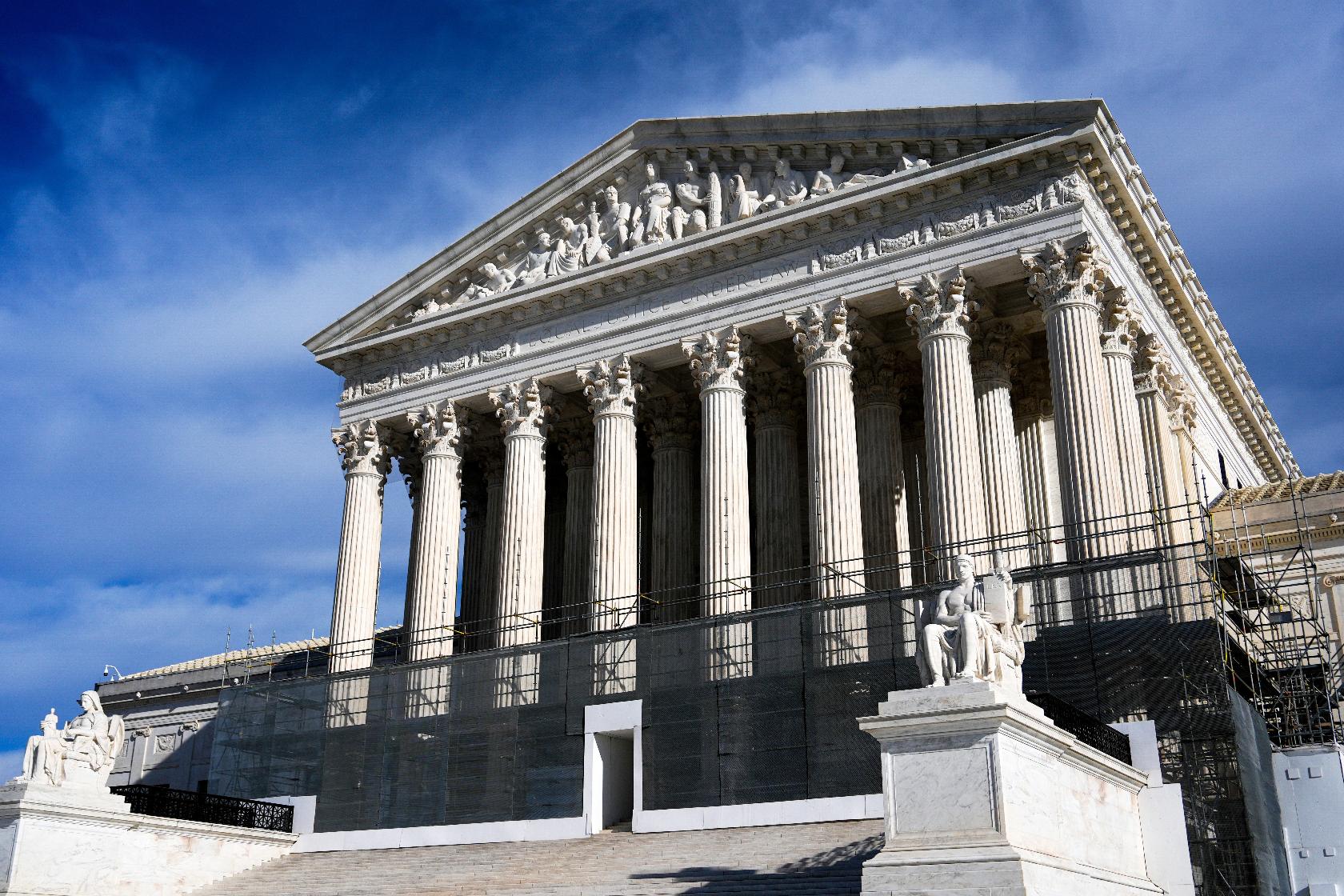
The Supreme Court struck down President Donald Trump’s far-reaching global tariffs in a 6-3 decision on Friday, handing him a stinging loss on an issue crucial to his economic agenda.
Furious about the defeat, Trump said he will impose a global 10% tariff as an alternative while pressing his trade policies by other means. The new tariffs would come under a law that restricts them to 150 days.
He made that announcement after lashing out at the Supreme Court for striking down much of his sweeping tariff infrastructure as an illegal use of emergency power. Trump said he was “absolutely ashamed” of justices who voted to strike down his tariffs and called the ruling “deeply disappointing.”
“Their decision is incorrect,” he said. “But it doesn’t matter because we have very powerful alternatives.”
The Latest:
American Farm Bureau Federation President Zippy Duvall says farmers understand Trump’s efforts to use tariffs “to create a more level playing field for U.S. goods, U.S. workers and the U.S. economy” but urged the administration to seek another way.
“Unfortunately, trade disruptions and declining prices for agricultural goods created additional hardships for farmers who came into 2025 already dealing with crippling inflation and declining farm prices,” Duvall said in a statement.
He added, “With supply costs already at or near record highs, we strongly encourage the president to avoid using any other available authorities to impose tariffs on agricultural inputs that would further increase costs.”
The head of the U.S.-ASEAN Business Council on Friday said the ruling adds “uncertainty and confusion” but it is not a deal breaker for U.S.-ASEAN economic ties.
“At the end of the day, Southeast Asian leaders are deeply pragmatic; they recognize the scale of the U.S. market and the quality and staying power of U.S. investments,” said Brian McFeeters, president and CEO of the business council.
He said the broader trajectory remains “firmly intact.” ASEAN is a grouping of ten governments in Southeast Asia.
Indonesia, Malaysia and Cambodia have reached trade agreements with the Trump administration.
The Tennessee Soybean Association, a state chapter of the national association, called on Trump to avoid using other authority to impose tariffs on agricultural products.
“We recognize and respect the complex geopolitical issues the Trump Administration is navigating around the globe; however, agricultural inputs like crop protection chemicals, farm equipment, seeds, and fuel are vital to our soybean growers here in Tennessee,” Jay Yeargin, president of the Tennessee Soybean Association, said in a statement. “With the economic crisis farmers are facing right now, there is little room for higher input costs, especially if we wish to compete in the global market.”
Illinois Gov. JB Pritzker is demanding a refund. The Democrat’s gubernatorial campaign on Friday released a letter addressed to Trump — with an attached invoice for $8.68 billion — following the Supreme Court’s ruling on tariffs.
“Your tariff taxes wreaked havoc on farmers, enraged our allies and sent grocery prices through the roof,” wrote Pritzker, who’s eyed as a 2028 presidential contender and has repeatedly sparred with the president. “This morning, your hand-picked Supreme Court justices notified you that they are also unconstitutional.”
The invoice, marked “Past Due—Delinquent,” sets the tariffs’ cost at $1,700 for each of the state’s 5.11 million households, a total of $8,679,261,600.
Pritzker says failure to pay will elicit “further action.”
The initial reaction from Europe focused on renewed upheaval and confusion regarding costs facing businesses exporting to the US.
The European Commission had reached a deal with the Trump administration capping tariffs on European imports at 15%. The deal gave businesses certainty that helped them plan, a factor credited with helping the 21 countries that use the euro currency skirt a recession last year.
“Uncertainty remains high for German enterprises doing business in the US,” said the German Chamber of Commerce and Industry. “Because there are other instruments for trade limitations in the hands of the US administration that German companies must prepare themselves for.”
Trump could resort to laws permitting more targeted tariffs that could hit pharmaceuticals, chemicals and auto parts, said Carsten Brzeski, global head of macro at ING bank: “Europe should not be mistaken, this ruling will not bring relief. ... The legal authority may be different, but the economic impact could be identical or worse.”
Brazil will continue trade negotiations with the United States regardless.
The South American nation’s leading negotiator on the topic, Vice President and Industry Minister Geraldo Alckmin, told journalists in Brasilia on Friday that the ruling “strengthens the trade negotiations between his country and the U.S.,” but added the two “will carry on with their dialogue” on the tariffs.
“The 10% (tariffs imposed later) are for all. We don’t lose competitiveness if it is 10% for all. What was happening was Brazil getting a 40% tariff that no one else had,” the Brazilian said. Alckmin added Brazil’s President Luiz Inácio Lula da Silva and Trump are expected to further discuss trade during a meeting sometime in March.
Linda Schlesinger-Wagner, owner of Birmingham, Michigan-based skinnytees, didn’t get overly excited after initially hearing about the Supreme Court’s ruling.
“He’ll find some way to get around this,” Schlesinger-Wagner said.
Schlesinger-Wagner estimates that the tariffs, so far, have cost her women’s apparel business about a $1 million. She says 100% of her garments come from China.
“I don’t know what I’m going to do,” she said Friday afternoon. “I never raised my prices. Now, with another 10% I’m going to be forced to.”
The tariffs have “affected every business I know because everybody gets something from somewhere,” Schlesinger-Wagner added. “We’re supposed to be global unity. He’s just alienating everyone from us.”
In Argentina, a key South American ally of the Trump administration, Vice President Victoria Villarruel characterized the U.S. Supreme Court’s decision as “a blow to production policies and business establishment.”
While serving as acting President during Javier Milei’s trip to the inaugural Board of Peace meeting in Washington, Villarruel argued on X that “the total and unrestricted opening of imports only favors dependence on China.”
She warned that such policies would deepen “economic and social emergencies.”
The Vice President framed the conflict as a choice between “Nationalism or Globalism.”
Steelmaking industry groups say the Supreme Court’s decision on Friday didn’t affect tariffs on steel imports put in place under national security provisions.
The tariffs on foreign steel were enforced under a law that grants the president broad authority to address threats to U.S. national security, Kevin Dempsey, president and CEO of the American Iron and Steel Institute, said in a statement.
The Steel Manufacturers Association’s president, Philip Bell, said the Supreme Court decision doesn’t undo the steel tariff that “is revitalizing the American steel industry, strengthened our national security, and fueled the creation of high-quality American jobs.”
Mexican Economy Secretary Marcelo Ebrard, speaking at a public event in parallel with Trump’s comments, was cautious about the effects of the Supreme Court’s decision.
“I don’t know how it will end,” he said, adding: “In the case of Mexico, only some of the tariff measures have to do with that legal provision, others do not.”
However, he said that Mexico’s government still plans to move forward this year depending on the “strength of trade between the two countries,” and recalled that just a year ago, Mexico was facing a 25% tariff on all its exports, “and today, as you can see, most of my exports do not have those burdens.”
It remains unclear what Trump’s announcement of 10% generalized tariffs will mean for Mexico’s economy, but it’s among the countries that could be hit the hardest as the U.S. and Mexican economies are inextricably intertwined from decades of free trade.
Ebrard and other officials have been locked in negotiations with the Trump administration for months in an effort to offset wider tariffs.
“I was a little surprised because I was in the Supreme Court hearing,” Bessent said when asked about his reaction to the SCOTUS decision at the Economic Club of Dallas, Friday. “I think what we saw was just a very narrowing of the definition of the president’s ability to use IEPPA powers.”
He added, “the look forward — no one should expect that tariff revenue will go down.”
“The total amount of revenue that Treasury will collect this year will be little changed”
Treasury Secretary Scott Bessent says the Supreme Court “did not rule against President Trump’s tariffs,” rather “Six Justices simply ruled that IEEPA authorities cannot be used to raise even one dollar of revenue.”
In a prepared speech to the Economic Club of Dallas delivered Friday afternoon, Bessent says the Trump administration “will invoke alternative legal authorities to replace the IEEPA tariffs.”
“Treasury’s estimates show that the use of Section 122 authority, combined with potentially enhanced Section 232 and Section 301 tariffs will result in virtually unchanged tariff revenue in 2026,” he says.
The president wrapped on a positive note, saying that with the ruling, “great certainty has been brought back to the economy of the United States and actually the economy of the world.”
He repeated one of his favorite lines, saying that the U.S. is “the hottest country in the world,” and added: “We’re going to keep it that way.”
Trump said the justices who voted in the majority against his tariffs are still “barely” invited to Tuesday’s State of the Union address.
But he added that “honestly I couldn’t care less if they come, OK?”
The president gives the State of the Union before a joint session of Congress.
But the chief executive doesn’t issue invitations to the speech, aside from his own special guests.
The House speaker actually invites the president to give the address in the first place, and while there is always reserved seating for members of the court, Chief Justice John Roberts has previously said it’s up to individual justices if they want to attend.
The president is clearly fuming at two of the justices he nominated in his first term who sided against his tariff policy.
“I think it’s an embarrassment to their families, if you want to know the truth. The two of them,” Trump said of Gorsuch and Barrett.
He said, “their decision was terrible.”
Still, he declined to say whether he regretted nominating them.
“I read very well. Great comprehension,” Trump said.
The president said that, when it came to the tariffs case, “I read everything there is to read. And I said, ‘Can’t lose this case.’”
But the Supreme Court did in fact rule against Trump’s sweeping tariff policy — an outcome Trump suggested was only possible because “judges want to be political, they want to be politically correct.”
Italian winemakers greeted the decision with skepticism, warning that the ruling “may ultimately deepen uncertainty rather than deliver immediate relief to transatlantic trade.”
The U.S. is Italy’s largest wine market, with sales having tripled in value over the past 20 years. In 2024, shipments to the U.S. reached a value of €1.93 billion, accounting for 24% of Italy’s total global wine exports, according to Unione italiana vini, or UIV, which represents more than 800 winemakers.
New tariffs on the EU, which the Trump administration initially threatened would be 200%, had sent fear throughout the industry, which remained even after the U.S. reduced, delayed and negotiated down.
“Paradoxically, the wine industry cannot welcome the Court’s decision as a clear victory,” said Lamberto Frescobaldi, president of the UIV trade association.
“There is a more than likely risk that tariffs will be reimposed through alternative legal channels, compounded by the uncertainty this ruling may generate in commercial relations between Europe and the United States.”
For months, the president has warned that if these tariffs were struck down, it would be a “disaster” for the country and it “would literally destroy the United States of America.”
But as he faced questions about the ruling, Trump repeatedly projected a sunny future for the U.S. and dismissed the idea that the country would face ruin.
He said the ruling gave “certainty” and said “I think you’re going to see the country get much stronger because of it.”
Trump also said the alternative paths he will pursue to try to impose tariffs, while a much more drawn out process, will “get us more money. And I think it’s going to be great.”
Despite the rebuke from the Supreme Court, the president is scoffing at the need to get Congress involved in enacting tariff policy.
“I don’t have to,” Trump said when asked why wouldn’t he just work with lawmakers on tariffs. “I have the right to do tariffs, and I’ve always had the right to do tariffs.”
The majority ruled that Congress has the power to write tax policy, which includes tariffs.
“Tariffs can be an important and effective tool to address unfair trade practices and help level the playing field with foreign competitors,” the Senate Republican leader wrote on social media.
The South Dakota Republican added: “Senate Republicans will continue working with the administration and our colleagues in the House to advance our shared goal to strengthen rural America, including South Dakota’s farm and ranch communities, and the broader U.S. economy.”
On the heels of his Supreme Court defeat, the president says he’ll sign an executive order that would impose a 10% global tariff under federal law known as Section 122.
The catch is that those tariffs would be limited to just 150 days, unless they are extended legislatively.
The president also said he is exploring other tariffs through other avenues, such as Section 232, which would require an investigation through the Commerce Department.
Trump says “other alternatives will now be used to replace” his sweeping tariffs that the Supreme Court rejected.
“We have alternatives. Great alternatives,” Trump said.
He said the ruling opened the door to allow him to go in “probably a direction that I should have gone in the first time.”
Trump also suggested the ruling may not “substantially constrain” tariffs going forward and mentioned using the Trade Expansion Act and other past laws, including the Tariff Act of 1930 going forward.
He said those alternatives would simple mean a “little bit longer” process.
Trump also scoffed at his ability to order full economic embargoes against countries, but not raise tariffs.
“How ridiculous is that?” he asked.
By name Trump thanked Justices Clarence Thomas, Samuel Alito and Brett Kavanaugh “for their strength and wisdom and love of our country” in dissenting from the majority to uphold his tariff policies.
And of the more liberal justices who opposed him, Trump said “you can’t knock their loyalty,” even though he disagrees with their views.
But of more conservatives justices who voted to knock down his tariffs — Chief Justice John Roberts and Justices Amy Coney Barrett and Neil Gorsuch — Trump said, “they’re just being fools and lapdogs for the RINOs and radical left Democrats.”
Without naming them, Trump referred to the jurists by their action as “very unpatriotic and disloyal to our Constitution.”
The president cited other sections of federal law that give him clearer power to impose tariffs, though those methods involve a more complex and bureaucratic process to impose the taxes on imports instead of the way Trump was quickly firing them off.
“Their decision is incorrect. But it doesn’t matter because we have very powerful alternatives,” Trump said.
He called it, “a little bit longer process,” and said his first attempt to impose tariffs was to try to “make things simple. But they didn’t let us do that.
Friday’s decision upends a core set of tariffs that Trump imposed using the 1977 International Emergency Economic Powers Act, or IEEPA. That includes the “Liberation Day” tariffs the president slapped on nearly every country in the world last spring — as well as other IEEPA-based levies he imposed on Canada, Mexico and China. Trump also cited IEEPA to impose additional tariffs on Brazil over the trial of former President Jair Bolsonaro, and on India over its purchases of Russian oil.
Despite Friday’s ruling, other sweeping levies remain in place. Trump used another law — Section 232 of the 1962 Trade Expansion Act — to slap sectoral tariffs on steel and aluminum, cars, copper, lumber and products like kitchen cabinets worldwide. And the president has plenty of other options to keep taxing imports aggressively.
“As a matter of policy, the empty merits of sweeping trade wars with America’s friends were evident long before today’s decision,” Sen. Mitch McConnell, R-Ky., said in a statement. “But as a matter of Constitutional authority, there is now no room for doubt: the use of IEEPA to circumvent Congress in the imposition of tariffs — already without precedent — is also illegal.”
“If the executive would like to enact trade policies that impact American producers and consumers, its path forward is crystal clear: convince their representatives under Article 1,” said the former Republican Senate leader.
Other senators also chimed in approvingly after the court’s decision.
“Today’s Supreme Court ruling reaffirms that only Congress has the constitutional authority to impose tariffs, and the President can only do so under a clear and limited delegation of authority from Congress,” Republican Sen. Susan Collins of Maine wrote on social media.
Republican Sen. John Curtis of Utah declared “that the Founders’ system of checks and balances remains strong nearly 250 years later.” But Curtis noted that the tariff saga may not be over.
“Several questions remain unanswered, including what happens to the revenue already collected and how the administration may use alternative authorities to impose tariffs,” said Curtis.
The National Foreign Trade Council applauded the court ruling and urged the Trump administration to refund tariff revenue and change its approach.
“It’s a relief to see the Supreme Court unequivocally decide that IEEPA did not provide the authority for the administration to impose more than $133 billion in tariffs on American businesses and consumers,” said Jake Colvin, president of the council. “We hope the administration will seize this opportunity to recalibrate its approach rather than rushing to replicate some or all of the tariffs through other means.”
The council urged the administration to “identify a low-burden and automated administrative process to return tariff revenue to U.S. importers quickly and efficiently.”
Trump told a news conference he’s “absolutely ashamed” of justices who voted to strike down his tariffs, calling the decision “deeply disappointing.”
It’s the first major piece of Trump’s broad agenda to come squarely before the nation’s highest court, which he helped shape with the appointments of three conservative jurists in his first term.
Trump called the majority decision “a disgrace” when he was notified during his morning meeting with several governors, according to someone with direct knowledge of the president’s reaction who spoke on the condition of anonymity to discuss the private conversation.
Trump was meeting privately with nearly two dozen governors from both parties when the decision was released. The White House did not immediately respond to a request for comment.
House Speaker Mike Johnson backed Trump’s use of tariffs in a post on social media after the Supreme Court ruling, saying they had “brought in billions of dollars and created immense leverage for America’s trade strategy.”
In the Supreme Court ruling, the majority found that it’s unconstitutional for the president to unilaterally set and change tariffs because taxation power clearly belongs to Congress.
“Congress and the Administration will determine the best path forward in the coming weeks,” Johnson wrote on X.
A GOP Congress member who voted to impeach Trump says the Supreme Court decision rightly takes back power from the executive branch on tariffs.
Washington Republican Rep. Dan Newhouse said in a statement that the ruling “restores balance between the legislative and executive branches,” adding that he’s committed to working with Trump on targeted tariffs “to secure trade deals that put American farmers, businesses, and consumers first.”
Washington state is home to the headquarters of Costco, one of the companies most critical of the tariffs.
Newhouse is one of the two GOP representatives to vote to impeach Trump during his first term and be reelected. Earlier this year, he welcomed the Trump administration’s move to effectively lower wages for immigrant farmworkers.
Newhouse announced that he is not seeking reelection.

/Microsoft%20Corporation%20logo%20on%20sign-by%20Jean-Luc%20Ichard%20via%20iStock.jpg)
/Micron%20Technology%20Inc_%20logo%20on%20building-by%20vzphotos%20vis%20iStock.jpg)

/NVIDIA%20Corp%20logo%20on%20phone-by%20Evolf%20via%20Shutterstock.jpg)
/Tesla%20Inc%20tesla%20by-%20Iv-olga%20via%20Shutterstock.jpg)